
What this calculator does
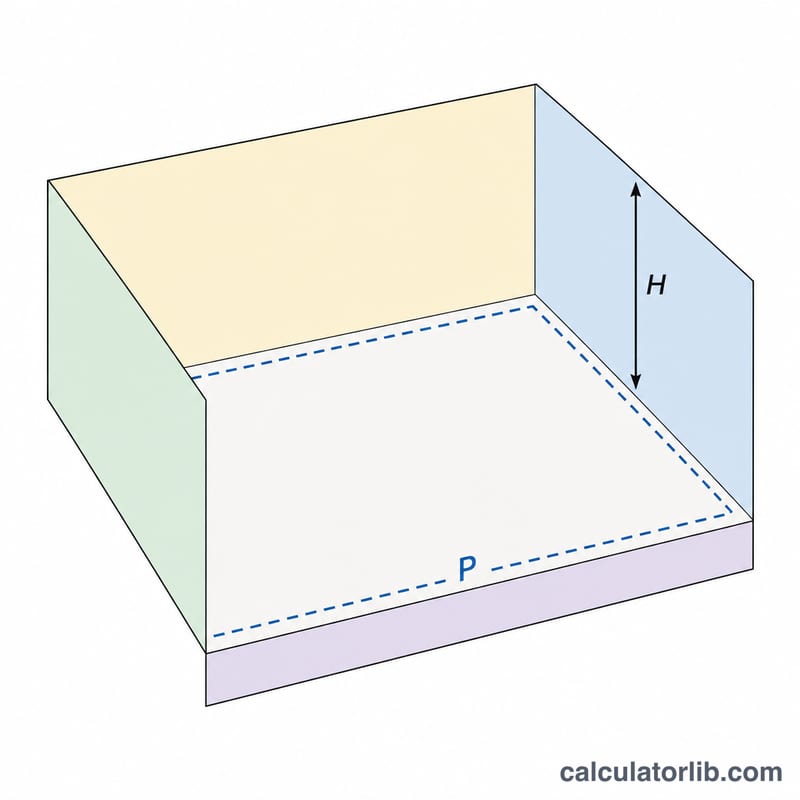
The Wallpaper Calculator estimates how many rolls of wallpaper you need to cover the walls of a room. Enter the total room perimeter (the distance all the way around the floor), the wall height, and the size of a single roll. The tool works out the total wall area and divides it by the area one roll covers, then rounds up to a whole number of rolls.
How to use it
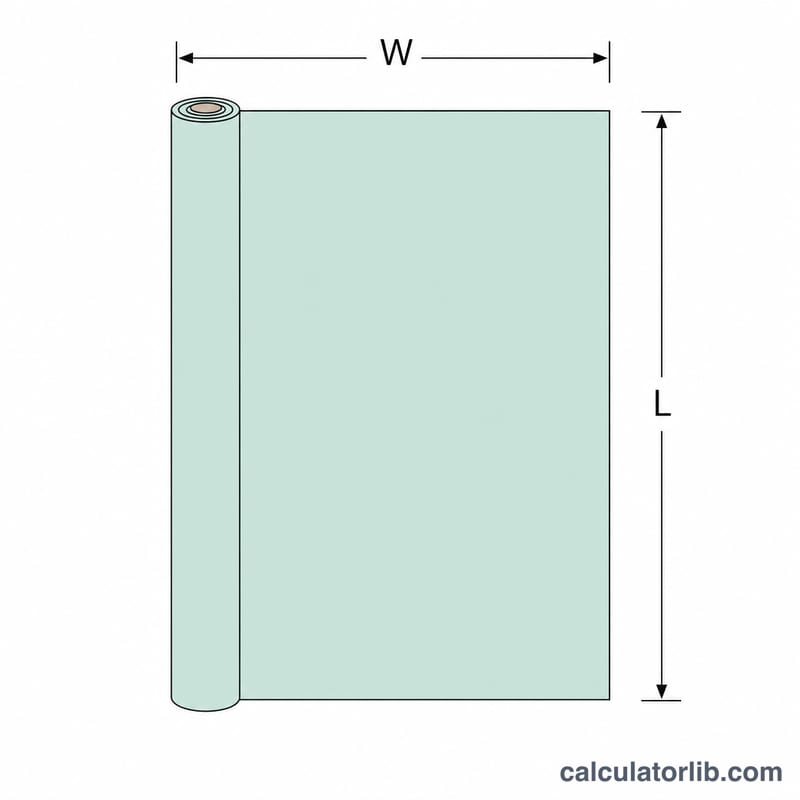
Measure the perimeter by adding the lengths of every wall. Measure the floor-to-ceiling height. Read the roll length and width from the wallpaper packaging — a common European roll is about 10 m long and 0.52 m wide. Type these four values in and read off the result. It is wise to buy one extra roll to allow for pattern matching and mistakes.
The formula explained
The formula is $$\text{Rolls} = \left\lceil \frac{P \times H}{L \times W} \right\rceil$$. The wall area is perimeter (\(P\)) times height (\(H\)). The coverage of one roll is its length (\(L\)) times its width (\(W\)). Dividing area by coverage gives the raw number of rolls, and the ceiling function (\(\lceil\ \rceil\)) rounds up because you can't buy a fraction of a roll.
Worked example
For a room with a 20 m perimeter and 2.4 m high walls, the wall area is \(20 \times 2.4 = 48\) m². A 10 m × 0.52 m roll covers 5.2 m². So $$48 \div 5.2 = 9.23$$ rounded up to 10 rolls.
FAQ
Does this subtract doors and windows? No. It assumes solid walls, which gives a safe margin. For very large openings you can reduce the perimeter slightly.
Does it account for pattern repeat? No. Patterned papers waste more, so add one or two extra rolls for large repeats.
What units should I use? Keep all four measurements in metres for the area to work out correctly in square metres.