
What this calculator does
The Wallpaper Rolls Calculator tells you how many rolls of wallpaper to buy to cover the walls of a room. It works from four measurements: the room perimeter, the wall height, the dimensions of the roll you intend to buy, and the size of the pattern repeat. The result is rounded up so you always have enough to finish the job.
How to use it
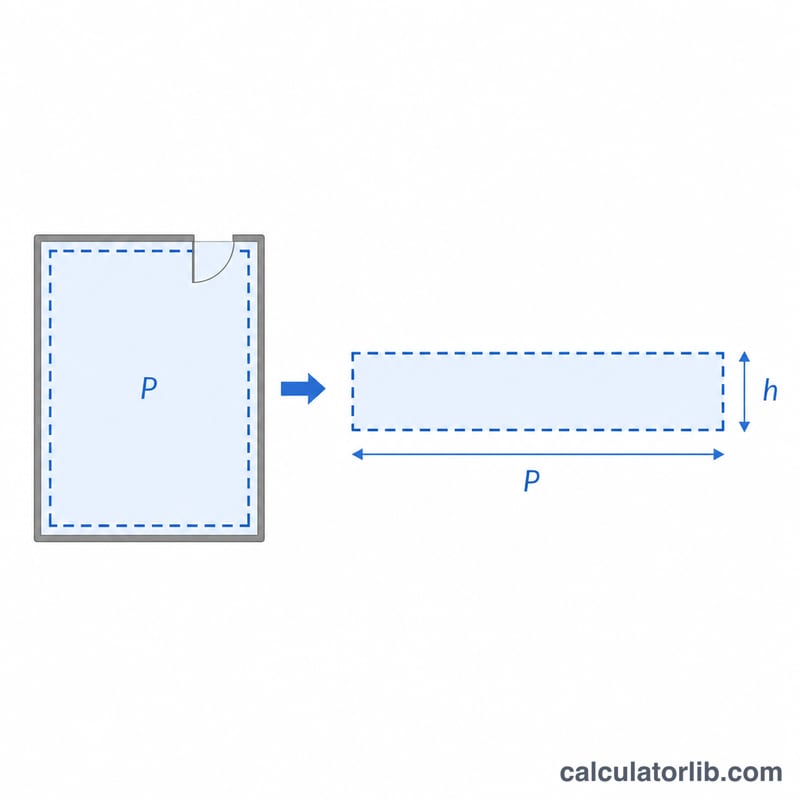
Measure the perimeter of the room (add the lengths of all walls). Measure the floor-to-ceiling height. Read the roll length, roll width and pattern repeat from the wallpaper's label. Enter all five values and the calculator returns the number of rolls, plus how many strips you can cut per roll and how many strips you need in total.
The formula explained
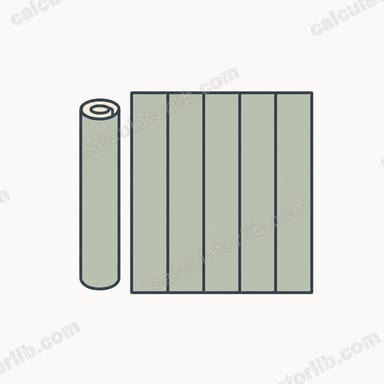
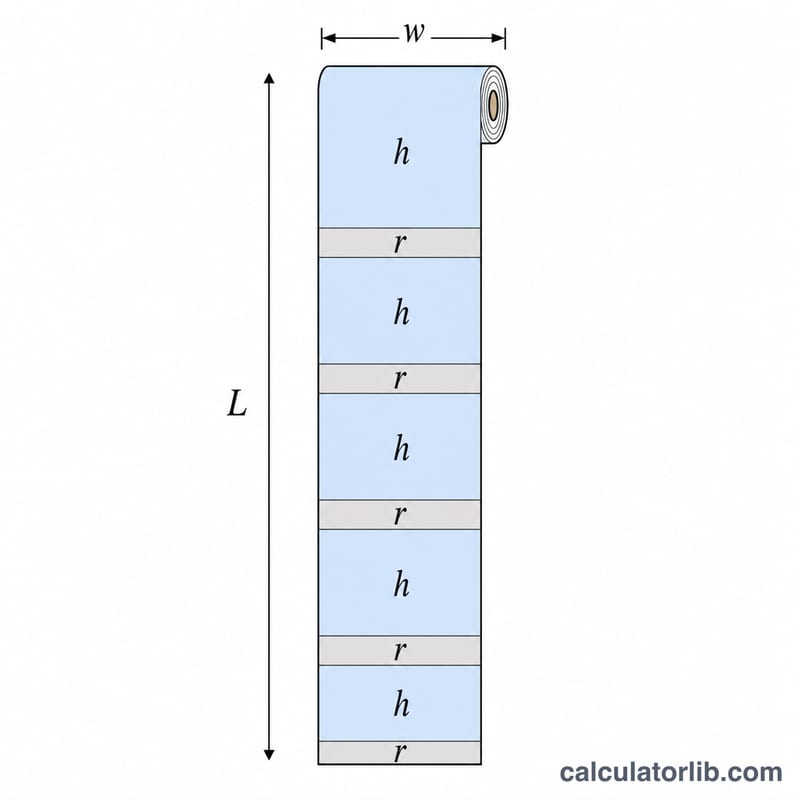
First we find how many full strips fit in one roll: strips per roll = floor(roll length / (wall height + pattern repeat)). The pattern repeat is added to the height because each strip must be cut a little longer so the pattern lines up with its neighbour. Next, strips needed = ceil(perimeter / roll width) — the number of vertical drops to go around the room. Finally rolls = ceil(strips needed / strips per roll), rounded up to whole rolls.
$$\text{Rolls} = \left\lceil \frac{S_{\text{need}}}{S_{\text{roll}}} \right\rceil$$
$$\text{where}\quad \left\{ \begin{aligned} S_{\text{need}} &= \left\lceil \frac{\text{Perimeter (m)}}{\text{Roll Width (m)}} \right\rceil \\[0.4em] S_{\text{roll}} &= \left\lfloor \frac{\text{Roll Length (m)}}{\text{Wall Height (m)} + \text{Pattern Repeat (m)}} \right\rfloor \end{aligned} \right.$$
Worked example
A room with a 20 m perimeter, 2.4 m walls, a roll 10 m long and 0.53 m wide, with no pattern repeat. Strips per roll = \(\lfloor 10 / 2.4 \rfloor = 4\). Strips needed = \(\lceil 20 / 0.53 \rceil = \lceil 37.7 \rceil = 38\). Rolls = \(\lceil 38 / 4 \rceil = \lceil 9.5 \rceil = 10\) rolls.
$$\text{Rolls} = \left\lceil \frac{38}{4} \right\rceil = 10$$
FAQ
Should I subtract doors and windows? For a safe estimate, no — covering openings provides spare paper for trimming and mistakes. Subtract them only for very large openings.
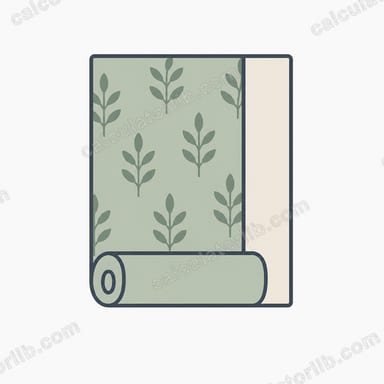
What is a pattern repeat? It is the vertical distance after which the design repeats. Larger repeats waste more paper, so they raise the rolls needed.
Why round up? You cannot buy a fraction of a roll, and dye lots can vary between batches, so buying whole rolls (with a little spare) is recommended.