
What is the Mbps to MB/s Converter?
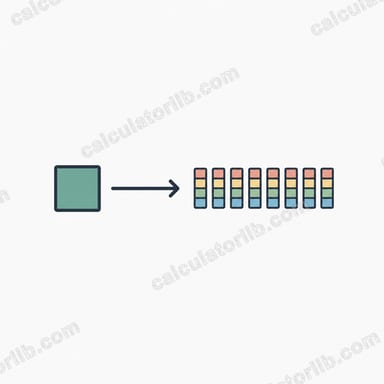
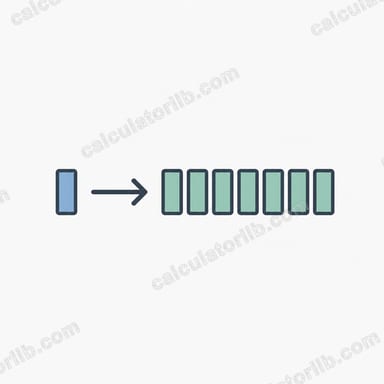
Internet providers advertise connection speeds in Mbps (megabits per second), but download managers, browsers, and file-transfer tools usually report progress in MB/s (megabytes per second). Because there are 8 bits in a byte, these two units differ by a factor of 8. This converter translates your advertised plan speed into the actual download rate you will see on screen.
How to Use It
Enter your connection speed in Mbps (for example, the number on your internet bill) and the calculator instantly returns the equivalent in MB/s, along with KB/s and GB/s for convenience. This is universal — it applies to any network in any country.
The Formula Explained
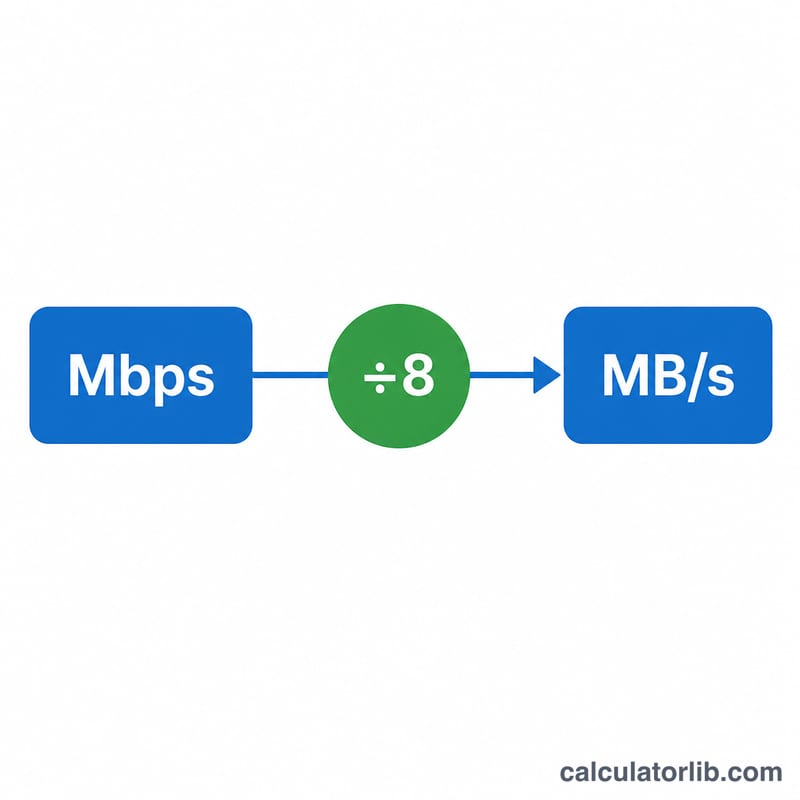
The conversion is simply:
$$\text{MB/s} = \frac{\text{Mbps}}{8}$$
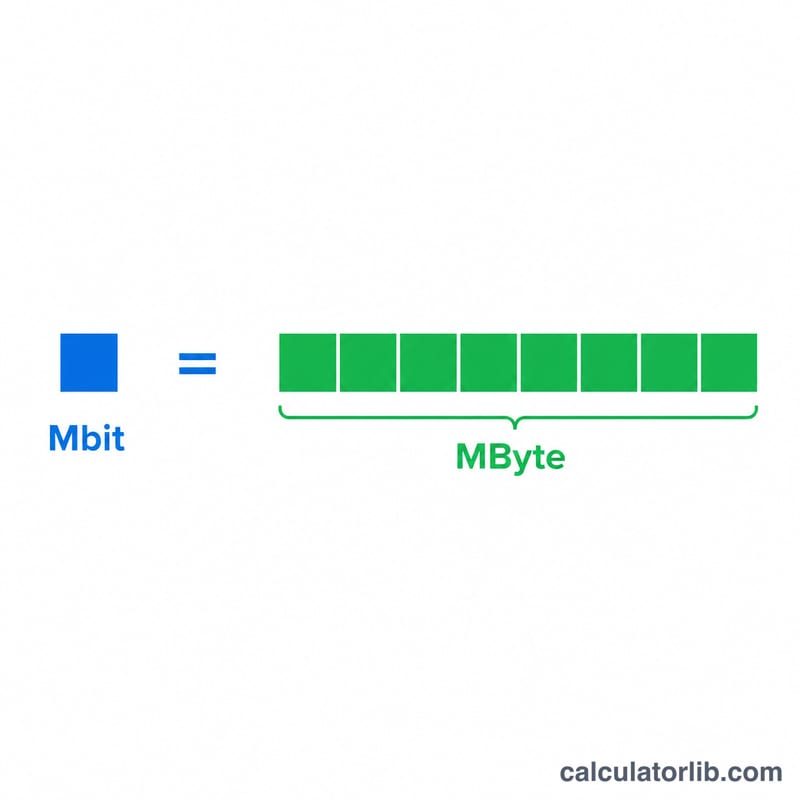
A "bit" is the smallest unit of digital data, while a "byte" is a group of 8 bits. Network speeds are measured in bits, but file sizes are measured in bytes — which is why a 100 Mbps connection downloads at roughly 12.5 MB/s, not 100 MB/s.
Worked Example
Suppose you have a 100 Mbps fiber plan. Dividing by 8: \(100 \div 8 = 12.5\) MB/s. So a 1,250 MB (1.25 GB) game would take about 100 seconds to download at full speed.
FAQ
Why is my download slower than my plan speed? Because plans are in megabits and downloads are in megabytes — your true max is the Mbps figure divided by 8, minus overhead.
Is 1 MB/s the same as 1 Mbps? No. \(1\ \text{MB/s}\) equals \(8\ \text{Mbps}\).
Does this use 1000 or 1024? This converter uses the standard decimal definition (8 bits = 1 byte, 1000 KB = 1 MB) used by ISPs and storage makers.