
What This Calculator Does
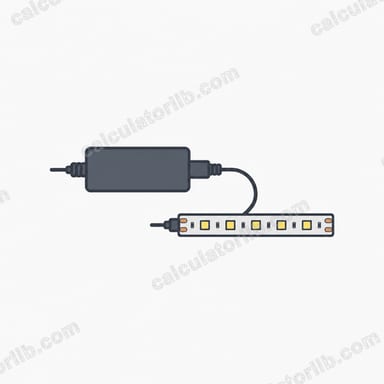
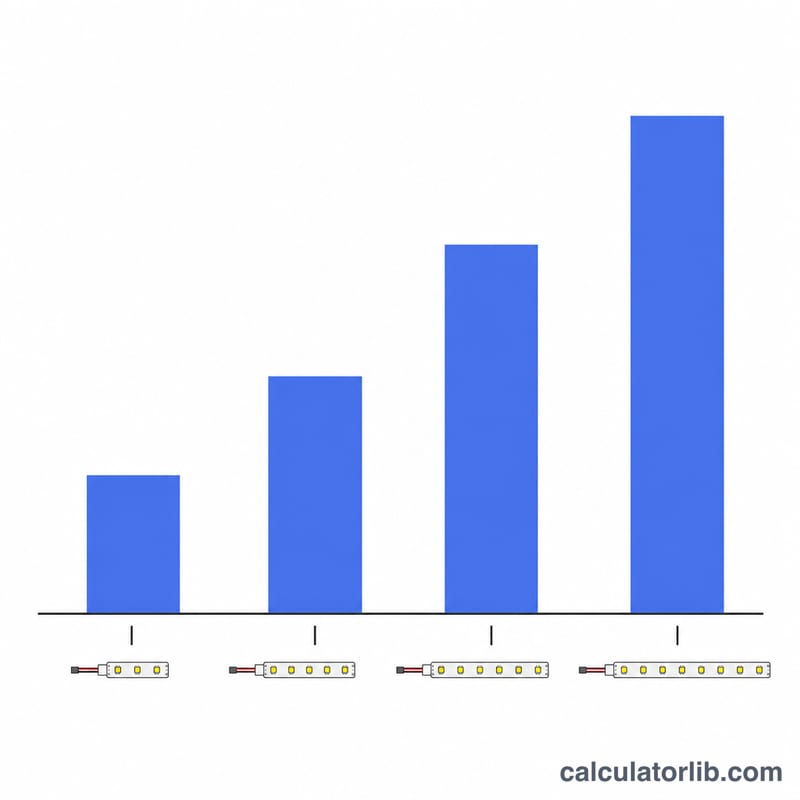
This LED strip calculator works out three things that matter when planning a lighting project: how many individual LEDs are on your strip, the total power the strip draws in watts, and the current it pulls in amps. From there it suggests a power supply size with a safety margin so you don't overload your driver. It is a universal electrical calculation and applies anywhere.
How to Use It
Enter the total strip length in meters, the LEDs per meter printed on the reel (commonly 30, 60, 96 or 144), the watts per LED from the datasheet (often 0.06 W to 0.3 W), and pick the supply voltage (5 V, 12 V or 24 V). The calculator instantly returns LED count, wattage, current and a recommended power supply.
The Formula Explained
The math is simple. First, total LEDs = length × LEDs per meter. Power in watts = total LEDs × watts per LED. Current in amps = watts ÷ voltage (Ohm's relationship \(P = V \times I\)). We then multiply the wattage by 1.2 to add a recommended 20% headroom, which keeps the power supply running cool and reliable.
$$\begin{gathered} N = \text{Length (m)} \times \text{LEDs/m}, \quad P = N \times \text{W/LED} \\[1.5em] I = \frac{P}{\text{Voltage (V)}}, \quad P_{\text{PSU}} = 1.2 \times P \end{gathered}$$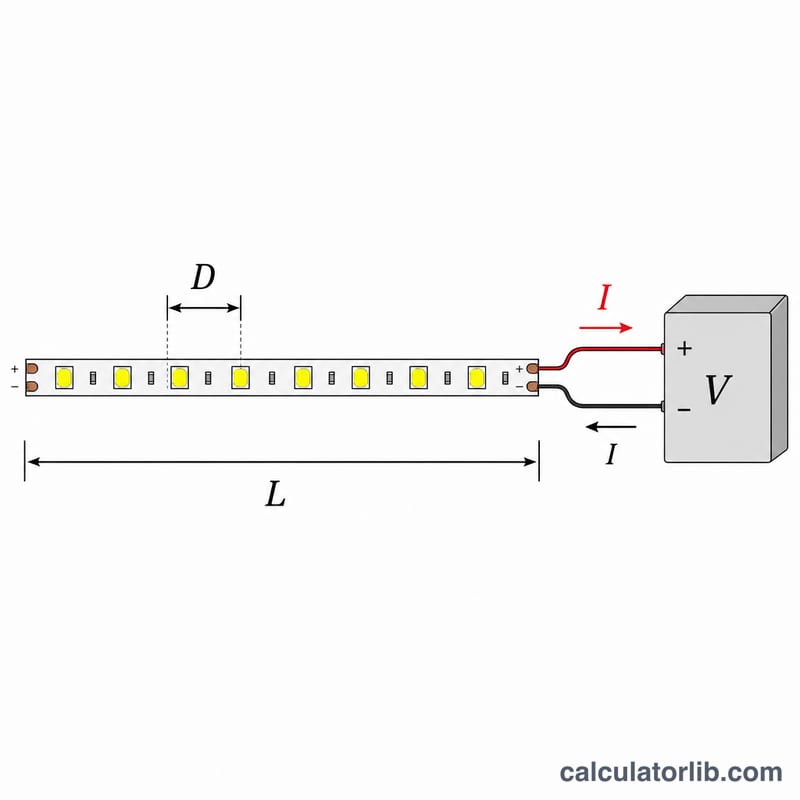
Worked Example
Suppose you have a 5 m strip with 60 LEDs/m, each LED rated 0.2 W, running at 12 V.
$$\text{Total LEDs} = 5 \times 60 = 300$$$$P = 300 \times 0.2 = 60\ \text{W}$$$$I = 60 \div 12 = 5\ \text{A}$$$$P_{\text{PSU}} = 60 \times 1.2 = 72\ \text{W}$$so a 72 W (or larger) 12 V supply is ideal.
FAQ
Why add 20% headroom? Power supplies last longer and stay cooler when not run at 100% load, and it leaves room for inrush and warm-up.
Do I need to derate for long runs? Yes — long single runs cause voltage drop and dimming at the far end. Inject power at both ends or use thicker wire for runs over a few meters.
Where do I find watts per LED? Check the strip's datasheet, which usually lists watts per meter; divide that by LEDs per meter to get watts per LED.