
What this calculator does
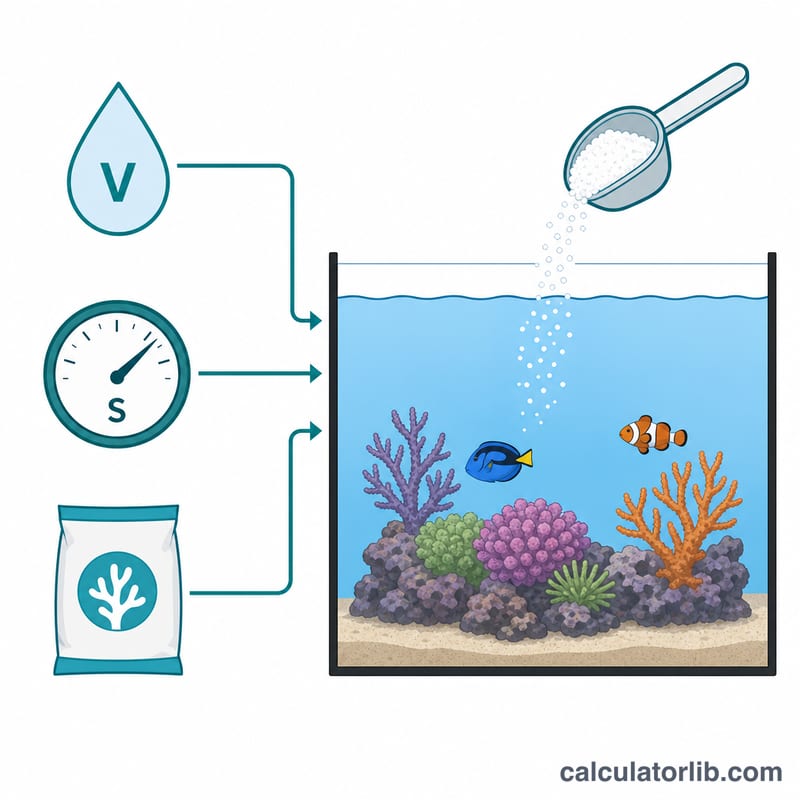
Mixing synthetic seawater for a reef or marine aquarium means dissolving the right amount of salt mix into fresh RO/DI water to hit a target salinity. This calculator turns three simple inputs — water volume, target salinity, and your salt brand's dose rate — into the exact grams (and kilograms) of salt to weigh out. It works for any volume and any salinity target, so it's useful for water changes, filling a new tank, or topping up a mixing barrel.
How to use it
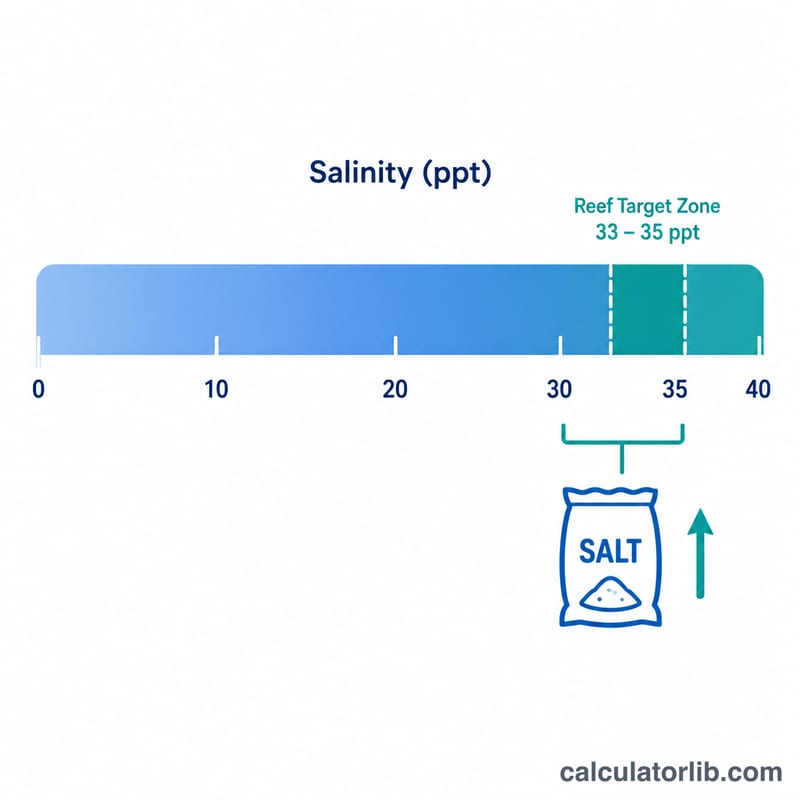
Enter the volume of fresh water in liters. Set your target salinity in parts per thousand (ppt) — most reef tanks aim for 35 ppt (specific gravity ≈ 1.026 at 25 °C). Finally, enter the dose rate printed on your salt bucket: the grams needed per liter to reach 35 ppt, typically 36–38 g/L. The calculator scales that dose linearly to your target and multiplies by your water volume.
The formula explained
The core relationship is $$\text{Salt (g)} = \text{Water (L)} \times \text{Dose (g/L)} \times \frac{\text{Target} \div 35}{1}$$. Because salinity in synthetic seawater is very nearly proportional to dissolved salt mass, scaling the brand's 35 ppt dose by target ÷ 35 gives the dose needed at any salinity. Multiplying by volume gives total mass. We also estimate cups using a rough density of about 145 g per level cup of reef salt.
Worked example
For 100 L of water, a 35 ppt target, and a 37 g/L dose: dose at target = \(37 \times (35 \div 35) = 37\) g/L; total = \(100 \times 37 =\) 3,700 g (3.7 kg), or about 25.5 cups.
FAQ
What if my brand doesn't list a dose rate? Use 37 g/L as a safe default for most reef salts, then verify with a refractometer and adjust.
Should I always add all the salt at once? Add most of it, let it dissolve and stabilize, then measure and fine-tune. Always add salt to water, never the reverse.
How accurate is this? It's a close estimate. Salt density and brand chemistry vary, so confirm final salinity with a calibrated refractometer before use.