
What This Calculator Does
The Sock Knitting Calculator tells you how many stitches to cast on for a top-down or toe-up hand-knit sock. A great-fitting sock should be slightly smaller than your actual foot so it hugs the leg and stays up — this is called negative ease. The calculator combines your foot circumference, your knitting gauge, and a chosen ease percentage to produce a recommended cast-on number.
How To Use It
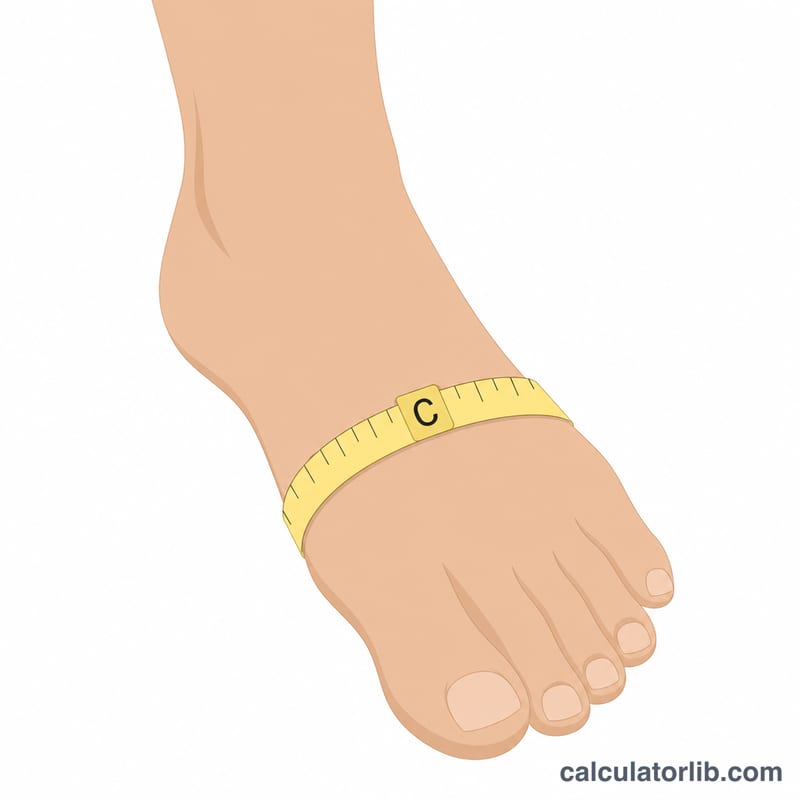
Measure the circumference of the widest part of your foot (usually around the ball of the foot) in inches. Knit a small gauge swatch in your sock yarn and count how many stitches fit in one inch. Enter both values, pick a negative ease percentage (10% is a reliable default), and read your cast-on number. We also round it to the nearest multiple of 4 so common rib patterns (k2, p2) and heel divisions work cleanly.
The Formula Explained
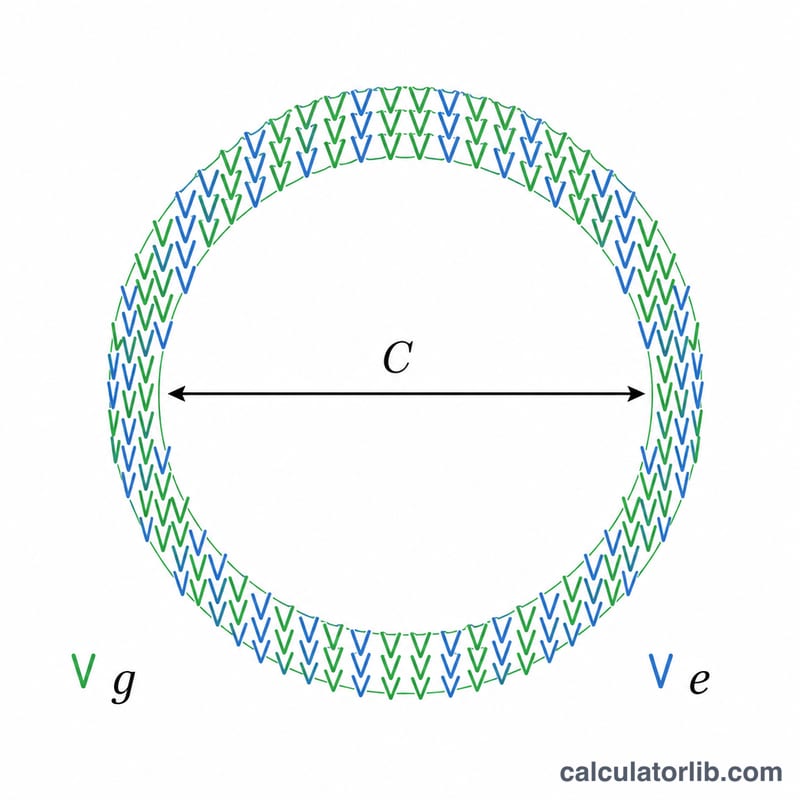
The core equation is $$\text{Cast On} = \operatorname{round}(C \times g \times (1 - e))$$ where \(C\) is foot circumference in inches, \(g\) is gauge in stitches per inch, and \(e\) is the ease as a decimal. Multiplying circumference by gauge gives the stitches needed to exactly match your foot; multiplying by \((1 - e)\) shrinks that target so the finished sock stretches snugly over your foot.
Worked Example
Suppose your foot circumference is 9 inches, your gauge is 8 stitches per inch, and you want 10% negative ease. The ease factor is \(1 - 0.10 = 0.9\). $$\text{Cast On} = \operatorname{round}(9 \times 8 \times 0.9) = \operatorname{round}(64.8) = 65 \text{ stitches}$$ Rounded to the nearest multiple of 4, that's 64 stitches — a tidy number for a 2×2 rib and an even heel flap.
FAQ
How much negative ease should I use? Most sock patterns use 10% negative ease. For very stretchy ribbed socks you can go up to 15%; for loose comfort socks use 5% or 0%.
Why round to a multiple of 4? Sock stitches are usually divided evenly between the instep and sole, and ribbing repeats like k2/p2 need a multiple of 4. Rounding keeps your pattern symmetric.
Does gauge really matter that much? Yes — gauge is the biggest factor in fit. Always swatch in the round if you can, because many knitters get a different gauge knitting in the round versus flat.