What is the Gift Wrap Paper Calculator?
This calculator tells you the exact size of wrapping paper sheet you need to fully cover a rectangular gift box. Instead of guessing and ending up with too little paper or a wasteful pile of offcuts, enter your box dimensions and get a precise paper width and length — plus the total area so you can plan how much off a roll to cut.
How to use it
Measure your box's length, width and height in centimetres. Add an overlap allowance (around 4–6 cm is comfortable for tucking and sealing seams). Enter all four values and the calculator returns the sheet dimensions and area instantly.
The formula explained
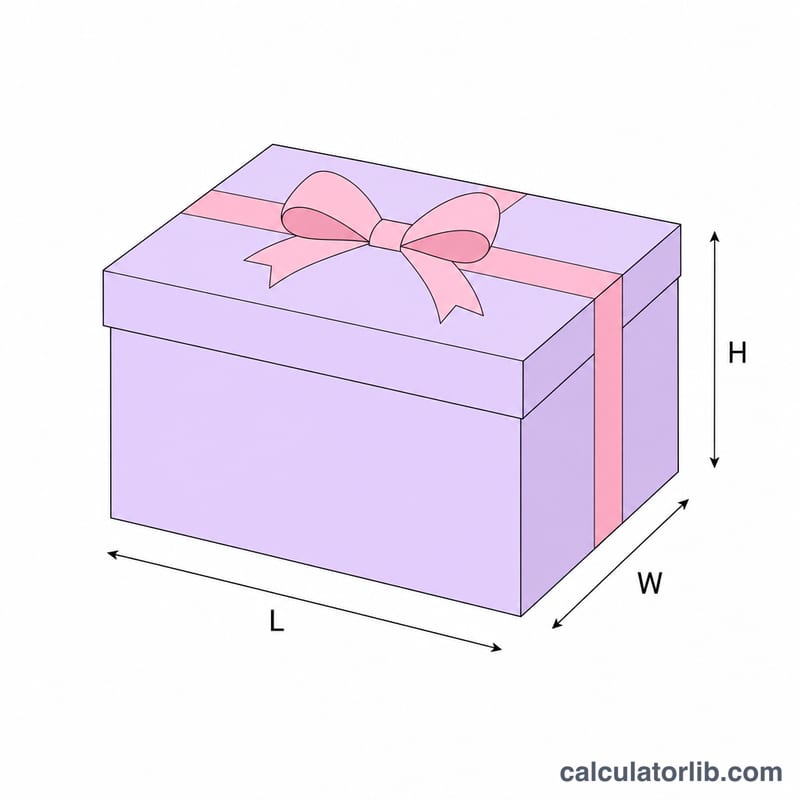
To wrap a box, the paper needs to go all the way around the cross-section formed by the width and height — that's two widths and two heights, so the paper width is \(2 \times (W + H) + \text{overlap}\). The paper length must cover the box length plus enough on each end to fold up the height, giving \(L + 2H + \text{overlap}\). The overlap creates a clean seam where the edges meet.
$$\begin{gathered} A = \frac{W \times L}{10000} \\[1.5em] \text{where}\quad \left\{ \begin{aligned} W &= 2\left(\text{Width} + \text{Height}\right) + \text{Overlap} \\ L &= \text{Length} + 2\,\text{Height} + \text{Overlap} \end{aligned} \right. \end{gathered}$$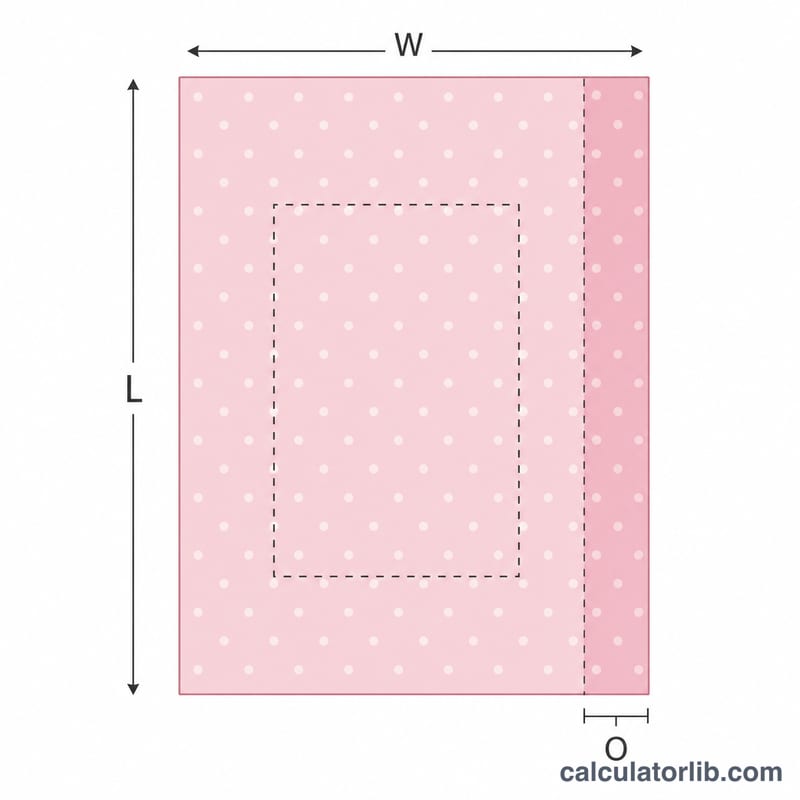
Worked example
Suppose a box is 25 cm long, 18 cm wide and 8 cm high, with a 5 cm overlap. Paper width = \(2 \times (18 + 8) + 5 = 2 \times 26 + 5 = 57\) cm. Paper length = \(25 + 2 \times 8 + 5 = 25 + 16 + 5 = 46\) cm. So you need a 57 × 46 cm sheet, which is about 0.26 m².
Paper Sheet Size for Common Gift Box Sizes
All rows below use the same relationships as the calculator, with the box's longest dimension taken as the length \(L\) laid along the roll:
$$W_{\text{paper}} = 2(W + H) + O \qquad L_{\text{paper}} = L + 2H + O \qquad A = \frac{W_{\text{paper}} \times L_{\text{paper}}}{10000}$$This calculator works in centimetres and reports area in square metres (the metric convention used for gift-wrap rolls in most of Europe and Asia). If you measure in inches, convert first (1 in = 2.54 cm). Every row uses an overlap of \(O = 5\) cm.
| Gift / box | Box L×W×H (cm) | Overlap O (cm) | Paper width 2(W+H)+O (cm) | Paper length L+2H+O (cm) | Sheet area (m²) |
|---|---|---|---|---|---|
| Jewellery box | 9 × 7 × 3 | 5 | 25 | 20 | 0.050 |
| Hardback book | 25 × 18 × 3 | 5 | 47 | 36 | 0.169 |
| Mug box | 12 × 12 × 11 | 5 | 51 | 39 | 0.199 |
| Shoebox | 33 × 20 × 12 | 5 | 69 | 62 | 0.428 |
| Wine bottle box (upright) | 9 × 9 × 35 | 5 | 93 | 84 | 0.781 |
| Large toy box | 50 × 35 × 25 | 5 | 125 | 105 | 1.313 |
Which rows fit a standard roll?
Gift-wrap rolls are commonly sold about 70 cm wide (roughly 27–28 in), although 50 cm, 76 cm and 100 cm widths also exist — check your own roll, as this is a market convention rather than a standard. Against a 70 cm roll:
- Fit comfortably: jewellery box (25 cm), book (47 cm), mug box (51 cm) — and the shoebox at 69 cm fits with only about 1 cm to spare, so cut it carefully or allow a slightly smaller overlap.
- Too wide as listed: the wine bottle box (93 cm) and the large toy box (125 cm).
The wine box only fails because the dimensions were assigned the wrong way round. Lay the 35 cm side along the roll instead (\(L = 35\), \(W = H = 9\)) and the required paper width drops to \(2(9+9)+5 = 41\) cm with a length of 58 cm — a 0.238 m² sheet that fits any ordinary roll. Because the paper width excludes \(L\), always assign the largest dimension to \(L\) to keep the wrap-around measurement as small as possible.
The toy box is genuinely over-size: 125 cm is its minimum paper width in any orientation, so it needs a wide (100 cm+) roll plus a seam, two sheets joined with double-sided tape along a straight edge, or a gift bag instead.
Practical Wrapping Tips Based on Your Result
- Round the sheet up before you cut. Take the calculated width and length up to the next whole centimetre, and add 2–3 cm on each if you are not confident cutting a straight line. Paper that is 2 cm too big can be folded under; paper 2 mm too small leaves a visible gap at the seam.
- Check the paper width against your roll width first. The \(2(W+H)+O\) figure is the dimension that has to travel around the box, and a roll physically cannot give you more than its own width. If your result exceeds the roll (commonly about 70 cm), re-run the calculation with the longest box dimension entered as the length, which almost always reduces the required width.
- If it still does not fit, seam two sheets. Overlap two pieces by 3–4 cm, join them with double-sided tape along a straight edge, and position the join on the underside of the box. Alternatively place the join where a ribbon will cross it.
- Increase the overlap for difficult paper and big boxes. Use 4–5 cm for thin, plain paper on small gifts, but 6 cm or more for thick, textured, foil or kraft paper, which does not crease tightly, and for any box over roughly 40 cm, where the end tucks swallow more paper. Example: a 45 × 30 × 20 cm box at a generous 7 cm overlap needs a paper width of 107 cm — a clear signal to switch to a wide roll before cutting anything.
- Estimate the roll length for a batch. Multiply the paper length by the number of gifts and add about 10% for trimming and pattern alignment. For ten shoeboxes at 62 cm each: \(62 \times 10 = 620\) cm, plus 10% gives roughly 680 cm, so a 7 m roll is enough — but only if the 69 cm paper width fits across the roll.
- Use the bounding box for anything not rectangular. For a cylinder, a ball, a bottle or an awkward toy, measure the smallest rectangular box that would enclose it and enter those figures. The result will be slightly generous, which is exactly what you want when gathering paper around curves.
- Mind the pattern direction. Cut so the pattern repeat runs along the roll, i.e. parallel to the paper length, and the motifs will line up across the seam and stay upright on the finished parcel. Checking this before the scissors come out avoids a second cut.
- Sanity-check the area. The m² figure is the quickest way to compare options — gift bag, box-in-a-bag or flat wrap — and to see whether what is left on a part-used roll will be enough.
These are general guidelines; roll widths, paper thickness and your own folding style all vary, so treat the calculated sheet as a minimum and keep a little extra on the first gift of a batch.
Key Terms and Variables
| Term | Symbol | Unit | Meaning |
|---|---|---|---|
| Length | \(L\) | cm | The box dimension laid along the paper roll — normally the longest one, since it does not enter the wrap-around measurement. |
| Width | \(W\) | cm | One of the two dimensions of the box cross-section that the paper has to travel around. |
| Height | \(H\) | cm | The other cross-section dimension. It appears twice in both results, so it has the strongest effect on how much paper you need. |
| Overlap | \(O\) | cm | Spare paper added for the seam where the two edges meet and for the folded end tucks. Typically 4–6 cm; more for thick or foil paper. |
| Paper width | \(2(W+H)+O\) | cm | The dimension that wraps right around the box cross-section and closes with an overlapping seam. |
| Paper length | \(L+2H+O\) | cm | The dimension running along the box, including the two end flaps of height \(H\) that fold over the open ends. |
| Sheet area | \(A\) | m² | Paper width × paper length, converted from cm² by dividing by 10 000. Useful for comparing wrapping options or costing paper. |
| Roll width | — | cm | The fixed width of a commercial roll (often about 70 cm, with 50, 76 and 100 cm also sold). It is a hard cap on the paper width you can cut in one piece. |
| Bounding box | — | cm | The smallest rectangular box that would fully enclose a non-rectangular gift; use its three dimensions as the inputs for bottles, cylinders and irregular shapes. |
| Seam | — | — | The taped join along the length of the parcel, or the join between two sheets when one sheet is not wide enough. |
FAQ
How much overlap should I add? About 4–6 cm works for most gifts. Add more for thick wrapping paper or large boxes so the seam sits flat.
Does the box orientation matter? Yes — length is the longest dimension along the paper roll, while width and height wrap around. Swapping them changes the sheet shape but covers the same box.
What units does it use? Centimetres for the box and resulting sheet, with the total area shown in square metres for easy roll planning.