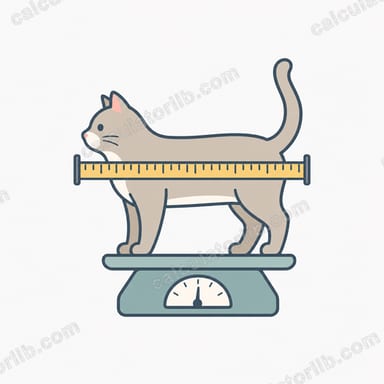
What Is the Cat Food Calculator?
This tool estimates how many grams of food your cat needs each day. It uses the same energy-based method veterinarians use: first it calculates your cat's Resting Energy Requirement (RER), multiplies it by a life-stage activity factor to get the Daily Energy Requirement (DER), then converts those calories into grams using the calorie density printed on your food's label.
How to Use It
Enter your cat's weight in kilograms, choose the life stage or activity level that best matches your cat, and type the food's energy in kilocalories per 100 grams (found on the package as "ME" or "metabolizable energy"). The calculator returns the recommended daily portion in grams plus the underlying RER and DER in calories.

The Formula Explained
The RER is calculated as \(70 \times \text{weight}^{0.75}\), an exponential curve that reflects how smaller animals burn more energy per kilogram. The DER multiplies RER by an activity factor: about 1.2 for a typical neutered indoor adult, up to 2.0–2.5 for kittens or pregnant/lactating cats, and around 1.0 for seniors or weight loss. Finally, daily calories are divided by the food's calories per gram to give grams per day.
$$\text{Food (g/day)} = \frac{70 \cdot \text{Weight}^{0.75} \cdot \text{Activity}}{\text{kcal per 100 g} / 100}$$
Worked Example
A 4 kg neutered indoor cat eating dry food rated 350 kcal/100 g:
$$\text{RER} = 70 \times 4^{0.75} = 70 \times 2.828 \approx 198 \text{ kcal}$$$$\text{DER} = 198 \times 1.2 \approx 238 \text{ kcal}$$$$\text{Food energy} = 350/100 = 3.5 \text{ kcal/g}$$$$\text{Daily food} = 238 \div 3.5 \approx \textbf{68 grams per day}$$Cat Life Stage Activity Factors (DER Multipliers)
Veterinary feeding guidance starts from the Resting Energy Requirement, \(\text{RER} = 70 \times \text{Weight}^{0.75}\) (weight in kg). It then multiplies RER by a life stage factor to estimate the Daily Energy Requirement (DER). The factors below are commonly cited estimates. They vary between sources (for example AAHA and WSAVA materials and veterinary nutrition textbooks), so treat them as starting points, not fixed rules.
| Life stage / status | Typical DER multiplier (× RER) |
|---|---|
| Kitten, up to 4 months | ~2.5 |
| Kitten, 4–12 months | ~2.0 |
| Neutered adult | ~1.2 |
| Intact adult | ~1.4 |
| Inactive or obesity-prone | ~1.0 |
| Weight loss | ~0.8 |
| Senior | ~1.1–1.2 |
| Pregnant | ~1.6–2.0 |
| Lactating | ~2.0–6.0, depending mainly on litter size |
The calculator's life stage selector offers 1.0, 1.2, 1.4, 1.6, 2.0 and 2.5. For values outside that list (such as 0.8 for weight loss), multiply the RER by the factor yourself, then divide by the food's energy density. Weight-loss plans are normally calculated by a veterinarian, often using the target weight.
Daily Food Amounts for Different Cats
Each row uses \(\text{RER} = 70 \times \text{Weight}^{0.75}\) and \(\text{DER} = \text{RER} \times \text{factor}\). Dry food is assumed at 350 kcal per 100 g (3.5 kcal/g) and wet food at 80 kcal per 100 g (0.8 kcal/g). Grams per day = DER ÷ kcal per gram. Values are rounded.
| Scenario | Weight | Factor | RER (kcal) | DER (kcal/day) | Dry food (g/day) | Wet food (g/day) |
|---|---|---|---|---|---|---|
| Kitten (under 4 months) | 3 kg | 2.5 | 160 | 399 | 114 | 499 |
| Neutered adult | 4 kg | 1.2 | 198 | 238 | 68 | 297 |
| Intact adult | 5 kg | 1.4 | 234 | 328 | 94 | 410 |
| Weight-loss cat (weight used: 6 kg) | 6 kg | 0.8 | 268 | 215 | 61 | 268 |
| Senior | 4 kg | 1.1 | 198 | 218 | 62 | 272 |
Worked example (4 kg neutered adult, dry food): \(\text{RER} = 70 \times 4^{0.75} = 70 \times 2.828 = 198\) kcal. \(\text{DER} = 198 \times 1.2 = 237.6\) kcal. \(\text{Food} = 237.6 \div 3.5 \approx 68\) g per day.
Real products differ widely in energy density, so always use the kcal value printed on your food's label. Some labels give kcal per kg, so divide by 10 to get kcal per 100 g.
Interpreting Your Result
- It is an estimate, not a fixed requirement. The result is a typical daily total. Individual cats can differ from the formula by roughly 20–30% because of metabolism, age, muscle mass, activity and environment.
- Body condition score (BCS). Veterinarians commonly score cats on a 1–9 scale, where 4–5 is considered ideal. A cat that scores above 5 on the current amount may be getting more energy than it uses. A cat that scores below 4 may need more. Adjustments are usually made in small steps, with the cat's weight and condition rechecked over a few weeks.
- Treats count. Treats and extras supply calories too. A commonly cited guideline is to keep them under about 10% of daily energy, and to reduce the main meal to match.
- It is the total across all meals. The figure covers everything eaten in 24 hours. Divide it by the number of meals you feed, for example two to four per day.
- Mixed feeding. If you feed both dry and wet food, split the calories between them. Add up each food's kcal, not just its grams.
This is general information, not veterinary advice. Cats with health conditions, or those who are underweight, overweight, pregnant or growing quickly, should have their feeding plan set with a veterinarian.
FAQ
Is this a substitute for veterinary advice? No. It is an estimate; always confirm portions with your vet, especially for weight management or medical diets.
Where do I find kcal per 100 g? Check the food label for "metabolizable energy." Wet food is usually 70–100 kcal/100 g; dry food is often 300–400 kcal/100 g.
Should I split into multiple meals? Yes — divide the daily grams across 2–4 feedings, and adjust gradually based on your cat's body condition.