
What Is the Cat BMI Calculator?
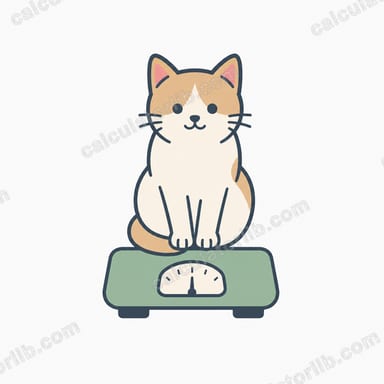
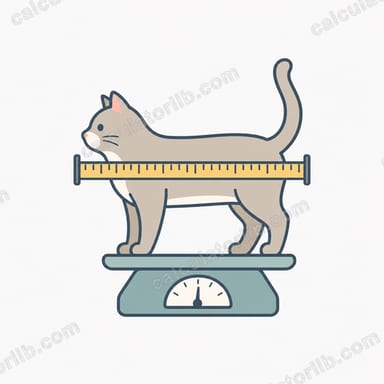
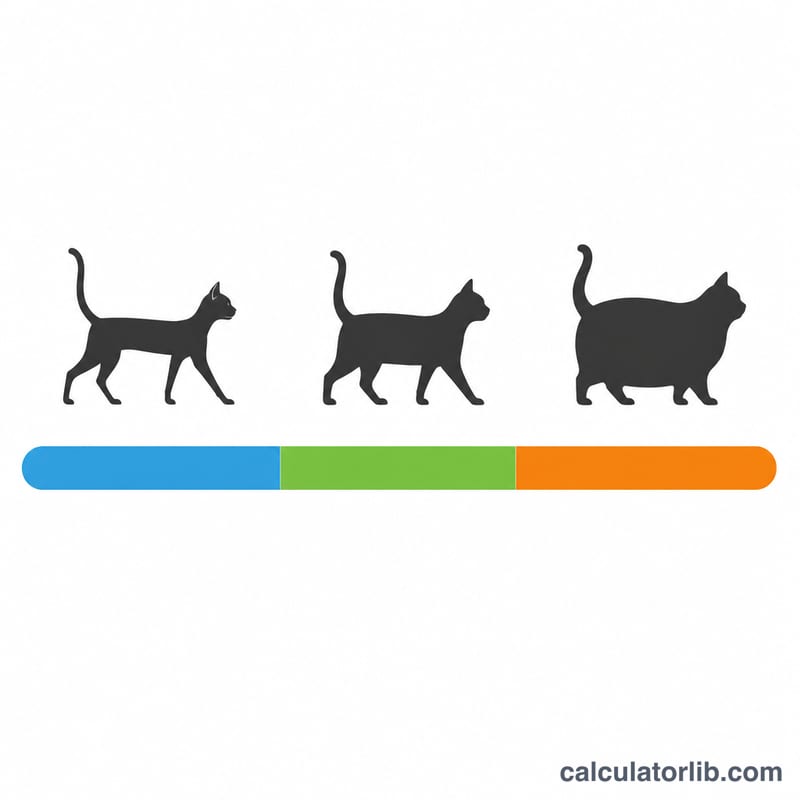
This tool estimates a cat's Body Mass Index (BMI) by dividing its weight in kilograms by the square of its body length in meters. Like the human BMI, it gives a single number that offers a rough indication of whether a cat may be underweight, at a healthy weight, or carrying excess body mass. It is a general screening aid only and not a substitute for a veterinary assessment.
How to Use It
Weigh your cat in kilograms (the easiest method is to weigh yourself holding the cat, then subtract your own weight). Measure the cat's body length in centimeters from the base of the neck to the base of the tail. Enter both values and the calculator converts the length to meters and computes the BMI automatically.
The Formula Explained
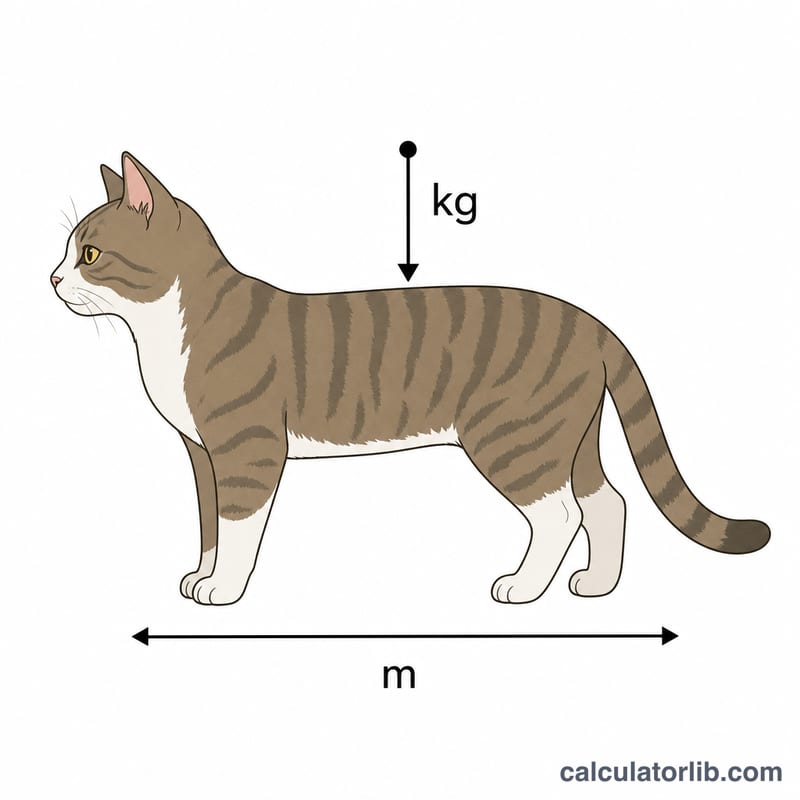
The calculation is $$\text{BMI} = \dfrac{\text{weight (kg)}}{\text{length (m)}^2}$$ where weight is in kilograms and length is in meters. The length you enter in centimeters is divided by 100 to get meters before squaring. Squaring the length reflects how body mass scales with frame size, so a longer cat needs more weight to reach the same BMI as a shorter one.
Worked Example
Suppose a cat weighs 4.5 kg and measures 50 cm in length. First convert the length: 50 cm = 0.50 m. Square it: \(0.50 \times 0.50 = 0.25\). Then divide: $$4.5 \div 0.25 = 18 \text{ kg/m}^2$$ That is the cat's BMI.
FAQ
Is there an official healthy BMI range for cats? Unlike humans, cats do not have a single standardized BMI scale. Vets typically use a 1–9 Body Condition Score instead. Treat this BMI as a relative tracking number over time.
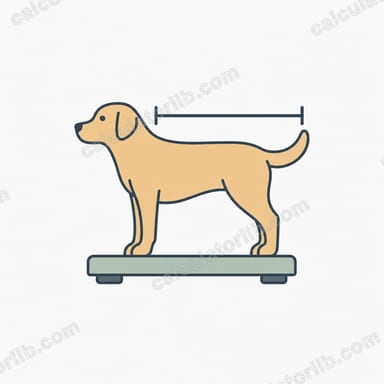
How should I measure length? Measure along the back from the base of the neck to the base of the tail while the cat stands or lies straight.
Can I use pounds? No — convert pounds to kilograms first (1 lb ≈ 0.4536 kg) before entering the weight.