What is the Cat Ideal Weight Calculator?
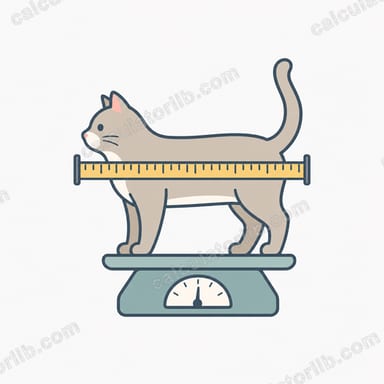
This tool estimates the healthy target weight for a cat based on its current weight and its Body Condition Score (BCS) — a standardized 9-point scale used by veterinarians worldwide. A BCS of 5 represents an ideal body condition, where the ribs are easily felt without excess fat, and the cat has a visible waist. Each point above 5 corresponds to roughly 10% over the ideal body weight, so the calculator works backwards from the current weight to estimate what the cat should weigh.
How to use it
Enter your cat's current weight, choose kilograms or pounds, then select the Body Condition Score that best matches your cat (1 = emaciated, 5 = ideal, 9 = severely obese). The calculator returns the estimated ideal weight, how much excess weight the cat is carrying, and the approximate extra body fat (about 5 percentage points per BCS point above 5). If your cat is already at a BCS of 5 or below, the ideal weight equals the current weight.

The formula explained
The excess weight fraction is \((\text{BCS} - 5) \times 0.10\). Ideal weight is then the current weight divided by \((1 + \text{fraction})\). This division (rather than simply subtracting a percentage) correctly back-calculates the lean target weight, because the excess is a percentage of the ideal, not of the current weight.
$$\text{Ideal Weight} = \frac{\text{Current Weight}}{1 + 0.10 \times \max\left(0,\; \text{BCS} - 5\right)}$$
Worked example
A cat weighs 6 kg with a BCS of 7. Points above ideal = \(7 - 5 = 2\), so the excess fraction = \(2 \times 0.10 = 0.20\) (20% overweight). Ideal weight = \(6 \div 1.20 =\) 5 kg. The cat needs to lose about 1 kg, which is its 20% excess.
$$\text{Ideal Weight} = \frac{6}{1 + 0.10 \times (7 - 5)} = \frac{6}{1.20} = 5\ \text{kg}$$Body Condition Score (BCS) 9-Point Scale Reference
The 9-point Body Condition Score is a widely used veterinary scale for judging whether a cat is underweight, ideal, or overweight. This calculator uses a simple rule of thumb: for every BCS point above 5, the cat is assumed to be about 10% over its ideal weight. Scores of 5 or below are treated as already at (or below) ideal, so the calculator returns the current weight unchanged.
| BCS | Category | Typical descriptors (ribs / waist / abdomen) | Approx. % over ideal (calculator rule) |
|---|---|---|---|
| 1 | Underweight | Ribs, spine and hip bones very visible; no palpable fat; severe abdominal tuck | 0% (not applied) |
| 2 | Underweight | Ribs easily visible; minimal fat; marked waist and abdominal tuck | 0% (not applied) |
| 3 | Underweight | Ribs easily felt with little fat cover; obvious waist; abdominal tuck | 0% (not applied) |
| 4 | Ideal | Ribs felt with minimal fat cover; waist clearly visible; slight abdominal tuck | 0% |
| 5 | Ideal | Ribs felt without excess fat; waist visible behind the ribs; minimal abdominal fat | 0% |
| 6 | Overweight | Ribs felt with slight excess fat; waist barely visible; abdominal fat pad present | ≈10% |
| 7 | Overweight | Ribs hard to feel under moderate fat; no clear waist; rounded abdomen with obvious fat pad | ≈20% |
| 8 | Obese | Ribs not palpable under heavy fat; no waist; distended abdomen with marked fat deposits | ≈30% |
| 9 | Obese | Massive fat deposits over ribs, spine and face; abdomen distended; fat on limbs | ≈40% |
The 10%-per-point figure is the lower end of the 10–15% per point reported in the veterinary literature (Hoelmkjaer and Bjornvad, 2014); the result also shows the weight for the 15% end. In body fat terms, each point is about 5 percentage points (Merck Veterinary Manual). Because the calculator divides by the overweight factor, the implied ideal weight is the current weight divided by 1.10, 1.20, 1.30 or 1.40.
Interpreting Your Result
The result is an estimate of a target weight, not a diagnosis. It is calculated as current weight divided by \(1 + 0.10 \times (\text{BCS} - 5)\) for scores above 5. For example, a 6 kg cat with a BCS of 7 gives \(6 \div 1.20 = 5\) kg as a rough target.
- Underweight (BCS 1-3): The cat may be too thin. This can have many causes, including inadequate food intake, parasites, dental problems, or underlying illness. The calculator does not suggest a higher weight for these scores, so please have a vet assess the cat.
- Ideal (BCS 4-5): Ribs can be felt under a thin fat layer and a waist is visible. The calculator returns the current weight as the target.
- Overweight (BCS 6-7): Excess fat is present, roughly 10-20% above ideal weight under this tool's rule. Gradual, vet-supervised weight loss is generally the recommended approach.
- Obese (BCS 8-9): Substantial excess fat, which is associated with higher risks of conditions such as diabetes mellitus and joint problems. Veterinary guidance is important before changing the diet, since rapid weight loss in cats can be dangerous.
BCS is subjective: The score is a hands-on assessment, ideally made by a veterinarian who can feel the ribs and judge the waist and abdomen. Your own score may differ from a professional's, which will change the estimate. Heavy or long coats can also hide body shape.
This is general information, not professional veterinary advice. Consult your vet before starting any weight-change plan for your cat.
FAQ
Is this a substitute for a vet? No. It is an estimate to guide a conversation with your veterinarian, who should confirm the BCS and a safe weight-loss plan.
How fast should a cat lose weight? A loss of about 0.5–2% of body weight per week is recommended. Rapid weight loss in cats is dangerous and can cause hepatic lipidosis.
Does breed matter? The 10%-per-point rule is a general approximation. Large breeds like Maine Coons are naturally heavier, so always interpret the result alongside BCS and vet advice.