What Is the Devine Ideal Body Weight Formula?
The Devine formula, introduced by Dr. B.J. Devine in 1974, estimates a person's ideal body weight (IBW) based on height and gender. Originally created to standardize medication dosing, it has become one of the most widely used IBW estimates in clinical and fitness settings. This tool is universal and uses metric output (kilograms) with an automatic pounds conversion.
How to Use This Calculator
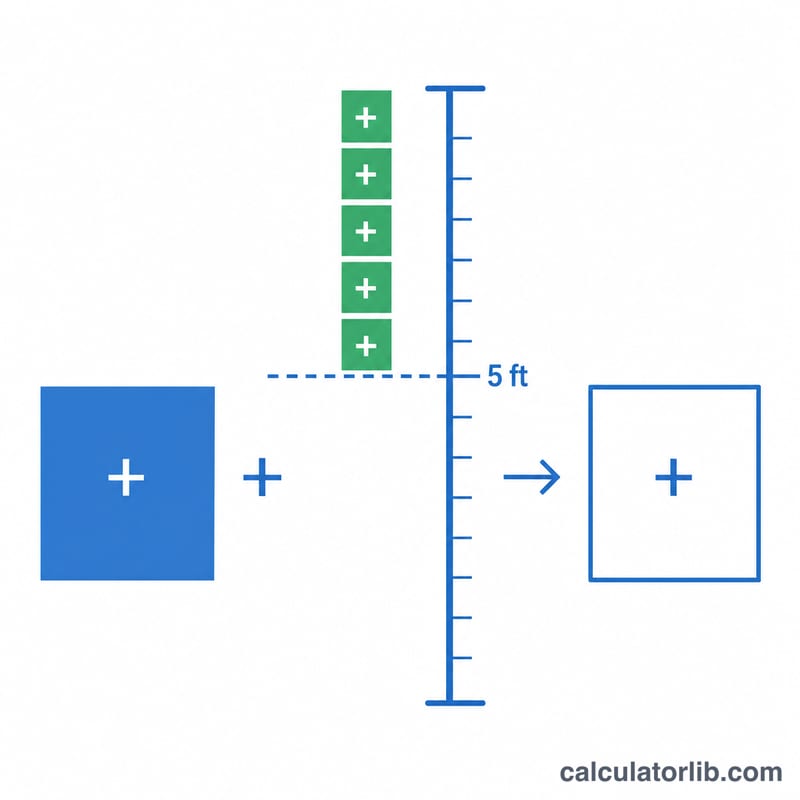
Select your gender, then enter your height in feet and inches. The calculator converts your height to total inches, subtracts 60 inches (5 feet), and applies the Devine equation. The result shows your ideal body weight in both kilograms and pounds.
The Formula Explained
For men, $$\text{IBW (kg)} = 50.0 + 2.3 \times \left( 12 \times \text{Feet} + \text{Inches} - 60 \right)$$ For women, $$\text{IBW (kg)} = 45.5 + 2.3 \times \left( 12 \times \text{Feet} + \text{Inches} - 60 \right)$$ Heights at or below 5 feet use the base weight only (no negative adjustment).
Worked Example
A man who is 5 feet 10 inches tall is 10 inches over 5 feet. His $$\text{IBW} = 50 + 2.3 \times 10 = 50 + 23 = \mathbf{73 \text{ kg}}$$ which is about 160.9 pounds.
Devine IBW by Height: Men vs. Women
The Devine formula gives 50.0 kg + 2.3 kg per inch over 5 feet for men and 45.5 kg + 2.3 kg per inch over 5 feet for women. Pounds are kilograms × 2.2046, rounded to 0.1. The formula was developed for adults and uses height in inches, so these figures are most meaningful for heights of about 5 feet and above.
| Height | Inches over 60 | Men (kg) | Men (lb) | Women (kg) | Women (lb) |
|---|---|---|---|---|---|
| 5'0" | 0 | 50.0 | 110.2 | 45.5 | 100.3 |
| 5'2" | 2 | 54.6 | 120.4 | 50.1 | 110.5 |
| 5'4" | 4 | 59.2 | 130.5 | 54.7 | 120.6 |
| 5'6" | 6 | 63.8 | 140.7 | 59.3 | 130.7 |
| 5'8" | 8 | 68.4 | 150.8 | 63.9 | 140.9 |
| 5'10" | 10 | 73.0 | 160.9 | 68.5 | 151.0 |
| 6'0" | 12 | 77.6 | 171.1 | 73.1 | 161.2 |
| 6'2" | 14 | 82.2 | 181.2 | 77.7 | 171.3 |
| 6'4" | 16 | 86.8 | 191.4 | 82.3 | 181.4 |
| 6'6" | 18 | 91.4 | 201.5 | 86.9 | 191.6 |
At every height the women's value is exactly 4.5 kg (about 9.9 lb) lower than the men's value.
Interpreting Your Devine IBW Result
Devine IBW is a height-based reference estimate. It is not a personal weight target and not a healthy-weight range. The formula was published in 1974 as a way to help estimate drug dosing, and it has since been used widely in clinical settings.
How it differs from BMI ranges
BMI-based guidance (the WHO adult range of 18.5–24.9 kg/m² for "normal weight") gives a range of weights for each height. Devine IBW gives a single number that often falls inside that range for average heights but is not designed to represent it. For example, a 5'10" (178 cm) person has a BMI range of roughly 58.6–78.9 kg, while the Devine IBW is 73.0 kg for men and 68.5 kg for women.
Limits
- It ignores age, frame size, muscle mass and body composition.
- It does not distinguish between muscle and fat, so a muscular person may weigh well above IBW without excess body fat.
- It was built from limited data and extrapolates linearly, so results for very short or very tall people are less reliable.
- It uses only two sex categories and does not account for ethnic or individual variation.
Common uses
In clinical pharmacology, IBW is used to calculate doses of some drugs and to estimate other values such as lung-protective ventilator settings. When a patient's actual weight is well above IBW, clinicians often use adjusted body weight, commonly IBW + 0.4 × (actual weight − IBW), for certain drugs. The exact method depends on the drug and the local protocol.
Other formulas
Other height-based formulas, such as Robinson, Miller and Hamwi, use different base weights and per-inch increments, so they give somewhat different values from Devine. None is a universal standard.
This is general information, not medical advice. Ask a healthcare professional about weight goals or medication dosing.
How to Calculate Devine IBW by Hand
- Convert height to total inches. Total inches = 12 × feet + inches. If you have metric height, divide centimeters by 2.54.
- Subtract 60 (5 feet) to get the inches over 5 feet.
- Floor at 0. If the result is negative (height under 5 feet), use 0, so IBW equals the base weight.
- Multiply by 2.3 to get the kilograms added above the base.
- Add the base weight: 50.0 kg for men, 45.5 kg for women.
- Convert to pounds by multiplying kilograms by 2.2046.
In formula form for men:
$$\text{IBW (kg)} = 50.0 + 2.3 \times (\text{total inches} - 60)$$
For women, replace 50.0 with 45.5.
Example: a woman who is 5'4"
Total inches = 12 × 5 + 4 = 64, and 64 − 60 = 4 inches over 5 feet.
$$\text{IBW} = 45.5 + 2.3 \times 4 = 45.5 + 9.2 = 54.7 \text{ kg}$$
IBW = 54.7 kg. In pounds, 54.7 × 2.2046 ≈ 120.6 lb.
FAQ
Is the Devine formula accurate for everyone? It is an estimate and does not account for body composition, muscle mass, or frame size. Athletes and very muscular people may exceed it while still being healthy.
What if I am shorter than 5 feet? The formula uses only the base weight (50 kg for men, 45.5 kg for women) since there are no inches over 5 feet to add.
Should I use this for medical dosing? Clinicians do use Devine IBW for some drug calculations, but always rely on professional medical judgment rather than a general calculator.