What is a Macro Split Calculator?
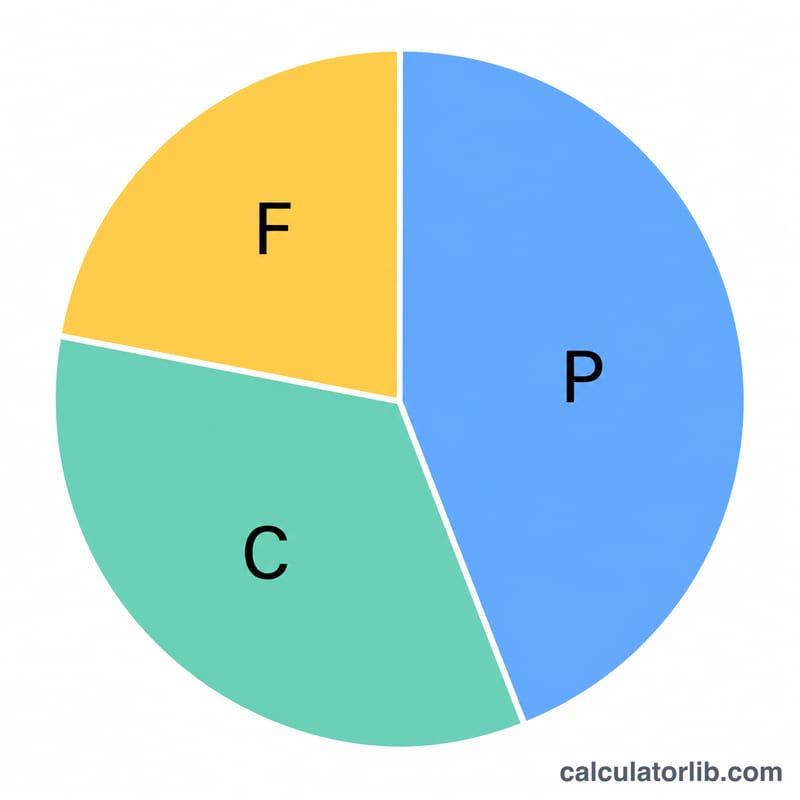
A macro split calculator converts your daily calorie target and chosen macronutrient ratio (the percentage of calories from protein, carbohydrate and fat) into actual grams you can track on a food label or in an app. Because food packaging lists macros in grams, knowing your daily gram targets makes meal planning far easier than working in percentages alone.
How to Use It
Enter your daily calorie goal, then enter the percentage of calories you want from protein, carbs and fat. The three percentages should add up to 100%. The calculator instantly returns the calories and grams for each macro. A common starting ratio is 30% protein / 40% carbs / 30% fat, but athletes, low-carb dieters and bulking lifters all adjust these to suit their goals.
The Formula Explained
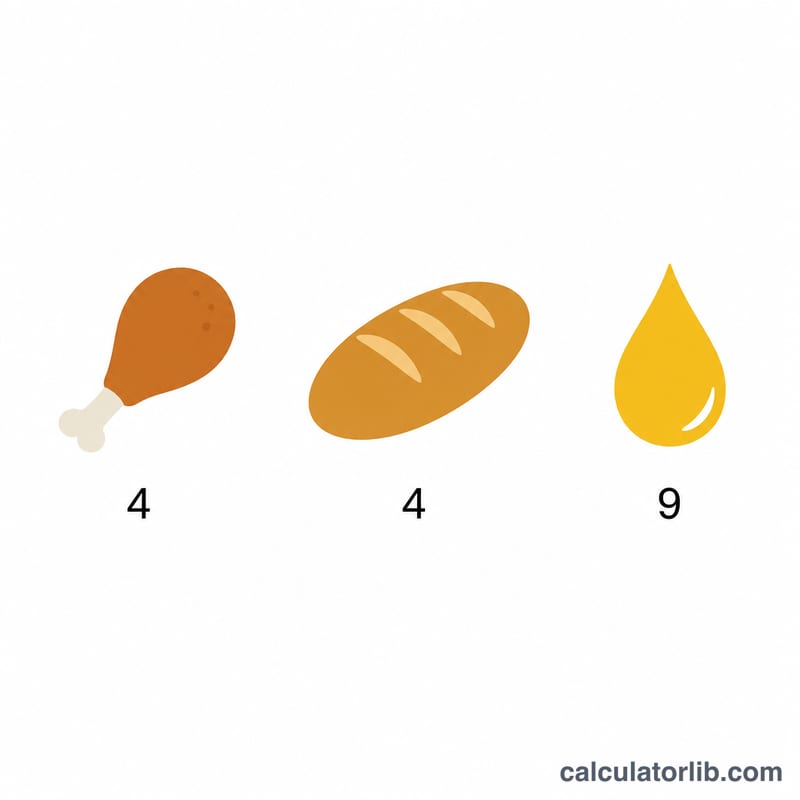
Each macronutrient supplies a fixed amount of energy: protein and carbohydrate provide about 4 kilocalories per gram, while fat provides about 9 kilocalories per gram. To find grams, take the calories assigned to a macro and divide by its energy density:
$$\text{Grams} = \frac{\text{Calories} \times \dfrac{\text{Macro \%}}{100}}{\text{kcal per gram}}$$
$$\begin{aligned} \text{Protein (g)} &= \frac{\text{Calories} \times \frac{\text{Protein \%}}{100}}{4} \\ \text{Carbs (g)} &= \frac{\text{Calories} \times \frac{\text{Carbs \%}}{100}}{4} \\ \text{Fat (g)} &= \frac{\text{Calories} \times \frac{\text{Fat \%}}{100}}{9} \end{aligned}$$
Worked Example
Suppose your target is 2,000 kcal with a 30/40/30 split. Protein gets \(600 \text{ kcal} \div 4 = 150 \text{ g}\). Carbs get \(800 \text{ kcal} \div 4 = 200 \text{ g}\). Fat gets \(600 \text{ kcal} \div 9 \approx 66.7 \text{ g}\). So your daily goal is roughly 150 g protein, 200 g carbs and 67 g fat.
FAQ
Do my percentages have to total 100%? Yes, for an accurate split. If they don't, the tool still calculates each macro but flags the mismatch.
Why is fat divided by 9 instead of 4? Fat is more energy-dense — each gram contains about 9 calories versus 4 for protein and carbohydrate.
What ratio should I use? It depends on your goals and preferences. Balanced diets often use 30/40/30, low-carb plans push fat higher, and many strength athletes prioritise protein around 1.6–2.2 g per kg of body weight.