
What the Macro Calculator Does
This Macro Calculator estimates your daily targets for calories, protein, carbohydrates and fat based on your personal details and weight goal. It uses metric units (kilograms and centimetres) and the widely-trusted Mifflin-St Jeor equation to find your energy needs, then splits those calories into the three macronutrients. It's a planning tool to guide your nutrition — not medical advice.
The Inputs You Provide
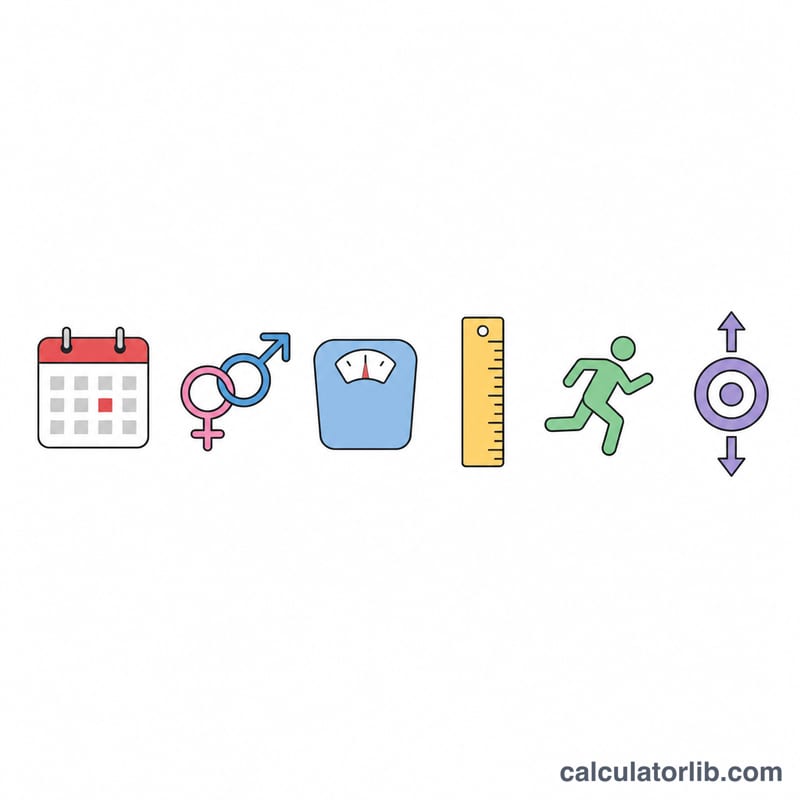
- Age – in years, used in the BMR formula.
- Gender – Male or Female; this changes the final constant in the equation.
- Height (cm) – your height in centimetres.
- Weight (kg) – your body weight in kilograms.
- Activity level – a multiplier reflecting how active you are.
- Goal – Maintain, Lose, or Gain Weight.
The Formula Explained
First, Basal Metabolic Rate (BMR) is calculated:
- Male: \((10 \times \text{weight}) + (6.25 \times \text{height}) - (5 \times \text{age}) + 5\)
- Female: \((10 \times \text{weight}) + (6.25 \times \text{height}) - (5 \times \text{age}) - 161\)
Your TDEE (Total Daily Energy Expenditure) is \(\text{BMR} \times \text{activity level}\). Calories are then adjusted by your goal: maintain keeps TDEE as-is, lose subtracts 500, gain adds 500. Macros are derived as: protein = \(\text{weight} \times 2.2\,\text{g}\) (roughly 1g per pound of bodyweight), fat = 25% of calories ÷ 9, and carbs = remaining calories ÷ 4.
$$\text{Calories} = \text{BMR} \times \text{Activity}$$$$\text{where}\quad \left\{ \begin{aligned} \text{BMR} &= 10\,\text{Wt} + 6.25\,\text{Ht} - 5\,\text{Age} + 5 \\ \text{Protein} &= 2.2 \times \text{Wt} \\ \text{Fat} &= \dfrac{0.25 \times \text{Calories}}{9} \\ \text{Carbs} &= \dfrac{\text{Calories} - 4\,\text{Protein} - 9\,\text{Fat}}{4} \end{aligned} \right.$$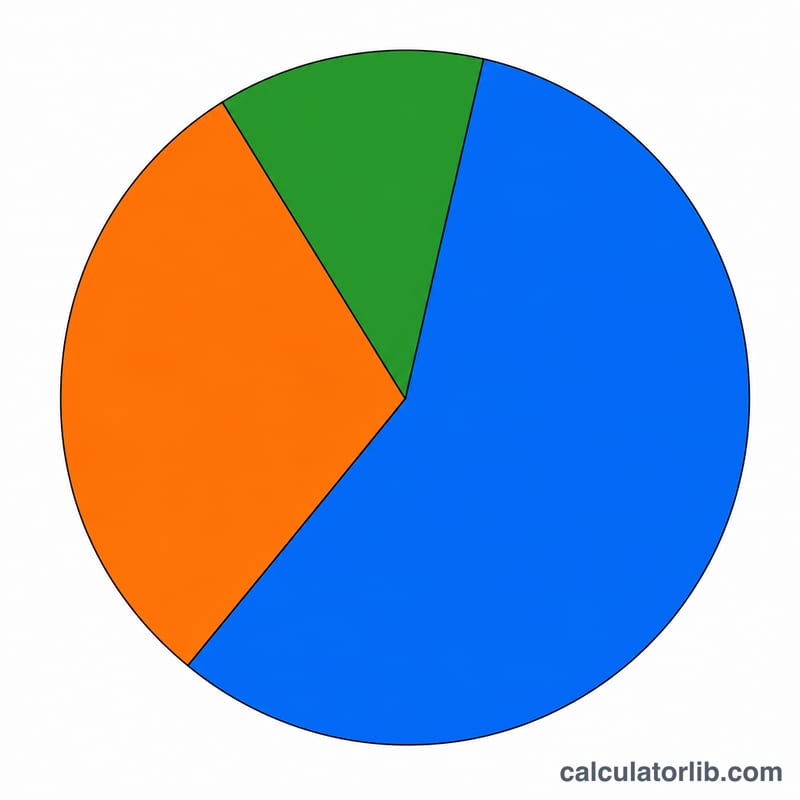
Worked Example
A 30-year-old male, 80 kg, 180 cm, activity 1.55 (moderately active), wanting to lose weight:
- \(\text{BMR} = (10 \times 80) + (6.25 \times 180) - (5 \times 30) + 5 = 1780\)
- \(\text{TDEE} = 1780 \times 1.55 = 2759\)
- \(\text{Lose-weight calories} = 2759 - 500 \approx 2259\)
- \(\text{Protein} = 80 \times 2.2 \approx 176\,\text{g}\)
- \(\text{Fat} = (2259 \times 0.25) \div 9 \approx 63\,\text{g}\)
- \(\text{Carbs} = (2259 - 704 - 565) \div 4 \approx 248\,\text{g}\)
FAQ
Why does protein use 2.2 grams per kilogram? The formula sets protein at roughly 1 gram per pound of bodyweight, a common target for active people and those losing fat to preserve muscle.
What activity multiplier should I use? Typical values are 1.2 (sedentary), 1.375 (light), 1.55 (moderate), 1.725 (very active) and 1.9 (extremely active).
Why is the calorie change exactly 500? A 500-calorie daily deficit or surplus corresponds to roughly 0.45 kg (1 lb) of weight change per week, a sustainable rate.