
What the Protein Calculator Does
This Protein Calculator estimates how many grams of protein you should eat each day based on your body and your training goal. It also works out your total daily calorie burn and suggests a matching split of protein, carbohydrates and fat. The protein targets used here follow widely cited sports nutrition guidelines (commonly used internationally). All weights are entered in kilograms and heights in centimetres.
The Inputs You Provide
- Age – in years, used in the calorie (BMR) formula.
- Gender – Male or Female, which changes the BMR equation.
- Weight (kg) – the main driver of your protein target.
- Height (cm) – used to estimate calorie needs.
- Activity Level – Sedentary, Lightly Active, Moderately Active, Very Active or Extra Active.
- Goal – Maintain Weight, Lose Weight or Gain Muscle, which sets your protein per kilogram.
The Formula Explained
First, the calculator finds your Basal Metabolic Rate (BMR) using the Mifflin/Harris-Benedict style equations:
- Male: \(88.362 + (13.397 \times \text{weight}) + (4.799 \times \text{height}) - (5.677 \times \text{age})\)
- Female: \(447.593 + (9.247 \times \text{weight}) + (3.098 \times \text{height}) - (4.330 \times \text{age})\)
BMR is multiplied by an activity factor (1.2 sedentary, 1.375 lightly, 1.55 moderately, 1.725 very, 1.9 extra) to get your Total Daily Energy Expenditure (TDEE).
Protein is then set per body weight: 1.6 g/kg to maintain, 2.0 g/kg to lose weight, and 2.2 g/kg to gain muscle. The remaining calories (TDEE minus protein calories) are split 60% to carbs and 40% to fat, then divided by 4 and 9 calories per gram respectively.
$$\text{Protein (g)} = \text{Weight (kg)} \times 1.6$$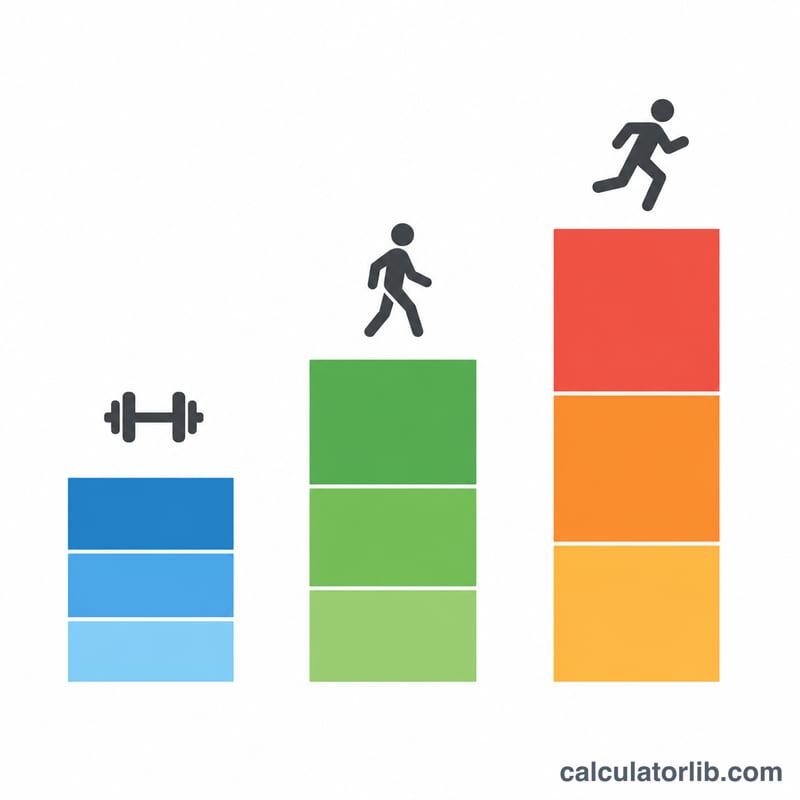
Worked Example
Take a 30-year-old male, 80 kg, 180 cm, Moderately Active, aiming to Gain Muscle:
- BMR = \(88.362 + (13.397 \times 80) + (4.799 \times 180) - (5.677 \times 30) \approx\) 1,860 kcal
- TDEE = \(1{,}860 \times 1.55 \approx\) 2,883 kcal
- Protein = \(80 \times 2.2 =\) 176 g (≈ 704 kcal)
- Remaining 2,179 kcal → carbs ≈ 327 g, fat ≈ 97 g
FAQ
Why is protein based on weight, not calories? Protein needs scale most closely with lean body mass and goal, so grams per kilogram is the standard approach in sports nutrition.
Is 2.2 g/kg too much? For active people building muscle, 1.6–2.2 g/kg is well supported by research. Sedentary individuals typically need less.
Are the carb and fat figures fixed? They are a starting suggestion using a 60/40 split of leftover calories. Adjust to suit your preferences and how you feel.