
What Is the Crude Protein Calculator?
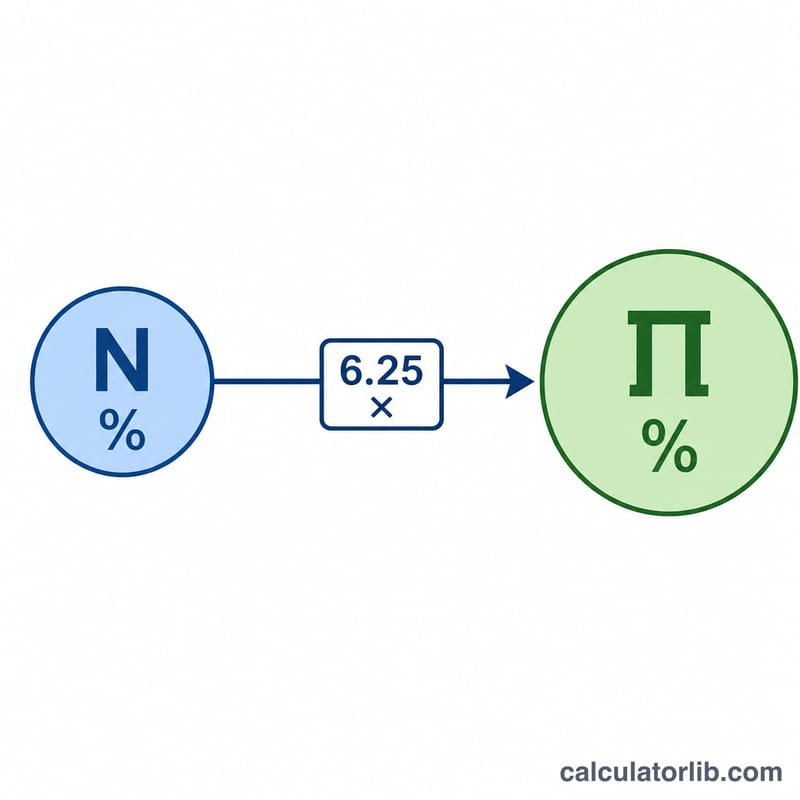
The Crude Protein Calculator converts a measured nitrogen percentage into a crude protein percentage. Because proteins contain a fairly constant proportion of nitrogen (about 16%), laboratories estimate protein content by measuring nitrogen — typically via the Kjeldahl or Dumas method — then multiplying by a conversion factor. The general-purpose factor is 6.25 (the inverse of 16%).
How to Use It
Enter the nitrogen content of your sample as a percentage and choose a conversion factor. Leave the factor at 6.25 for a general estimate, or use a commodity-specific value such as 5.70 for wheat, 6.38 for dairy products, or 5.95 for rice. The calculator instantly returns the crude protein percentage.
The Formula Explained
The equation is simply:
$$\text{Crude Protein \%} = \text{Nitrogen \%} \times \text{Conversion Factor}$$
The factor 6.25 assumes protein is 16% nitrogen \(1 \div 0.16 = 6.25\). "Crude" protein means the value is estimated from total nitrogen and includes any non-protein nitrogen, so it is an approximation rather than a direct protein measurement.
Worked Example
A feed sample is found to contain 2.5% nitrogen. Using the standard factor of 6.25:
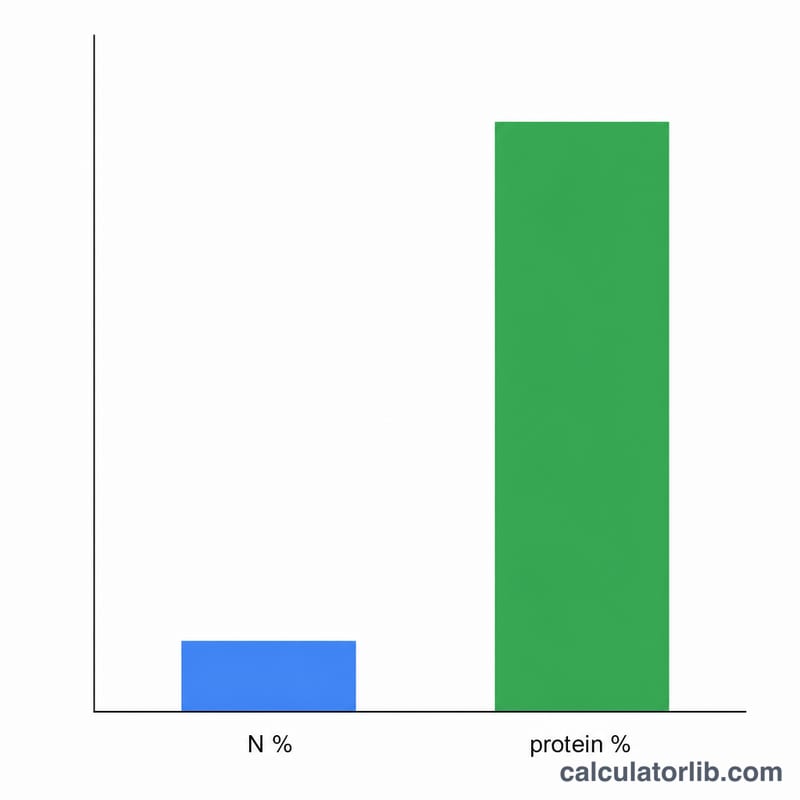
$$\text{Crude Protein \%} = 2.5 \times 6.25 = \mathbf{15.625\%}$$
So the feed is estimated to contain about 15.6% crude protein.
FAQ
Why is the factor 6.25? Most proteins contain roughly 16% nitrogen by mass, and 1 divided by 0.16 equals 6.25.
Should I always use 6.25? No. Different foods have different amino acid compositions. Wheat uses 5.70, dairy 6.38, and many regulatory standards still default to 6.25.
Is crude protein the same as true protein? Not exactly. Crude protein includes non-protein nitrogen sources, so it slightly overestimates true protein content.