
What Is the Protein-to-Creatinine Ratio?
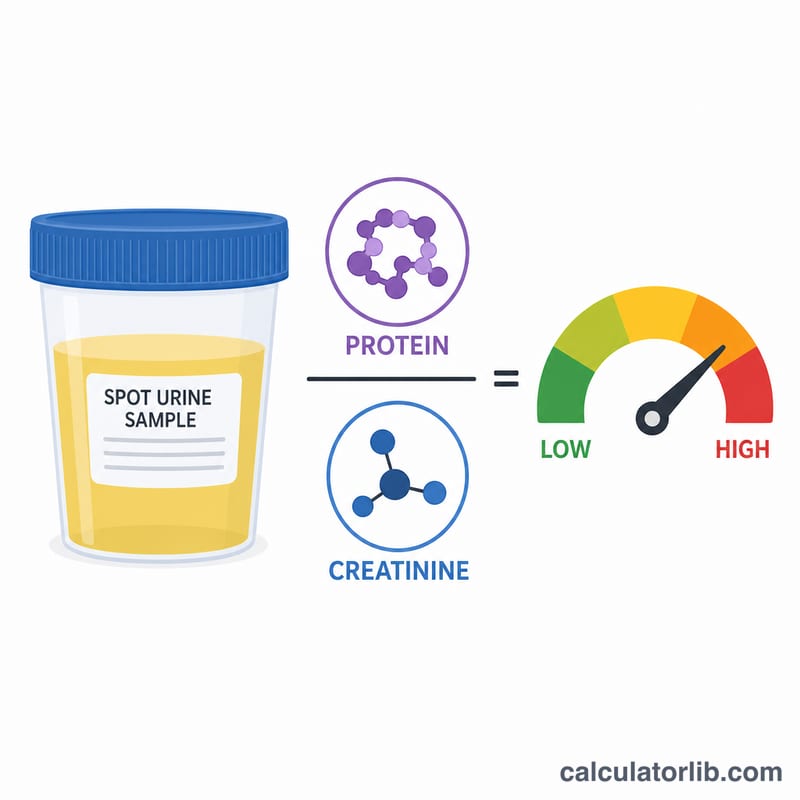
The urine protein-to-creatinine ratio (UPCR or PCR) is a quick way to estimate how much protein the kidneys are leaking into the urine without requiring a cumbersome 24-hour urine collection. Because creatinine is excreted at a fairly steady rate, dividing protein by creatinine corrects for how dilute or concentrated a single "spot" urine sample happens to be. The result, expressed in milligrams of protein per gram of creatinine (mg/g), closely approximates total protein excretion in grams per 24 hours.
How to Use This Calculator
Enter the urine protein concentration and urine creatinine concentration from a spot urine sample, both in mg/dL (the standard units on most lab reports). The calculator divides protein by creatinine and multiplies by 1000 to give the ratio in mg/g. A value near or below 150 mg/g is generally considered normal.
The Formula Explained
$$\text{PCR (mg/g)} = \frac{\text{Urine Protein (mg/dL)}}{\text{Urine Creatinine (mg/dL)}} \times 1000$$ The factor of 1000 converts the dimensionless ratio into mg of protein per gram of creatinine, since \(1\,\text{g} = 1000\,\text{mg}\). Dividing the mg/g result by 1000 gives the equivalent g/g value, which approximates daily grams of proteinuria.
Worked Example
Suppose urine protein is 30 mg/dL and urine creatinine is 100 mg/dL. $$\text{PCR} = \frac{30}{100} \times 1000 = 300 \text{ mg/g}$$ or 0.3 g/g. This falls in the mild proteinuria range and would typically prompt repeat or confirmatory testing.
FAQ
Is this the same as a 24-hour collection? No, but a spot PCR correlates well with 24-hour protein excretion and is far more convenient, so it is widely used for screening and monitoring.
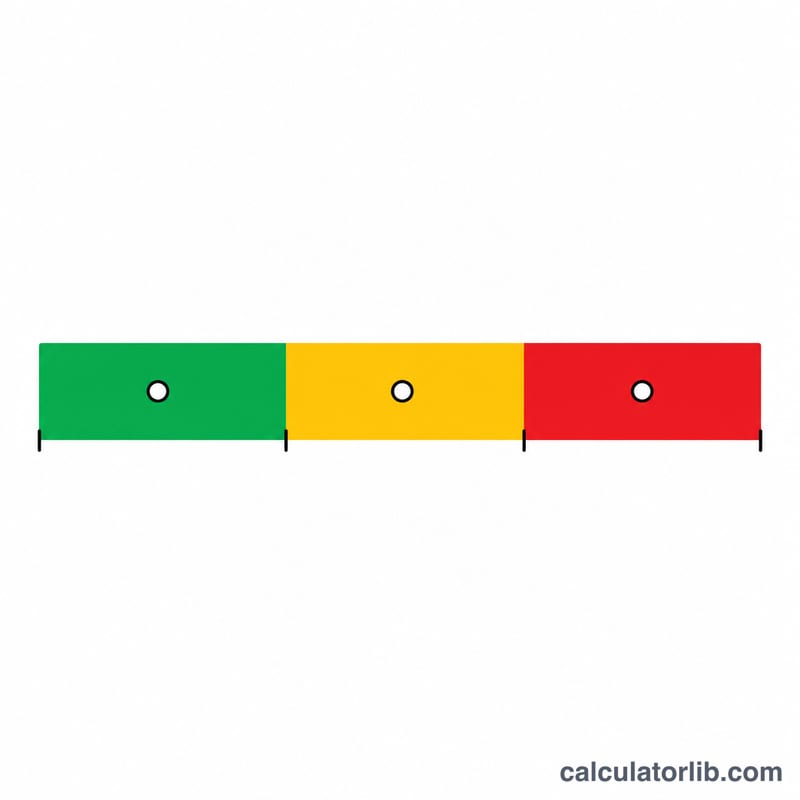
What is a normal result? Below roughly 150 mg/g is normal. 150–500 mg/g is mild, 500–3500 mg/g moderate, and above 3500 mg/g is nephrotic-range proteinuria.
Does this replace medical advice? No. This tool is for educational estimation only. Always discuss lab results with a qualified clinician.