

What Is the Urine Output Calculator?
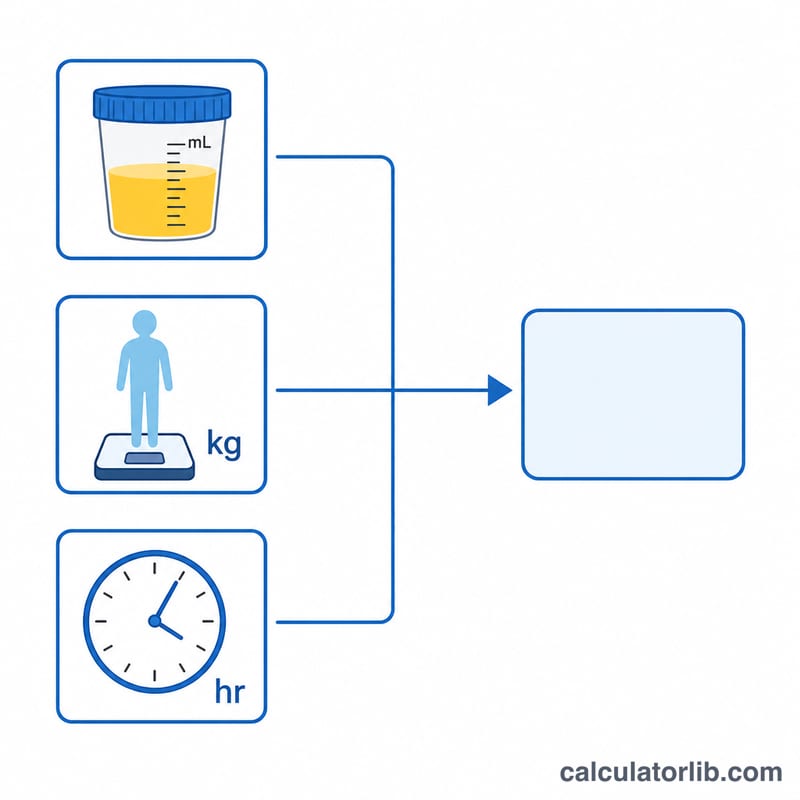
The Urine Output Calculator measures how much urine a patient produces relative to their body weight and the time over which it was collected. The result is expressed in milliliters per kilogram per hour (mL/kg/hr), the standard clinical unit used to assess kidney function and hydration status. It is widely used in hospitals, ICUs, and during fluid-balance monitoring.
How to Use It
Enter three values: the total urine volume collected (in mL), the patient's weight (in kg), and the number of hours over which the urine was collected. The calculator instantly returns the output rate in mL/kg/hr, the hourly output in mL/hr, and a simple classification.
The Formula Explained
The core equation is:
$$\text{Rate} = \frac{\text{Total Urine Volume}}{\text{Weight} \times \text{Hours}}$$
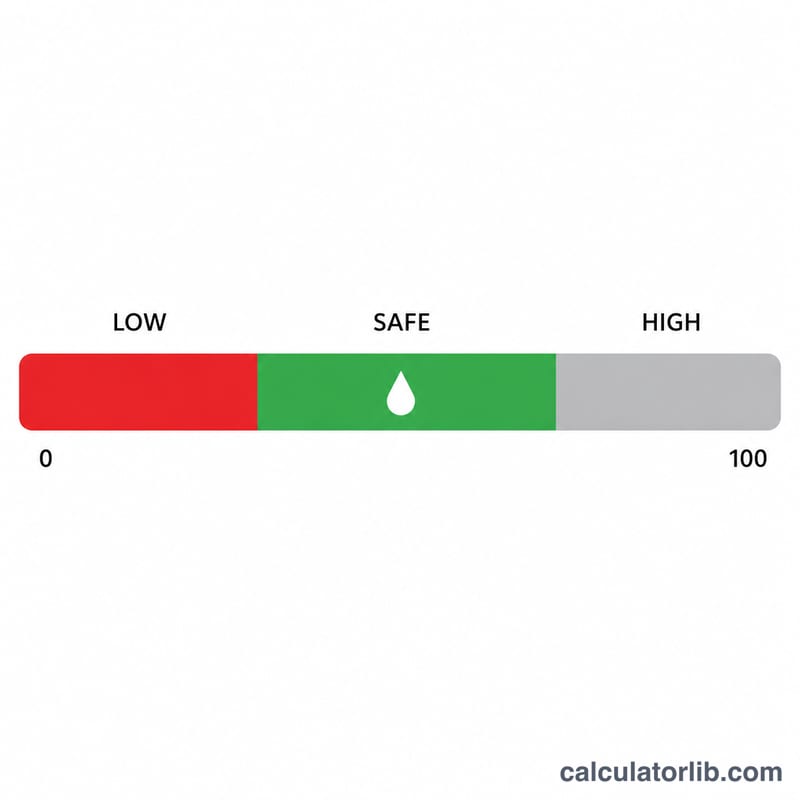
For example, a 70 kg patient who produced 1,200 mL of urine over 24 hours has an output of $$1{,}200 \div (70 \times 24) = 0.714 \text{ mL/kg/hr}.$$ This falls within the typical normal range of roughly 0.5–1.5 mL/kg/hr for adults.
Worked Example
A 50 kg patient produces 600 mL of urine in 12 hours. Output = $$600 \div (50 \times 12) = 1.0 \text{ mL/kg/hr},$$ and hourly output = \(600 \div 12 = 50\) mL/hr — a healthy, normal result.
FAQ
What is a normal urine output? In adults, a normal rate is about 0.5–1.5 mL/kg/hr. Below 0.5 mL/kg/hr is often termed oliguria.
What is oliguria? Oliguria is abnormally low urine output, classically defined as less than 0.5 mL/kg/hr in adults, which may signal dehydration or kidney injury.
Is this a medical diagnosis? No. This tool is for educational and estimation purposes only. Always consult a qualified healthcare professional for clinical decisions.