
What Is the Hydropower Output Calculator?
This calculator estimates the electrical power a hydroelectric scheme can generate from flowing water. Given the volumetric flow rate, the net head (vertical drop), and the overall efficiency of the turbine-generator system, it returns power in watts and kilowatts. It is a universal physics tool and applies anywhere — micro-hydro, run-of-river, and large dam projects alike.
How to Use It
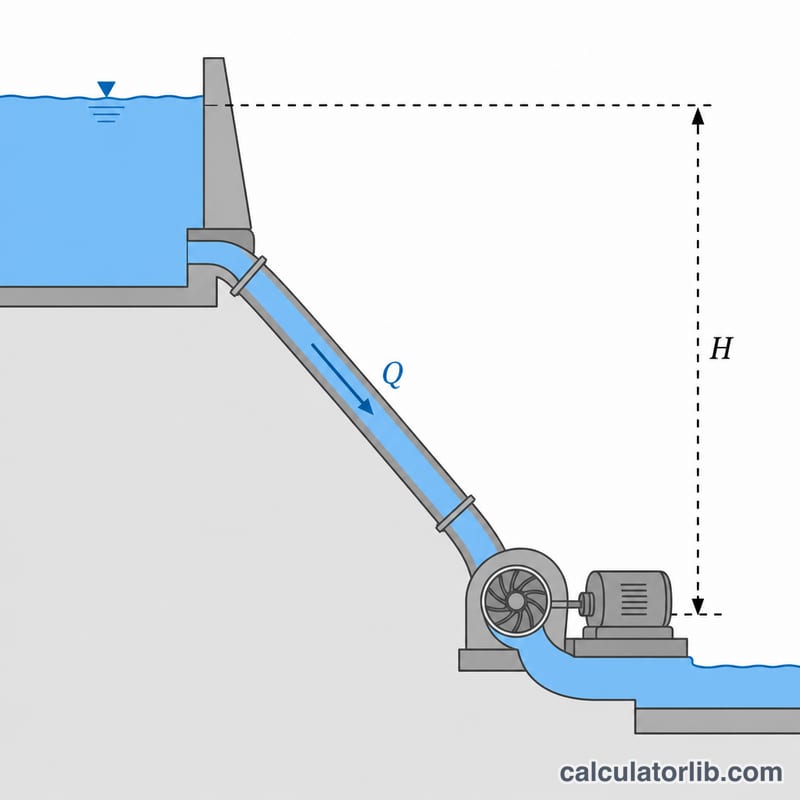
Enter the flow rate Q in cubic metres per second (m³/s), the net head H in metres, and the system efficiency as a percentage (typical real-world systems are 70–90%). The calculator multiplies these with the density of water and gravity to give the available power output.
The Formula Explained
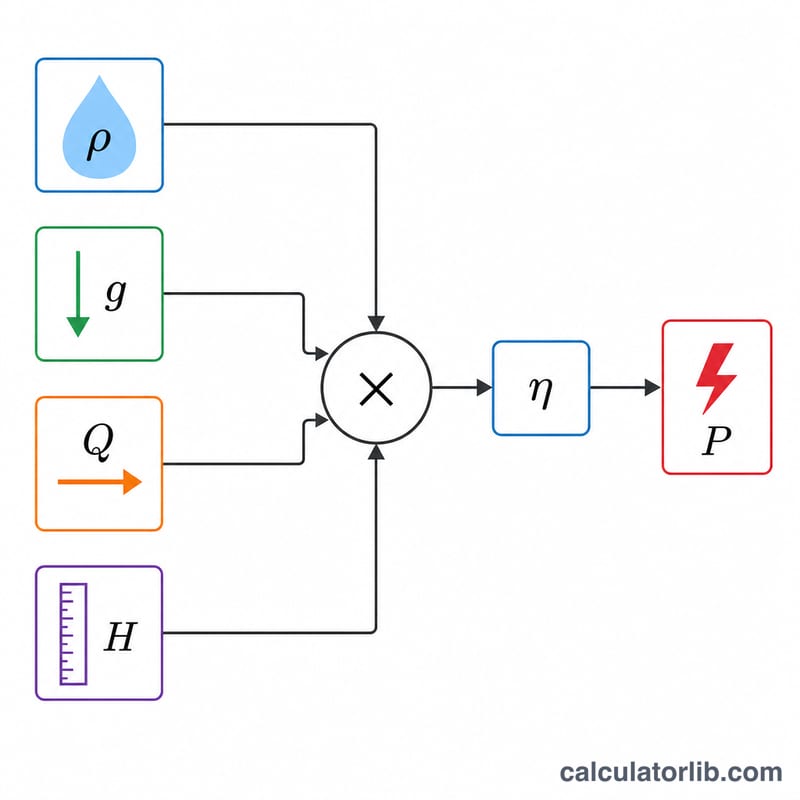
The governing equation is $$P = \rho \cdot g \cdot Q \cdot H \cdot \eta$$ where \(\rho\) is water density (1000 kg/m³), \(g\) is gravitational acceleration (9.81 m/s²), \(Q\) is flow rate (m³/s), \(H\) is net head (m), and \(\eta\) is the dimensionless efficiency (0–1). The product \(\rho \cdot g \cdot Q \cdot H\) is the theoretical hydraulic power; multiplying by \(\eta\) accounts for losses in the penstock, turbine, and generator.
Worked Example
Suppose Q = 2 m³/s, H = 10 m, and efficiency = 85%. Then $$P = 1000 \times 9.81 \times 2 \times 10 \times 0.85 = 166{,}770 \text{ W} \approx 166.77 \text{ kW}$$ That is enough to supply roughly a hundred homes.
FAQ
What efficiency should I use? Small micro-hydro systems are often 50–70% efficient; well-designed large plants reach 85–90%.
What is net head? Net head is the effective vertical distance the water falls, after subtracting friction losses in the pipe.
Why is water density 1000? Fresh water has a density of about 1000 kg/m³; the calculator uses this standard value.