
What This Calculator Does
The Solar Panel Output Calculator estimates how much electricity a photovoltaic (PV) system will generate. By combining your system's rated capacity, your location's average peak sun hours, and a performance ratio that accounts for real-world losses, it produces daily, monthly, and annual energy estimates measured in kilowatt-hours (kWh).
How to Use It
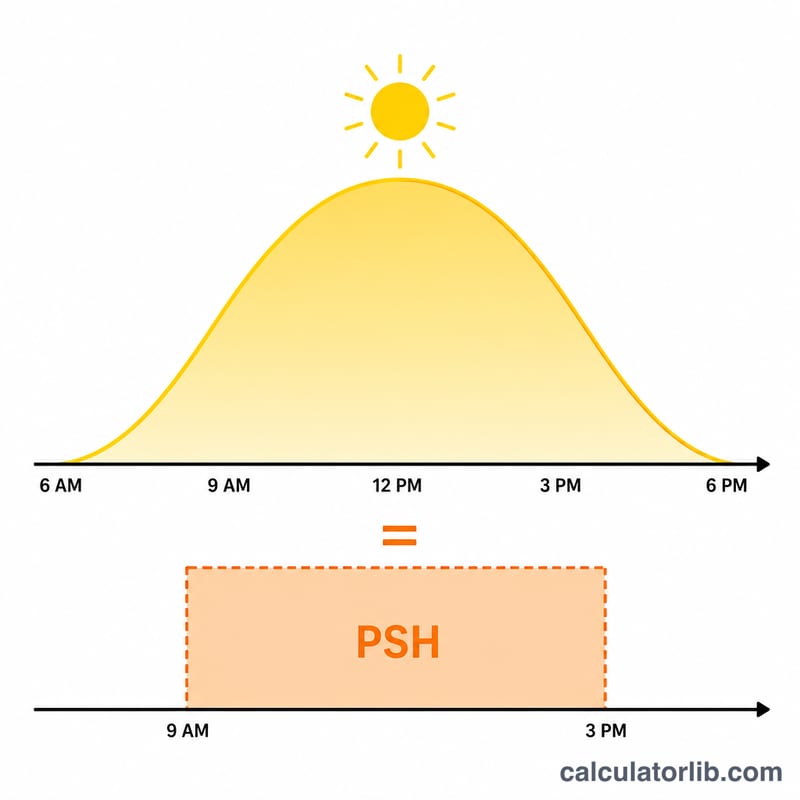
Enter three values: the system size in kilowatts (the sum of your panel ratings, e.g. a 5 kW array), the peak sun hours for your area (the number of hours per day equivalent to 1,000 W/m² of sunlight — typically 3 to 6 depending on climate and season), and a performance ratio between 0 and 1. A typical real-world performance ratio is 0.70–0.80, accounting for inverter losses, wiring, heat, soiling, and shading.
The Formula Explained
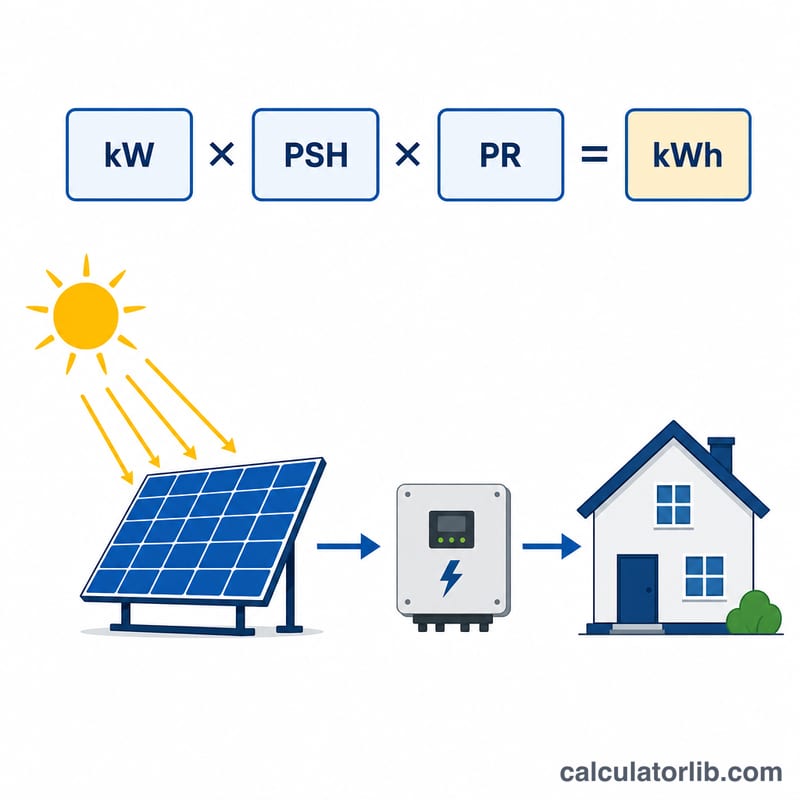
The core equation is:
$$E_{\text{daily}} = \text{System Size (kW)} \times \text{Peak Sun Hours} \times \text{Performance Ratio}$$
System size multiplied by peak sun hours gives the theoretical output, and multiplying by the performance ratio discounts that figure to reflect practical losses. Monthly output uses an average of \(30.44\) days, and annual output multiplies the daily value by \(365\).
Worked Example
Suppose you have a 5 kW system in a region with 4.5 peak sun hours and a performance ratio of 0.75:
Daily = $$5 \times 4.5 \times 0.75 = 16.875 \text{ kWh/day}$$ Over a year that is $$16.875 \times 365 \approx 6{,}159 \text{ kWh}$$ — enough to cover a large share of a typical household's electricity needs.
FAQ
What are peak sun hours? They represent the daily solar energy received, expressed as the number of hours at a standard 1,000 W/m² intensity. Sunny desert regions may see 6+, while cloudy northern climates may average 3.
Why use a performance ratio? No system converts 100% of available sunlight. Inverter inefficiency, high temperatures, dust, and wiring resistance reduce output, so a ratio of around 0.75 keeps estimates realistic.
Is this a guaranteed figure? No. It is an estimate. Actual production varies with weather, panel orientation, tilt, and seasonal sun angles. Use it for planning and comparison.