
What Is the Solar Panel Wattage Calculator?
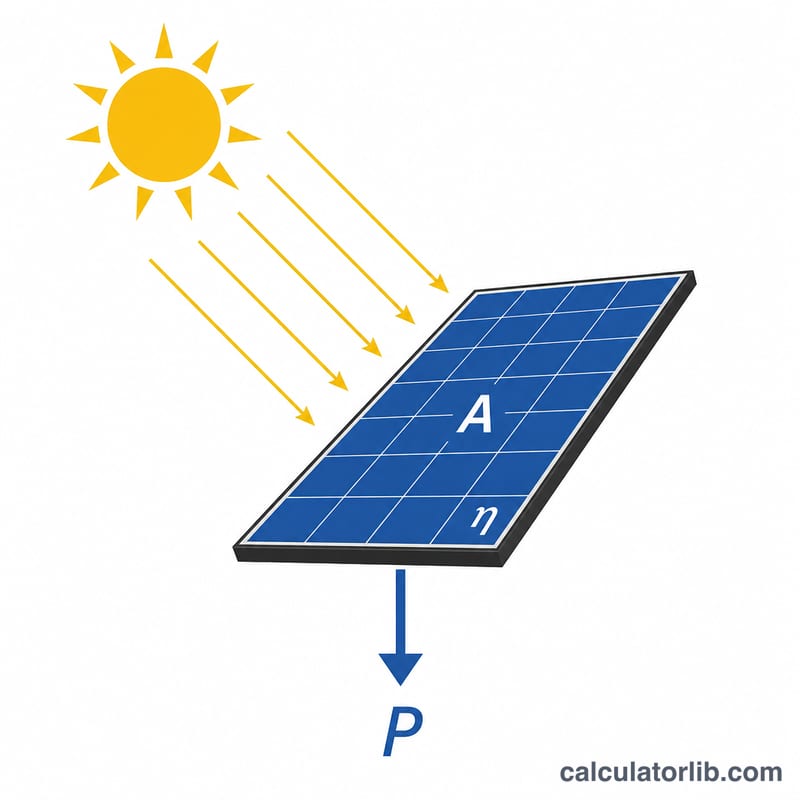
This tool estimates the electrical power output of a solar panel using three inputs: the panel's surface area, the incoming solar irradiance, and the panel's conversion efficiency. It is a universal physics-based estimator and works for any location—simply adjust the irradiance to match your conditions. The result tells you how many watts a panel can deliver at the chosen irradiance level.
How to Use It
Enter the panel area in square metres, the solar irradiance in watts per square metre (the global standard test condition is 1000 W/m²), and the panel efficiency as a percentage (typical modern panels are 15–22%). The calculator returns the instantaneous power in watts and an estimated daily energy yield based on roughly 5 peak sun-hours per day.
The Formula Explained
The core equation is \(P = A \times G \times \eta\), where P is power in watts, A is area in m², G is irradiance in W/m², and η is efficiency as a decimal (percentage ÷ 100). Irradiance is the energy striking each square metre; multiplying by area gives total incoming energy, and multiplying by efficiency gives the fraction the panel actually converts to electricity.
Worked Example
Suppose a panel is 1.6 m², sits under 1000 W/m² irradiance, and is 20% efficient. Then $$P = 1.6 \times 1000 \times 0.20 = 320 \text{ W}.$$ Over 5 sun-hours that is \(320 \times 5 = 1600 \text{ Wh} = 1.6 \text{ kWh}\) per day.
FAQ
What irradiance should I use? Standard Test Conditions use 1000 W/m². On a cloudy day or low sun angle it may be 200–600 W/m².
Why is real output lower? Heat, dust, wiring losses, and inverter inefficiency reduce real-world output by 10–25%.
What efficiency is realistic? Most residential panels range from 15% to 22%; premium models can exceed 22%.