
What This Calculator Does
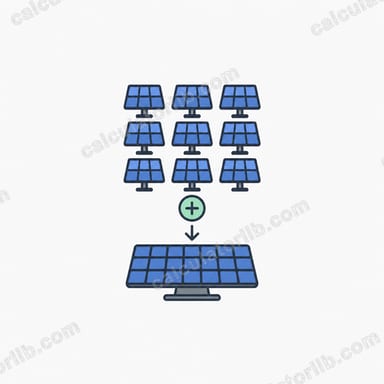
The Solar Panel Number Calculator estimates how many photovoltaic panels you need to cover your daily electricity consumption. It works for any location and panel type, since you supply the local peak sun hours and your own energy needs. By accounting for real-world losses through a system efficiency (derate) factor, it gives a far more realistic count than simply dividing wattage figures.
How to Use It
Enter your average daily energy use in kilowatt-hours (check your utility bill — divide the monthly kWh by 30). Add the panel rating in watts (common values are 350–450 W), the peak sun hours for your area (roughly 3–6 depending on climate), and a system derate percentage. A typical derate of 75–85% covers inverter losses, wiring, dust, temperature, and shading.
The Formula Explained
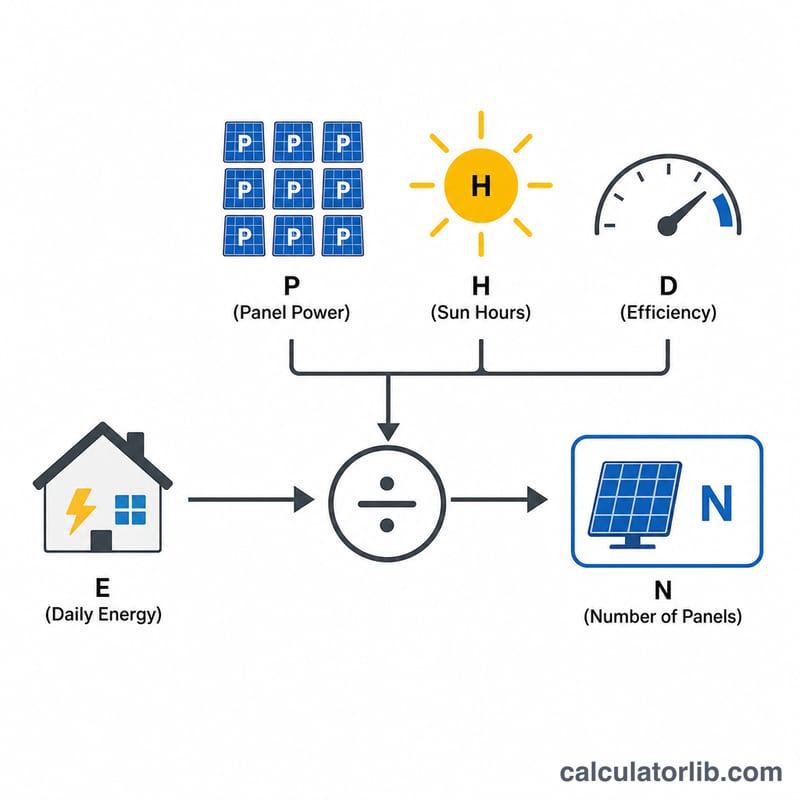
The number of panels is your daily energy need divided by what a single panel actually delivers each day:
$$N = \left\lceil \dfrac{E_{\text{daily}}}{\frac{P}{1000} \times H \times D} \right\rceil$$
Here \(P/1000\) converts the panel rating from watts to kilowatts, \(H\) is peak sun hours, and \(D\) is the derate factor as a decimal. The result is rounded up to a whole number because you cannot install a fraction of a panel.
Worked Example
Suppose you use 20 kWh/day, with 400 W panels, 5 peak sun hours, and an 80% derate. One panel makes $$(400/1000) \times 5 \times 0.80 = 1.6 \text{ kWh/day}.$$ You need $$20 / 1.6 = 12.5 \text{ panels},$$ rounded up to 13 panels, giving a 5.2 kW system that produces about 20.8 kWh/day.
FAQ
What are peak sun hours? They represent the equivalent hours per day of full 1,000 W/m² sunlight — not daylight hours. Sunny regions average 5–6; cloudier ones 3–4.
Why use a derate factor? Real systems never deliver nameplate output. Inverters, heat, wiring, soiling and shading typically cut output by 15–25%, so 80% is a safe default.
Should I add a margin? Yes — adding 10–20% extra capacity helps cover future demand growth and panel degradation over time.