
What Is the Pulley RPM & Speed Calculator?
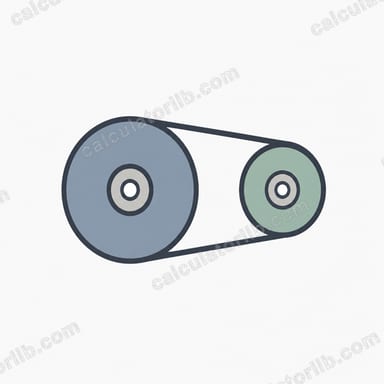
This calculator determines how fast a driven (output) pulley spins when connected by a belt to a driver (input) pulley. Belt-and-pulley systems are everywhere — fans, compressors, conveyors, machine tools, and engines — and the relationship between pulley size and speed lets you trade speed for torque or vice versa. The tool works with any consistent unit of diameter (mm, inches, or pitch diameter) because the calculation only depends on the ratio of the two diameters.
How to Use It
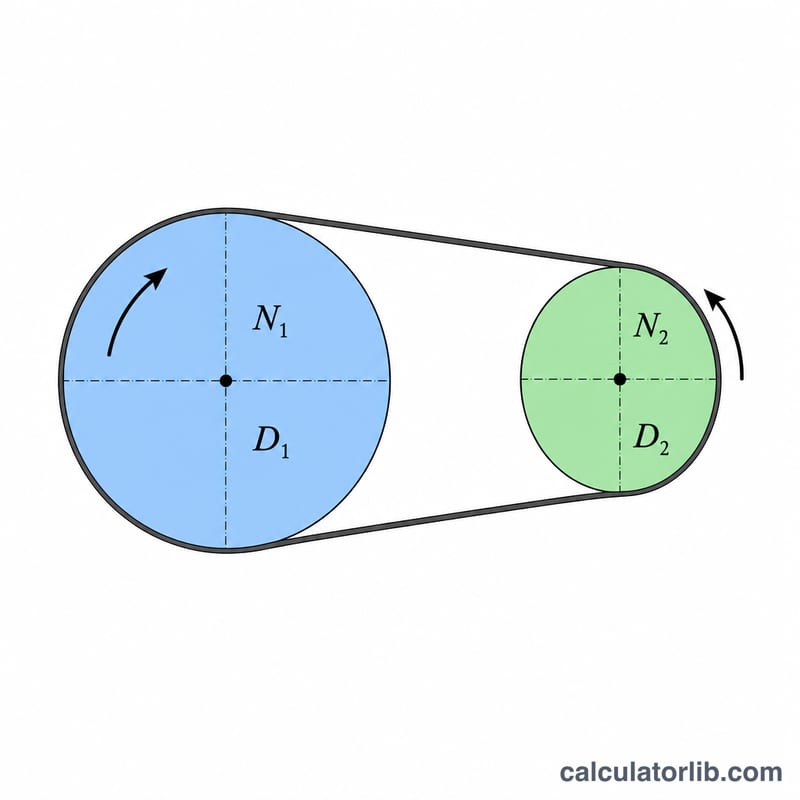
Enter three values: the driver pulley diameter (D1), the driver pulley speed (N1) in RPM, and the driven pulley diameter (D2). The calculator returns the driven pulley speed (N2) in RPM, plus the drive ratio. A driven pulley larger than the driver slows the output down; a smaller driven pulley speeds it up.
The Formula Explained
Because the belt does not slip, the surface speed of both pulleys is equal: \(N_1 \times D_1 = N_2 \times D_2\). Rearranging gives
$$N_2 = N_1 \times \frac{D_1}{D_2}$$The diameters can be measured at the belt contact (pitch) line for best accuracy, but the outer diameter gives a close estimate.
Worked Example
Suppose a motor pulley of 100 mm spins at 1500 RPM and drives a 200 mm pulley. Then
$$N_2 = 1500 \times \frac{100}{200} = 750 \text{ RPM}$$The output runs at half the input speed, and the drive ratio is \(200 / 100 = 2 : 1\) — meaning roughly double the torque at the output.
FAQ
Do the diameter units matter? No — as long as \(D_1\) and \(D_2\) use the same unit, the RPM result is correct because they appear as a ratio.
Does belt thickness affect the result? For precise work, use the pitch diameter (the effective belt line) rather than the outer diameter. The difference is usually small.
What about torque? Ignoring losses, torque changes inversely to speed: a 2:1 reduction roughly doubles output torque.