
What Is the RPM to Linear Speed Calculator?
This tool converts a rotational speed measured in revolutions per minute (RPM) into the linear, or surface, speed of a point on the edge of a rotating object. It is widely used for wheels, pulleys, conveyor rollers, grinding wheels, lathes, and CNC tooling where you need to know how fast the surface is actually moving. The calculation is universal physics and works in any consistent unit system.
How to Use It
Enter the diameter of the rotating part and choose its unit (m, cm, mm, inches, or feet). Then enter the rotational speed in RPM. The calculator returns the linear speed in meters per second, plus equivalents in m/min, km/h, ft/min, and mph, along with the circumference.
The Formula Explained
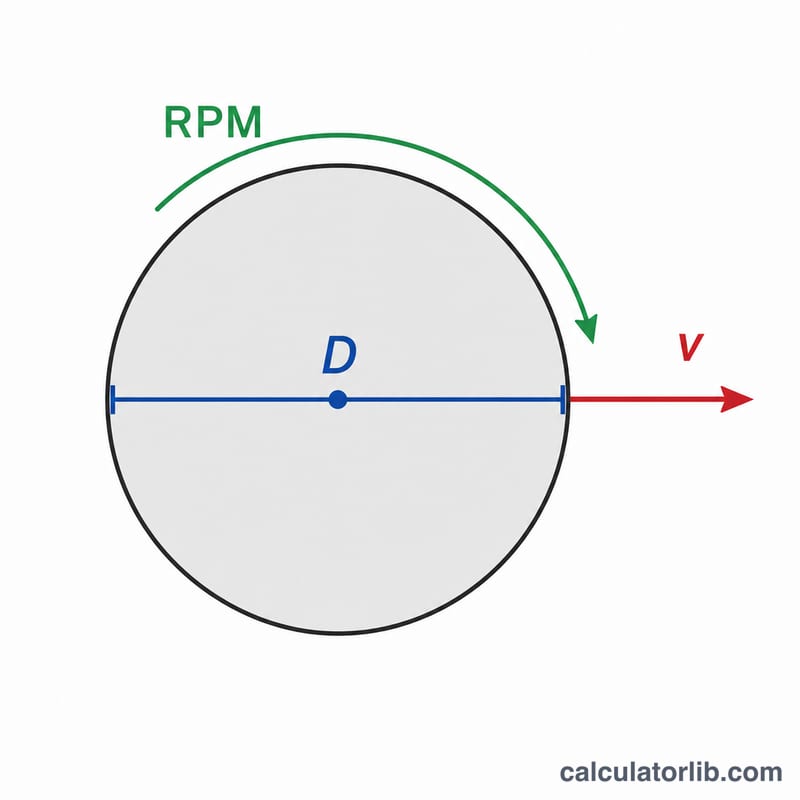
A rotating object covers one full circumference per revolution. The circumference is \(\pi \times D\). Multiplying by the number of revolutions per minute gives distance per minute: $$v = \pi \times D \times \text{RPM}$$ Dividing by 60 converts that to distance per second. Diameter is internally converted to meters first so all output units are consistent.
Worked Example
A wheel with a diameter of 0.5 m spins at 1000 RPM. Circumference = \(\pi \times 0.5 \approx 1.5708\) m. Speed per minute = \(1.5708 \times 1000 = 1570.8\) m/min. Per second: $$v = \frac{1570.8}{60} \approx 26.18 \text{ m/s}$$ which is about 94.25 km/h.
FAQ
Do I use diameter or radius? Use the diameter. If you only know the radius, multiply it by 2 first.
Is this the same as surface speed (SFM)? Yes — for machining, the ft/min value corresponds to Surface Feet per Minute (SFM).
Does it account for slip? No. It assumes a rigid surface with no slipping, which is the ideal theoretical speed.