
What Is a Discounted Cash Flow (DCF) Calculator?
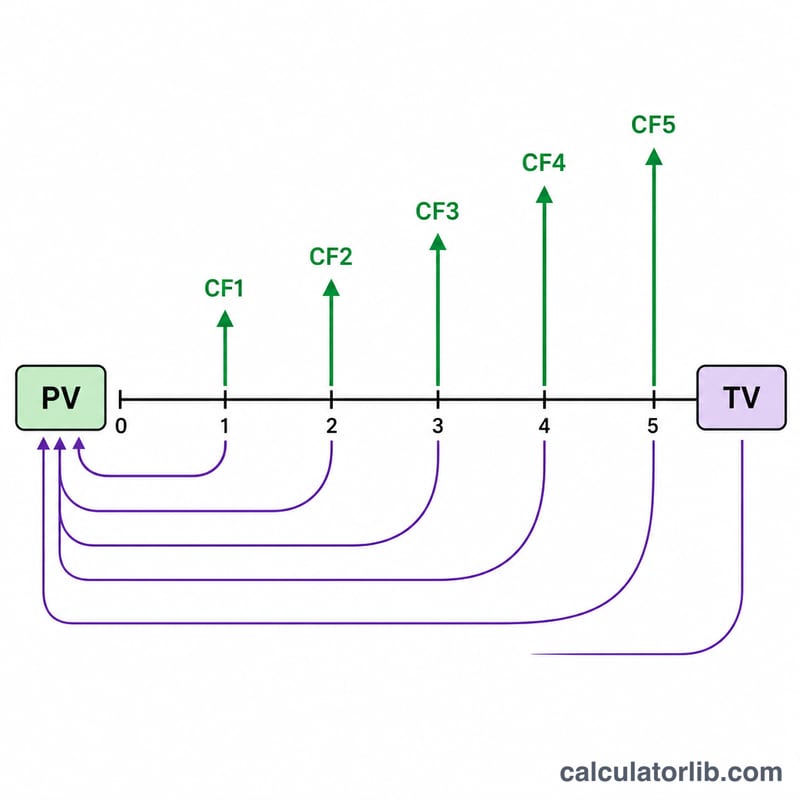
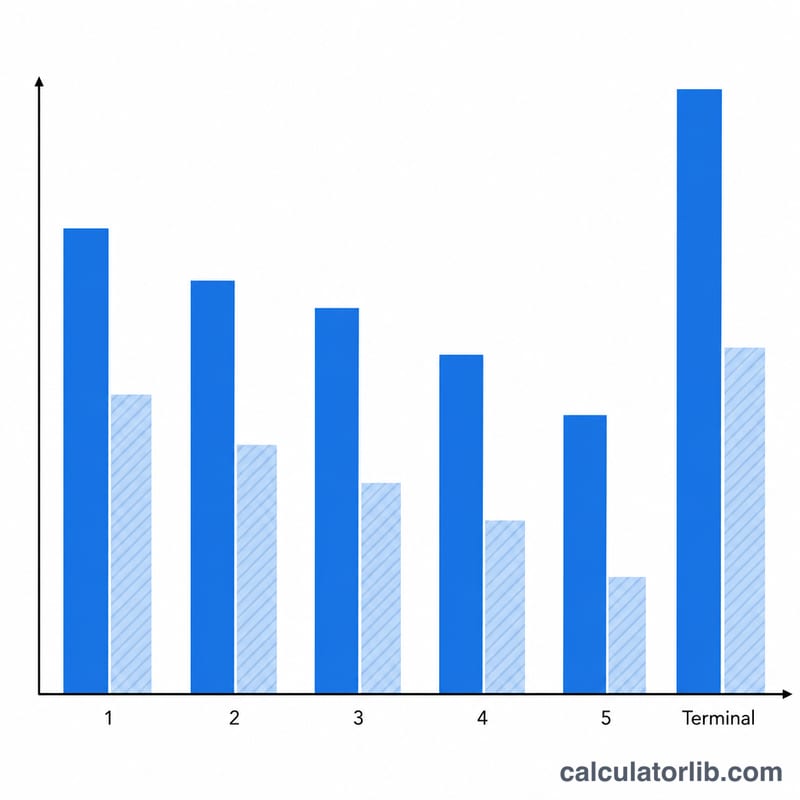
A Discounted Cash Flow calculator estimates what a stream of future cash flows is worth today. Because money received in the future is worth less than money in hand now, each future cash flow is "discounted" back to its present value using a rate that reflects risk and the time value of money. This tool sums those present values for up to five years and adds a discounted terminal value to capture cash flows beyond the forecast period.
How to Use It
Enter the projected cash flow for each year (leave later years at zero if your forecast is shorter), set your discount rate (often a required rate of return or weighted average cost of capital), and optionally add a terminal value representing the business's worth at the end of the final year. The calculator returns the total present value, broken down into the present value of explicit cash flows and the present value of the terminal value.
The Formula Explained
The core equation is $$\text{Value} = \sum_{t=1}^{5} \frac{\text{CF}_t}{(1+r)^{t}} + \frac{\text{TV}}{(1+r)^{n}}$$. Here \(\text{CF}_t\) is the cash flow in year \(t\), \(r\) is the discount rate as a decimal, \(n\) is the final year, and \(\text{TV}\) is the terminal value. Each cash flow is divided by a growing discount factor, so distant cash flows contribute less to today's value.
Worked Example
Suppose you expect $1,000 of cash flow each year for 5 years and use a 10% discount rate with no terminal value. The present values are roughly \(909.09\), \(826.45\), \(751.31\), \(683.01\), and \(620.92\). Adding these gives about $3,790.79 — the value today of receiving $1,000 a year for five years.
FAQ
What discount rate should I use? Many analysts use the weighted average cost of capital (WACC) for company valuations or a personal required rate of return for investments.
What is terminal value? It approximates the value of all cash flows beyond the explicit forecast, often estimated with a perpetuity growth or exit-multiple method, then entered as a single figure here.
Why is DCF sensitive? Small changes in the discount rate or growth assumptions can swing the result significantly, so test a range of inputs.