
What Is Unlevered Free Cash Flow?
Unlevered Free Cash Flow (UFCF), also called Free Cash Flow to the Firm (FCFF), is the cash a business generates from operations before any debt-related payments. Because it ignores interest and the capital structure, UFCF represents the cash available to all capital providers — both debt and equity holders. It is the cash flow most commonly discounted in a Discounted Cash Flow (DCF) valuation using the Weighted Average Cost of Capital (WACC).
How to Use This Calculator
Enter five figures from a company's financial statements: EBIT (operating income), the effective tax rate as a percentage, Depreciation & Amortization, Capital Expenditures (CapEx), and the change in Net Working Capital. The calculator returns UFCF along with the implied taxes and NOPAT. Use consistent currency units (e.g., all in thousands or millions).
The Formula Explained
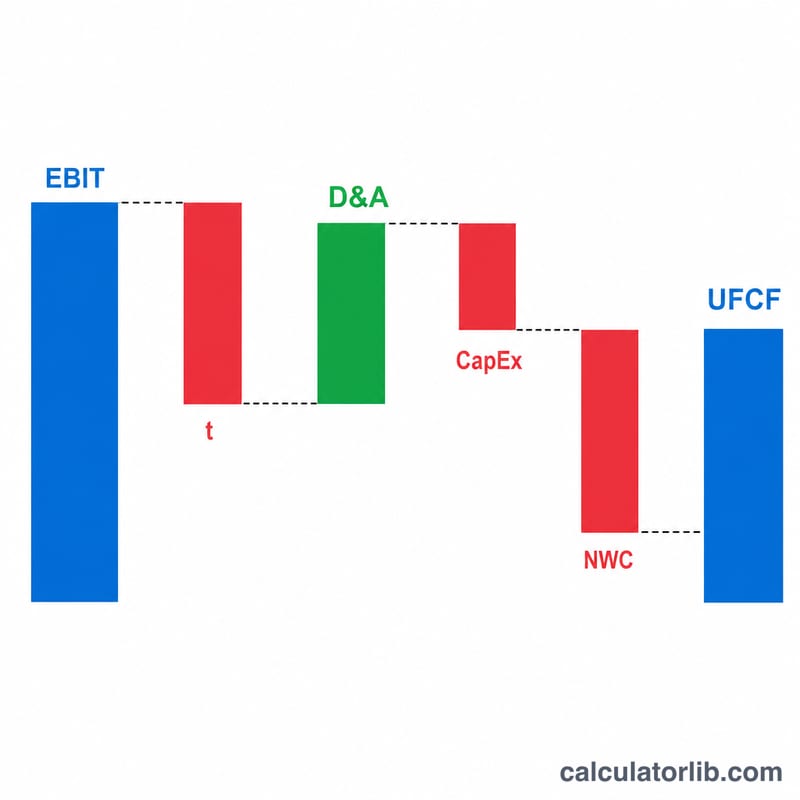
$$\text{UFCF} = \text{EBIT}\left(1 - \frac{\text{Tax Rate}}{100}\right) + \text{D\&A} - \text{CapEx} - \text{ΔNWC}$$First, EBIT is taxed to get NOPAT. We add back D&A because it is a non-cash expense. We subtract CapEx because it is a real cash outflow for long-term assets, and we subtract the increase in working capital because money tied up in receivables and inventory is cash not available to investors.
Worked Example
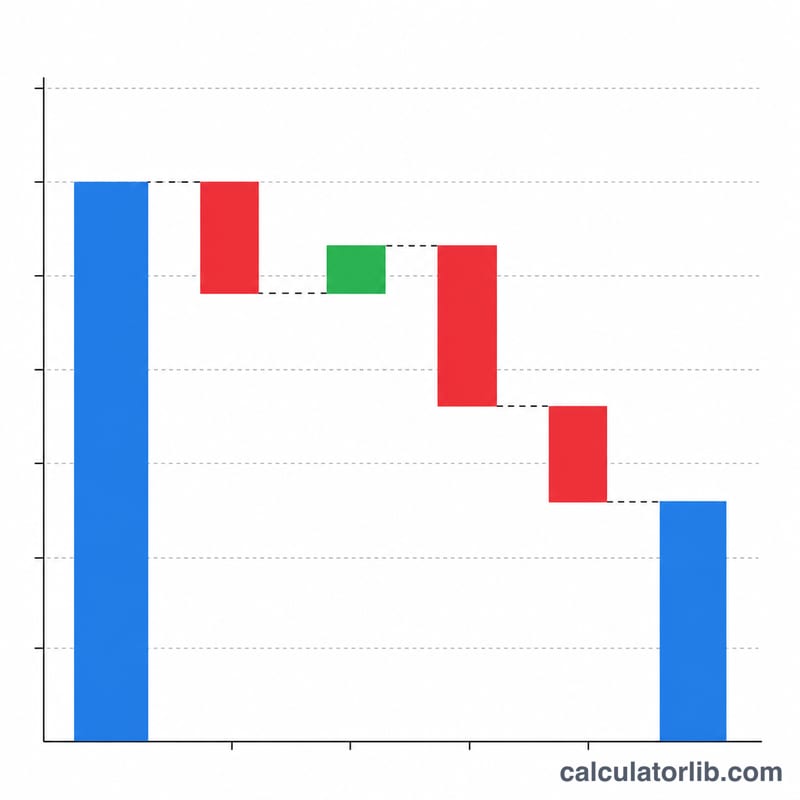
Suppose EBIT is 500,000, the tax rate is 21%, D&A is 80,000, CapEx is 120,000, and the change in working capital is 30,000. \(\text{NOPAT} = 500{,}000 \times (1 - 0.21) = 395{,}000\). Then $$\text{UFCF} = 395{,}000 + 80{,}000 - 120{,}000 - 30{,}000 = \mathbf{325{,}000}$$
FAQ
Why "unlevered"? Because interest expense and debt repayments are excluded, the figure is independent of how the firm is financed.
What if working capital decreases? Enter a negative value — a fall in working capital releases cash and increases UFCF.
Should I use marginal or effective tax rate? Most analysts use the company's effective or marginal tax rate; use the rate that best reflects future expected taxes.