

What Is the Cobb-Douglas Production Function?
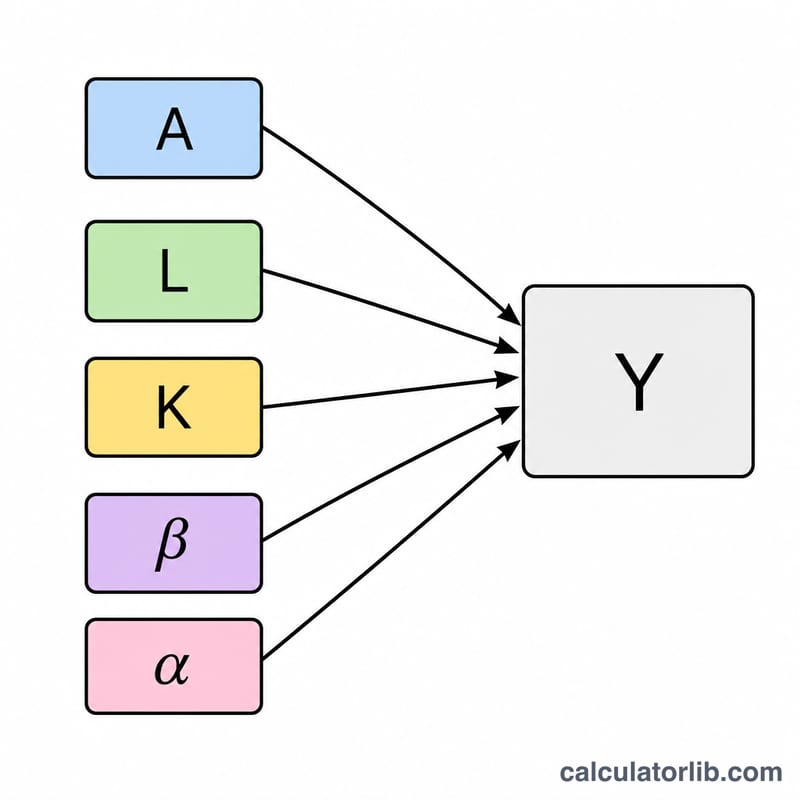
The Cobb-Douglas production function is a foundational model in economics that relates the output of a firm or economy to two key inputs: labor and capital. Developed by economists Charles Cobb and Paul Douglas in 1928, it expresses output as $$Y = \text{A} \cdot \text{L}^{\,\beta} \cdot \text{K}^{\,\alpha}$$ where A is total factor productivity (technology), L is labor, K is capital, \(\beta\) is the output elasticity of labor, and \(\alpha\) is the output elasticity of capital.
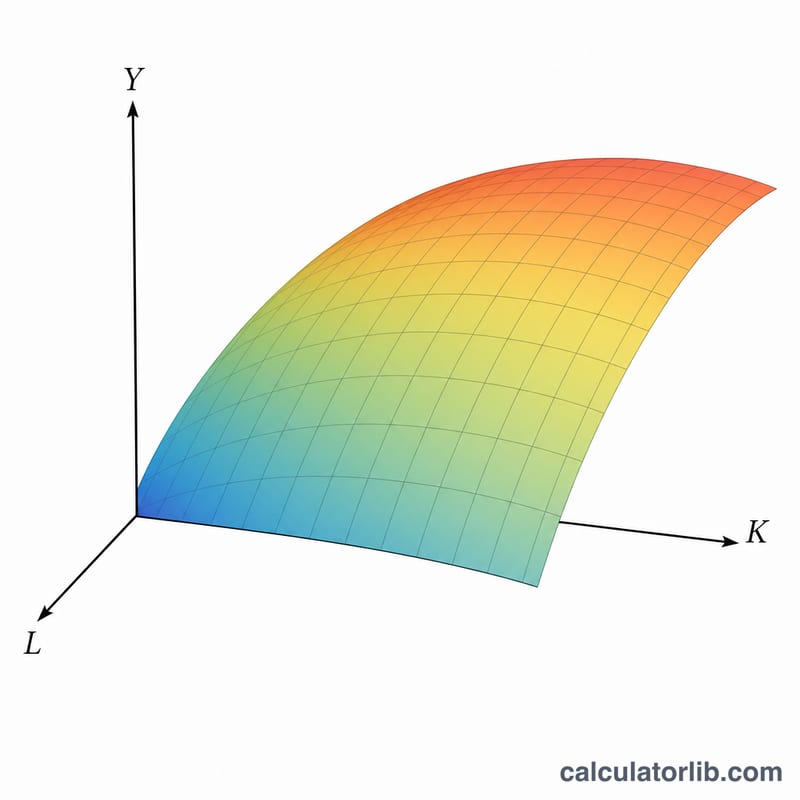
How to Use This Calculator
Enter total factor productivity (A), labor input (L), capital input (K), and the two elasticity exponents (\(\beta\) for labor, \(\alpha\) for capital). The calculator raises labor and capital to their respective exponents, multiplies them together with A, and returns total output Y. It also reports the labor and capital terms and the returns to scale (\(\alpha + \beta\)).
The Formula Explained
Each input's exponent measures how responsive output is to a change in that input. If \(\alpha + \beta = 1\), the function exhibits constant returns to scale — doubling both inputs doubles output. If the sum exceeds 1 you have increasing returns; below 1, decreasing returns. Total factor productivity A scales the entire function, capturing technology and efficiency gains.
Worked Example
Suppose A = 1, L = 100, K = 50, \(\beta = 0.7\), and \(\alpha = 0.3\) (constant returns to scale). Then \(\text{L}^{0.7} = 25.1189\) and \(\text{K}^{0.3} = 3.2336\). Output $$Y = 1 \times 25.1189 \times 3.2336 \approx 81.23 \text{ units}$$
FAQ
What does total factor productivity (A) represent? It captures everything affecting output besides labor and capital — technology, management, and efficiency.
Must \(\alpha\) and \(\beta\) sum to 1? No. They sum to 1 only under constant returns to scale. You can enter any positive values to model increasing or decreasing returns.
Can I use this for a national economy? Yes. The same form is widely used in macroeconomics with aggregate labor and capital stocks.