
What is the Price Elasticity of Supply?
The price elasticity of supply (PES) measures how responsive the quantity that producers are willing to supply is to a change in the market price. A high PES means suppliers can quickly ramp output up or down; a low PES means supply is rigid (for example because of capacity limits or long production lead times). This calculator is universal — it is pure microeconomics and applies in any country or market.
How to use this calculator
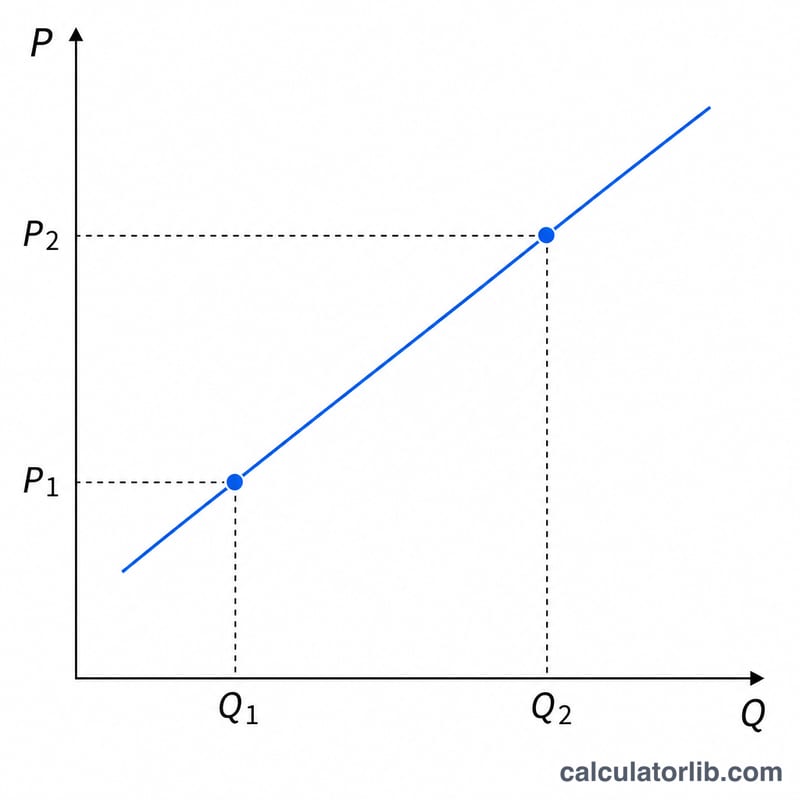
Enter the original quantity supplied (Q1) and the new quantity supplied (Q2), then the original price (P1) and the new price (P2). The tool returns the elasticity coefficient, the percentage change in quantity and price, and a classification of the result.
The formula explained
This calculator uses the midpoint (arc) method, which divides each change by the average of the two values rather than the starting value. This makes the elasticity symmetric — you get the same number whether price rises or falls. The percentage change in quantity supplied is divided by the percentage change in price:
$$\text{PES} = \dfrac{(\text{Q2} - \text{Q1}) / \frac{\text{Q1} + \text{Q2}}{2}}{(\text{P2} - \text{P1}) / \frac{\text{P1} + \text{P2}}{2}}$$
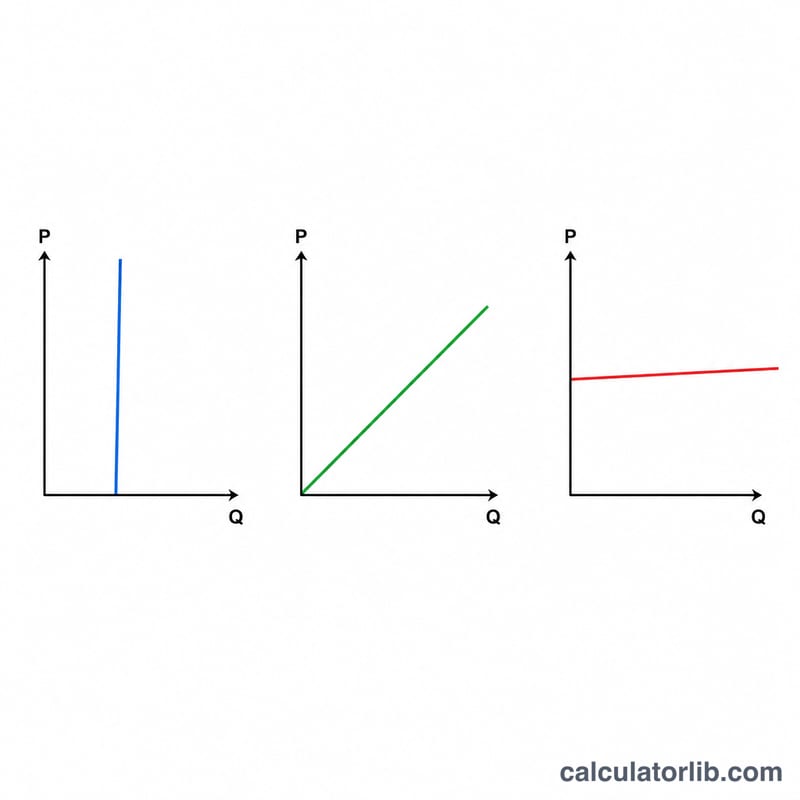
Because the law of supply is upward-sloping, PES is normally positive. PES \(< 1\) is inelastic, PES \(= 1\) is unit elastic, and PES \(> 1\) is elastic.
Worked example
A bakery sells 100 loaves at $10. When the price rises to $12, it supplies 120 loaves. The percentage change in quantity is \((120-100)/110 = 18.18\%\), and the percentage change in price is \((12-10)/11 = 18.18\%\). $$\text{PES} = 18.18\% \div 18.18\% = 1.0$$ — unit elastic.
FAQ
Why use the midpoint method? It avoids the inconsistency of getting different elasticities depending on which point you start from.
Can PES be negative? For normal goods supply slopes upward so PES is positive. A negative value usually means quantity and price moved in opposite directions.
What does perfectly inelastic mean? A PES of 0 means quantity supplied does not change at all when price changes — common with fixed-supply items like land or sold-out concert tickets.