
What Is the Spending Multiplier?
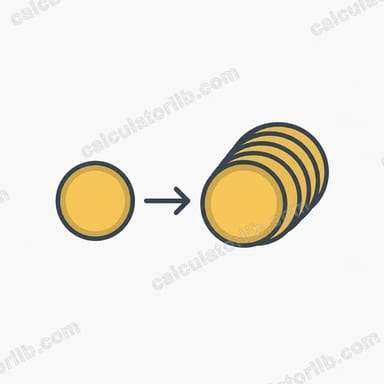
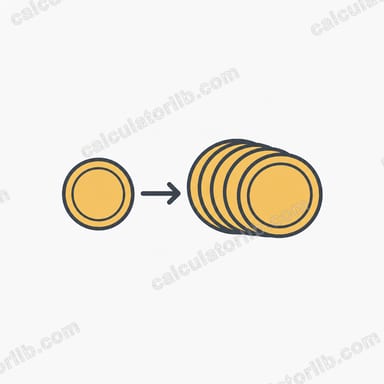
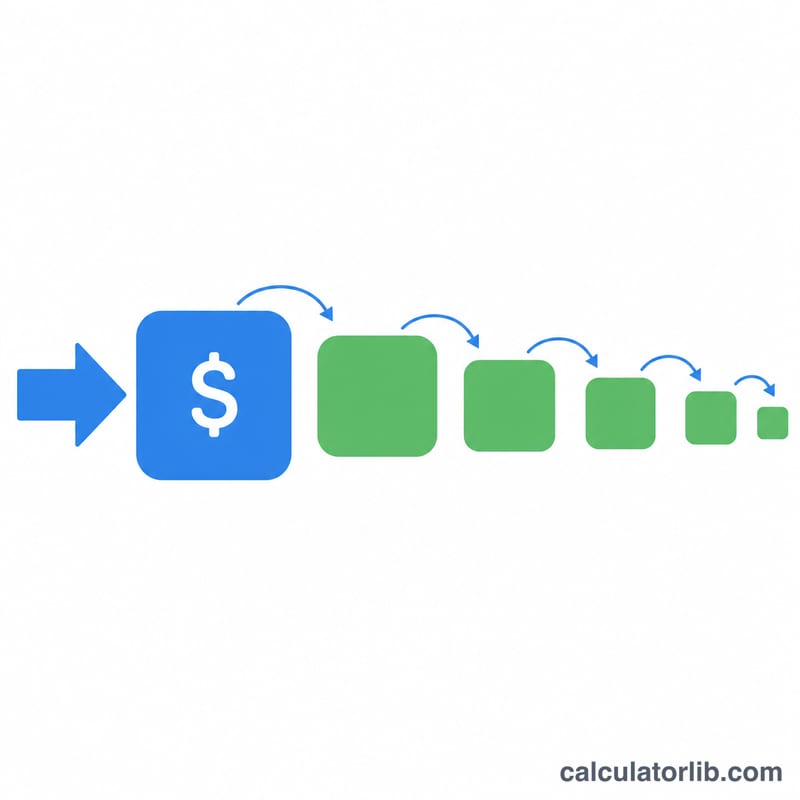
The spending multiplier (also called the Keynesian or fiscal multiplier) measures how much total economic output changes in response to an initial change in spending. When a household, business, or government spends an extra dollar, that dollar becomes income for someone else, who in turn spends a portion of it — creating a ripple effect through the economy. The multiplier captures the cumulative size of that ripple.
How to Use This Calculator
Enter the Marginal Propensity to Consume (MPC) — the fraction of each extra dollar of income that gets spent rather than saved (a value between 0 and 1). Then enter the change in spending (the initial injection). The calculator returns the multiplier, the implied marginal propensity to save (MPS), and the estimated total change in GDP.
The Formula Explained
The multiplier is \(k = \dfrac{1}{1 - \text{MPC}}\). Because \(\text{MPC} + \text{MPS} = 1\), this is equivalently \(k = \dfrac{1}{\text{MPS}}\). A higher MPC means more of each dollar is re-spent, so the multiplier is larger. The total impact on output is then
$$\Delta \text{GDP} = k \times \text{Change in Spending}$$where
$$k = \frac{1}{1 - \text{MPC}}, \qquad \text{MPS} = 1 - \text{MPC}$$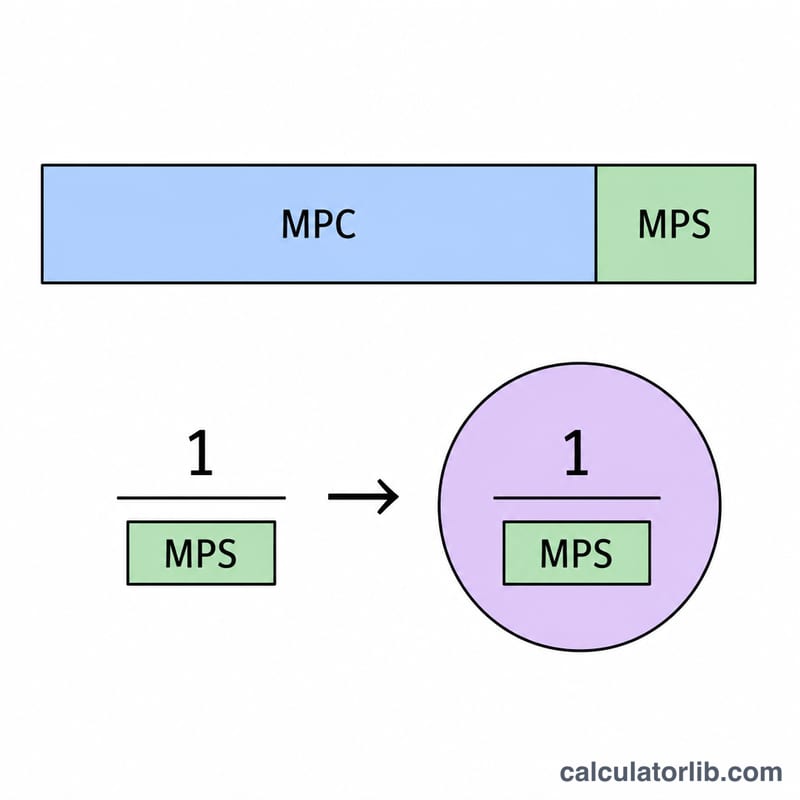
Worked Example
Suppose the MPC is 0.8 and the government increases spending by $1,000,000. The MPS is \(1 - 0.8 = 0.2\), so the multiplier is \(\dfrac{1}{0.2} = 5\). The total change in GDP is
$$\Delta \text{GDP} = 5 \times \$1{,}000{,}000 = \$5{,}000{,}000$$The original injection grows fivefold as it circulates through the economy.
FAQ
Does a higher MPC give a bigger multiplier? Yes. The closer the MPC is to 1, the more income is re-spent at each round, producing a larger multiplier.
What if MPC equals 1? The formula would divide by zero, implying an infinite multiplier — unrealistic, so this tool caps MPC just below 1.
Is this a real-world prediction? It's a simplified model. Real multipliers are affected by taxes, imports, interest rates, and capacity constraints, which can shrink the effect.