

What Is the Multiplier Effect?
The multiplier effect is a core idea in Keynesian macroeconomics. It describes how an initial change in autonomous spending — such as new investment or government spending — sets off a chain of further spending that ultimately changes national income by a larger amount than the original injection. This calculator works for any economy; the income-expenditure model is universal and not tied to any single country.
How to Use This Calculator
Enter the Initial Investment / Spending Change (the autonomous amount injected into the economy, often written as \(\Delta I\) or \(\Delta G\)) and the Marginal Propensity to Consume (MPC) — the fraction of each extra unit of income that households spend. The tool returns the multiplier coefficient and the total resulting change in national income.
The Formula Explained
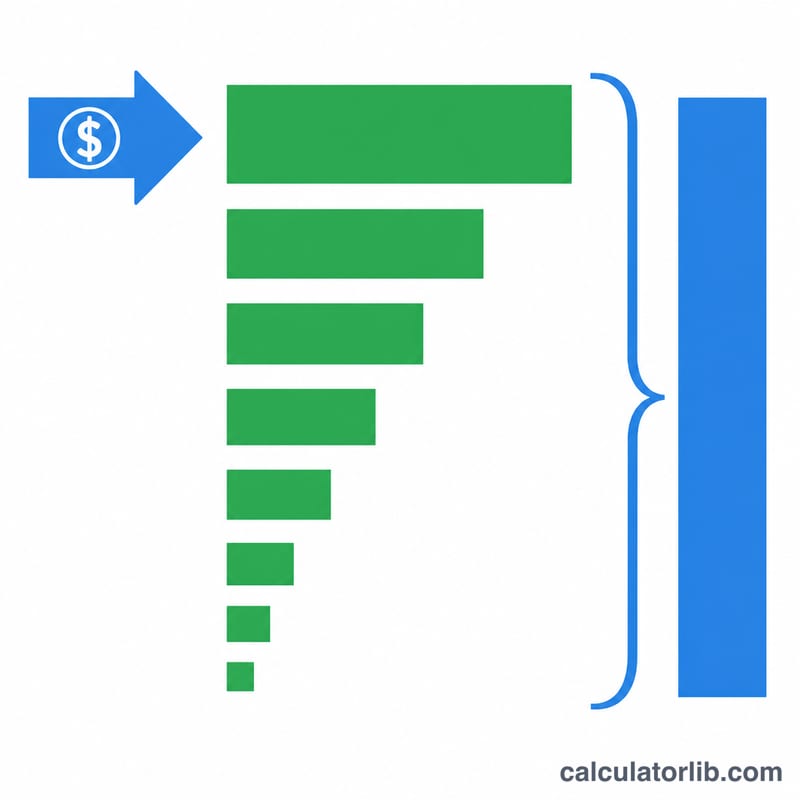
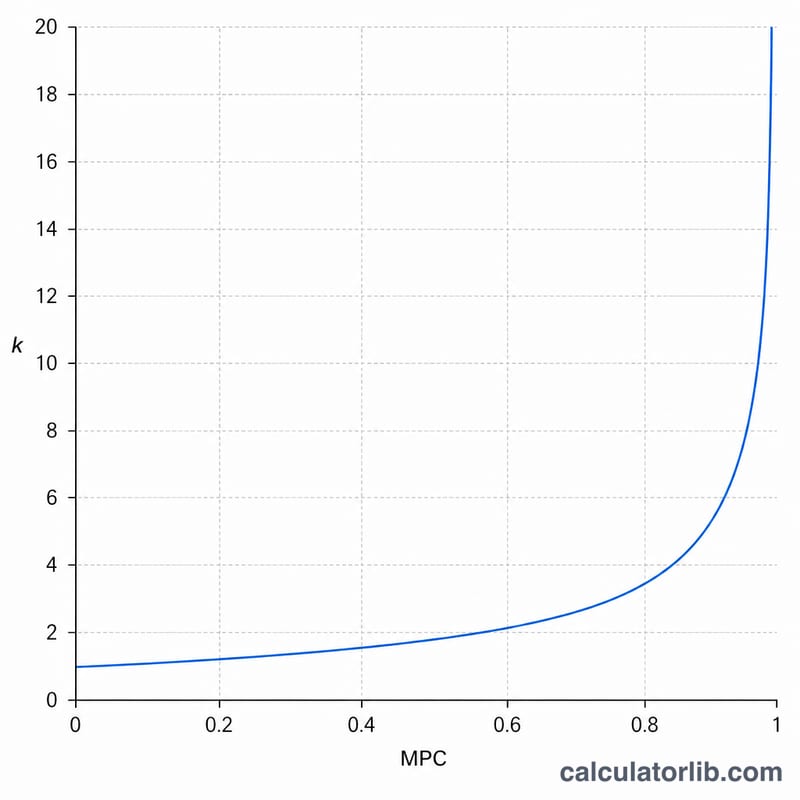
The multiplier is $$k = \frac{1}{1 - \text{MPC}}$$ Because households re-spend a fraction \(\text{MPC}\) of every new income, the initial injection \(\Delta I\) generates $$\Delta I + \text{MPC} \cdot \Delta I + \text{MPC}^2 \cdot \Delta I + \ldots$$ This geometric series sums to $$\Delta I \times \frac{1}{1 - \text{MPC}}$$ when \(0 \le \text{MPC} < 1\). Equivalently, \(k = \frac{1}{\text{MPS}}\), where \(\text{MPS} = 1 - \text{MPC}\) is the marginal propensity to save.
Worked Example
Suppose a government injects 100 units of spending and the MPC is 0.8. Then $$k = \frac{1}{1 - 0.8} = \frac{1}{0.2} = 5$$ The total change in national income is $$100 \times 5 = 500 \text{ units}$$ So a 100-unit injection ultimately raises national income by 500 units — five times the original amount.
FAQ
What happens if MPC equals 1? The denominator \((1 - \text{MPC})\) becomes zero, so the multiplier is mathematically undefined and diverges to infinity. The MPC must satisfy \(0 \le \text{MPC} < 1\).
Can the spending change be negative? Yes. A negative value represents a spending cut and produces a proportionally negative change in national income.
Why is a higher MPC associated with a bigger multiplier? The more of each new income that gets re-spent rather than saved, the longer the chain of induced spending, so the cumulative effect on income is larger.