

What Is the Deposit Multiplier?
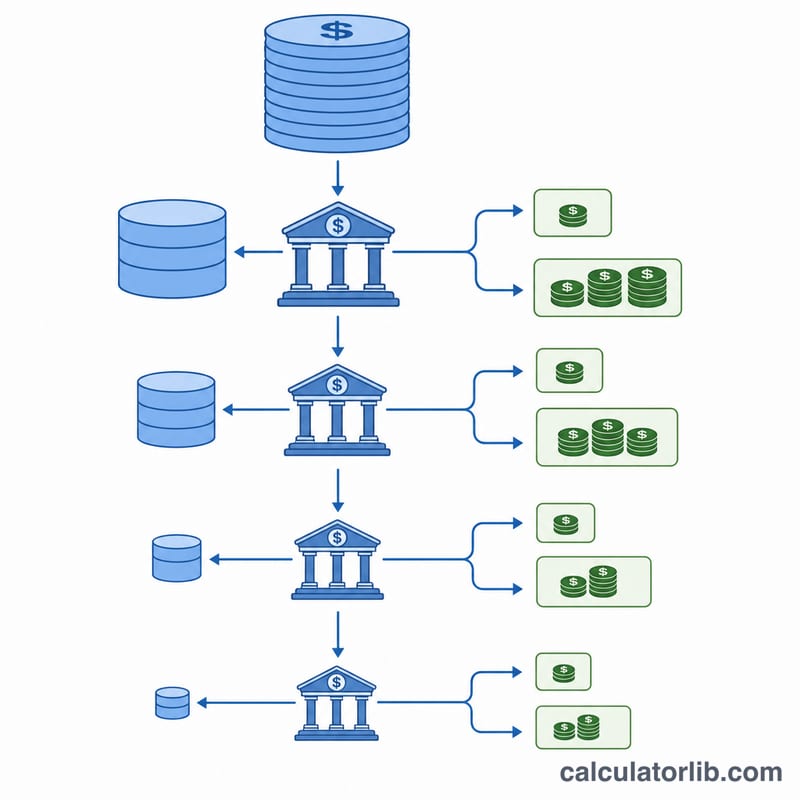
The deposit multiplier (also called the money multiplier or simple deposit multiplier) measures the maximum amount the money supply can expand for each dollar of reserves held by the banking system. When banks are required to keep only a fraction of deposits as reserves, the remainder can be lent out, redeposited, and lent again — a chain that multiplies the original deposit throughout the economy.
How to Use This Calculator
Enter the initial deposit and the reserve ratio (the percentage of deposits banks must hold in reserve). The calculator returns the deposit multiplier, the total potential money supply, and the new money created beyond the original deposit.
The Formula Explained
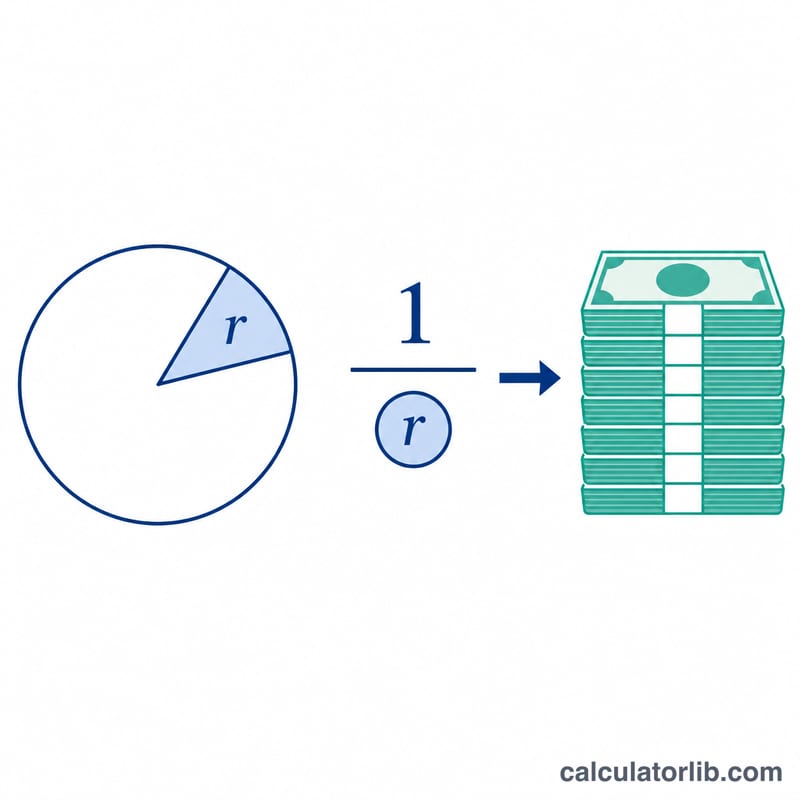
The multiplier is simply the reciprocal of the reserve ratio: \(m = 1 / r\), where \(r\) is expressed as a decimal. The total money the system can create is:
$$\text{Total Money} = \text{Deposit} \times \frac{1}{\dfrac{\text{Reserve Ratio (\%)}}{100}}$$The "new" money created is the total minus the original deposit.
Worked Example
Suppose a customer deposits $1,000 and the reserve ratio is 10% (\(r = 0.10\)). The multiplier is \(1 / 0.10 = 10\). The total money supply that can be created is:
$$\$1{,}000 / 0.10 = \$10{,}000$$of which $9,000 is newly created credit money.
FAQ
Is this the real amount of money banks create? No — this is the theoretical maximum. In practice leakages such as cash holdings and excess reserves reduce the actual multiplier.
What if the reserve ratio is 100%? The multiplier becomes 1, meaning no additional money is created — banks must hold every dollar deposited.
Does a lower reserve ratio create more money? Yes. The lower the reserve ratio, the larger the multiplier and the greater the potential money expansion.