

What Is the Money Multiplier?
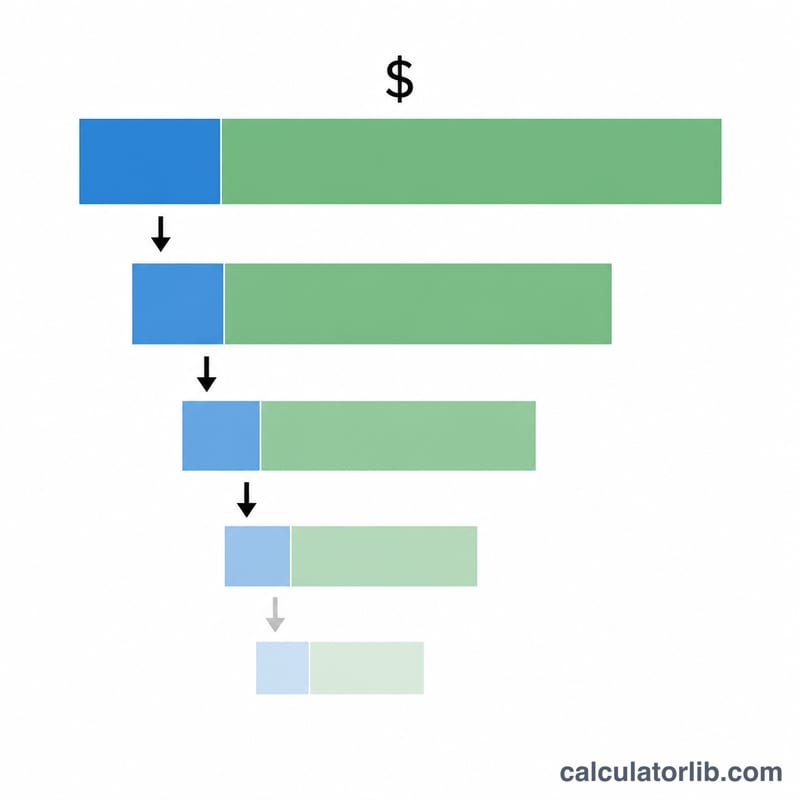
The money multiplier measures how much the money supply can expand for each unit of new reserves injected into a fractional-reserve banking system. When banks are only required to hold a fraction of deposits as reserves, the remainder is lent out, re-deposited, and lent again — multiplying the original deposit through the economy. The multiplier is the theoretical maximum of this expansion.
How to Use This Calculator
Enter the reserve requirement ratio as a percentage (for example, 10 for a 10% requirement). Optionally enter an initial deposit to see how much total money the banking system could create from it. The calculator returns the multiplier plus the resulting total money supply and the new money created beyond the original deposit.
The Formula Explained
The money multiplier equals 1 divided by the reserve requirement ratio expressed as a decimal: \(m = 1 / rr\). A 10% reserve ratio (\(rr = 0.10\)) gives a multiplier of 10, meaning $1 of reserves can support up to $10 of deposits. The total money created from a deposit \(D\) is \(M = D \times m\), and new money created is \(M - D\).
Worked Example
Suppose the reserve requirement ratio is 10% and a customer deposits $1,000. The multiplier is $$\frac{1}{0.10} = 10.$$ The total money supply created is $$\$1{,}000 \times 10 = \$10{,}000,$$ of which $9,000 is new money created by repeated lending across the banking system.
FAQ
Is the multiplier always achieved in practice? No. It is a theoretical maximum. Real-world expansion is limited by excess reserves banks hold and by cash that the public keeps out of the banking system.
What if the reserve ratio is 0%? Mathematically the multiplier becomes undefined (infinite), so the calculator requires a ratio greater than 0.
Does a lower reserve ratio increase the multiplier? Yes. A smaller required reserve fraction allows banks to lend more, raising the multiplier and the money supply expansion.