
What is the Priming Sugar Calculator?
When homebrewers bottle their beer, they add a small, precise amount of fermentable sugar so the remaining yeast produce CO₂ inside the sealed bottle — a process called bottle conditioning. This calculator tells you exactly how many grams of corn sugar (dextrose) to add to reach your desired carbonation level without over-pressurizing the bottles.
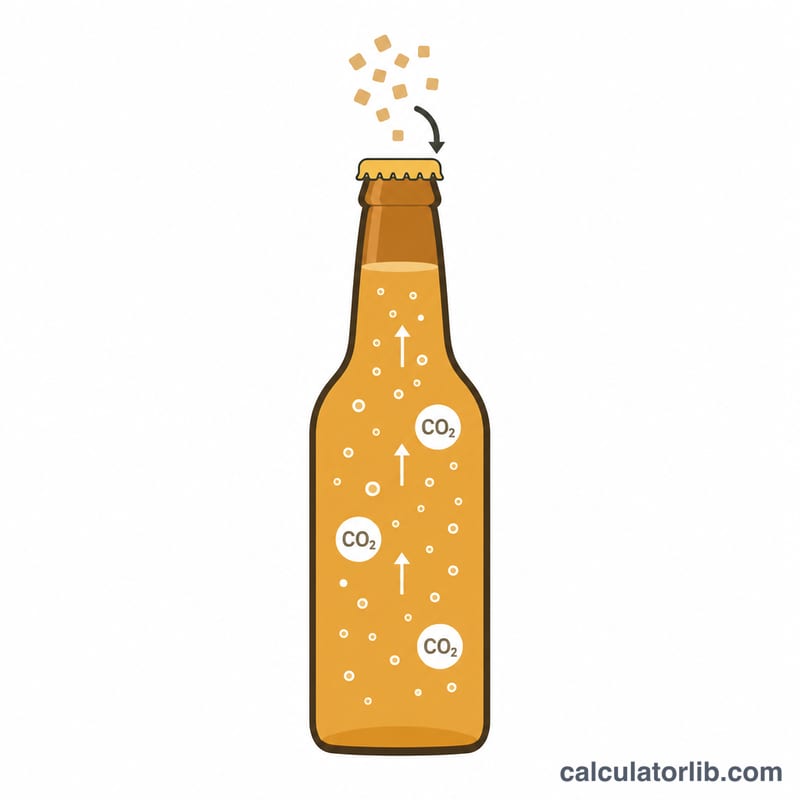
How to use it
Enter three values: the total volume of beer you are bottling (in liters), your target carbonation in CO₂ volumes (typical ales 2.0–2.6, wheat beers and Belgians 3.0–4.5), and the temperature of the beer — use the warmest temperature the beer reached after fermentation, since that determines how much CO₂ is already dissolved. The result is the total grams of dextrose to dissolve in boiled water and mix into the batch before bottling.
The formula explained
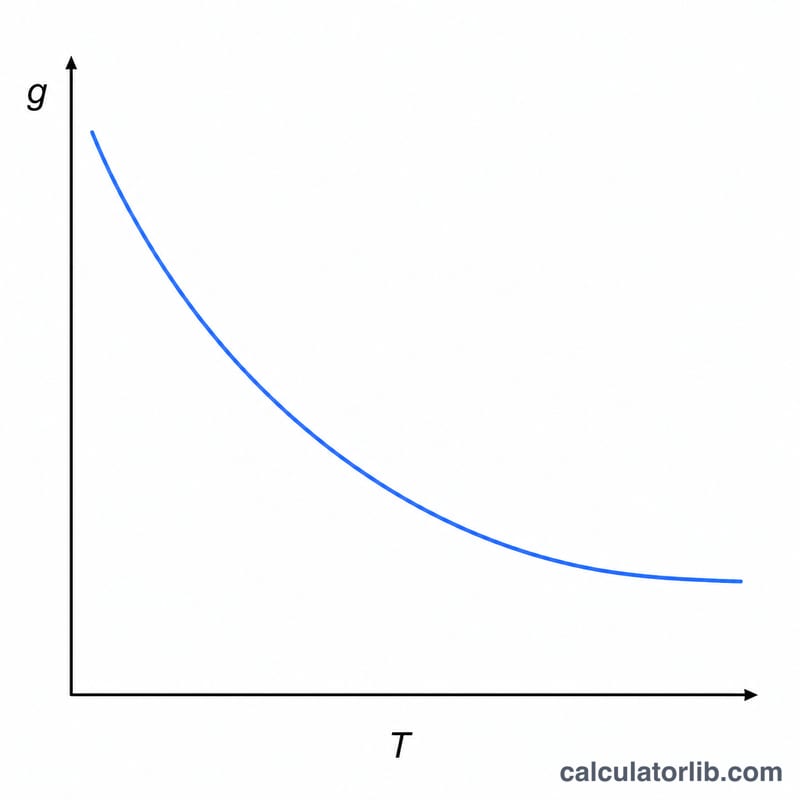
The calculation accounts for residual CO₂ that is already present in the beer. The term \( 3.0378 - 0.050062 \cdot T + 0.00026555 \cdot T^{2} \) estimates dissolved CO₂ in volumes at temperature \( T \) (°C). The difference between your target and that residual amount is multiplied by 15.195 (a constant derived from the molar relationship for sucrose-equivalent dextrose) and the volume in liters to give grams of sugar. The full formula is:
$$ \text{Sugar (g)} = 15.195 \cdot \text{Volume} \cdot \left( \text{Target CO}_2 - C_{r} \right) $$
$$ \text{where}\quad \left\{ \begin{aligned} C_{r} &= 3.0378 - 0.050062\,T + 0.00026555\,T^{2} \\ T &= \text{Temperature (}^{\circ}\text{C)} \end{aligned} \right. $$
Worked example
For 20 L of beer, a target of 2.4 volumes, and a beer temperature of 20 °C: residual CO₂ = \( 3.0378 - 0.050062 \times 20 + 0.00026555 \times 400 \approx 2.1437 \). Then sugar:
$$ \text{Sugar} = 15.195 \times 20 \times (2.4 - 2.1437) \approx \mathbf{78.07}\ \textbf{g} $$
of corn sugar.
FAQ
Can I use table sugar instead? Yes, but sucrose is slightly more fermentable than dextrose; use about 91% of the dextrose figure.
Why does temperature matter? Warmer beer holds less dissolved CO₂, so it needs more priming sugar to reach the same carbonation.
What if I get a value of zero? That means your beer already contains more CO₂ than your target at the given temperature, so no priming sugar is needed.