

What is the CFU/mL Calculator?
A colony-forming unit (CFU) is a single viable microbial cell or cluster of cells that grows into a visible colony on an agar plate. The CFU/mL calculator converts the number of colonies you counted on a plate into the concentration of viable organisms in your original sample, expressed as colony-forming units per milliliter. It is a core tool in microbiology, food safety, water testing and clinical labs.
How to use it
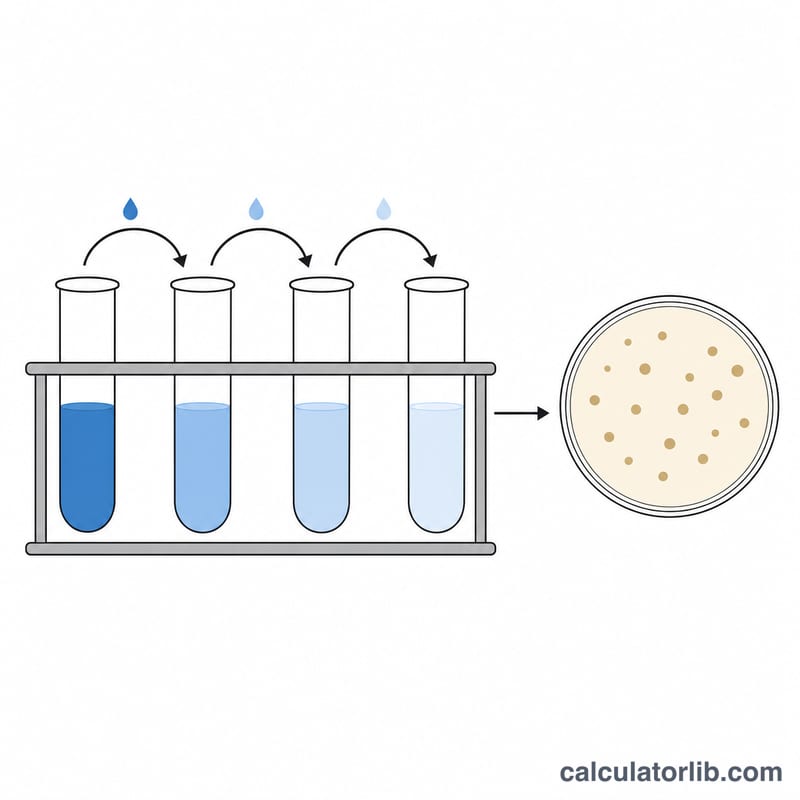
Enter three values: the number of colonies counted on a countable plate (ideally between 30 and 300), the dilution factor (the reciprocal of the dilution plated — for example 1,000,000 for a 10⁻⁶ dilution), and the volume of diluted sample you spread on the plate in milliliters (commonly 0.1 mL or 1.0 mL). The calculator returns the CFU/mL of the original undiluted sample.
The formula explained
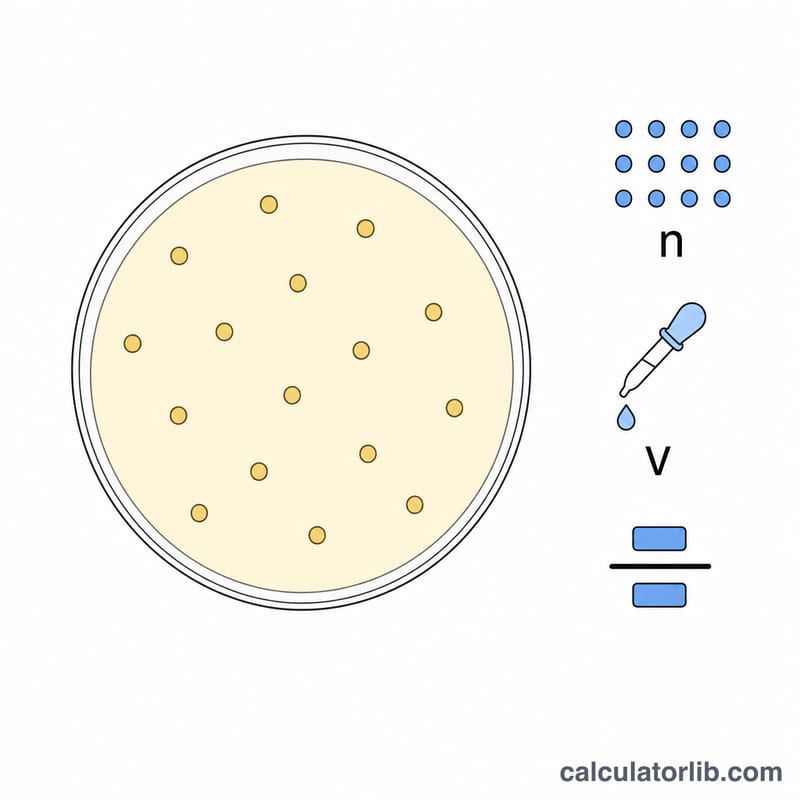
The standard plate-count equation is $$\text{CFU/mL} = \frac{\text{Colonies} \times \text{Dilution Factor}}{\text{Volume (mL)}}$$ Multiplying by the dilution factor reverses the serial dilution to recover the original concentration, while dividing by the volume plated scales the count to a per-milliliter basis. Always count plates in the 30–300 colony range for statistical reliability.
Worked example
Suppose you counted 150 colonies from a 10⁻⁶ dilution (dilution factor = 1,000,000) and plated 0.1 mL. Then $$\text{CFU/mL} = \frac{150 \times 1{,}000{,}000}{0.1} = 1{,}500{,}000{,}000$$ or \(1.5 \times 10^9\) CFU/mL.
FAQ
What dilution factor should I enter? Use the reciprocal of the dilution. A 10⁻⁶ dilution means you enter 1,000,000.
Why count 30–300 colonies? Below 30 the count is statistically unreliable; above 300 colonies overlap and become hard to distinguish, so the count is inaccurate.
Can I use 1 mL volume? Yes. For pour plates 1.0 mL is common; for spread plates 0.1 mL is typical. Just enter the actual volume plated.