
What This Calculator Does
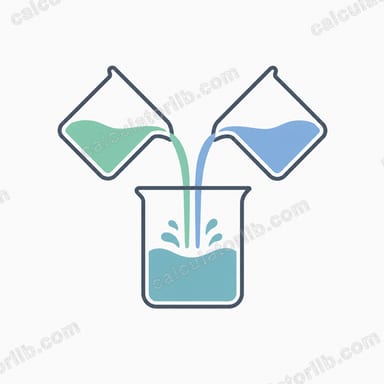
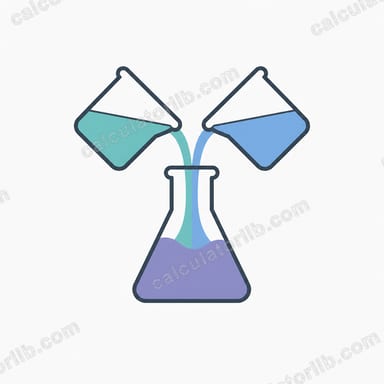
When you combine two solutions of different concentrations, the resulting mixture has a concentration somewhere between the two originals. This calculator computes that final concentration using a volume-weighted average. It works with any consistent units — molarity (M), percent (%), mg/mL, ppm — as long as both concentrations use the same unit and both volumes use the same unit.
How to Use It
Enter the concentration and volume of the first solution (C₁ and V₁) and the second solution (C₂ and V₂). The calculator returns the final concentration of the combined mixture and the total volume. To model simple dilution with pure solvent (such as water), set the second concentration C₂ to 0.
The Formula Explained
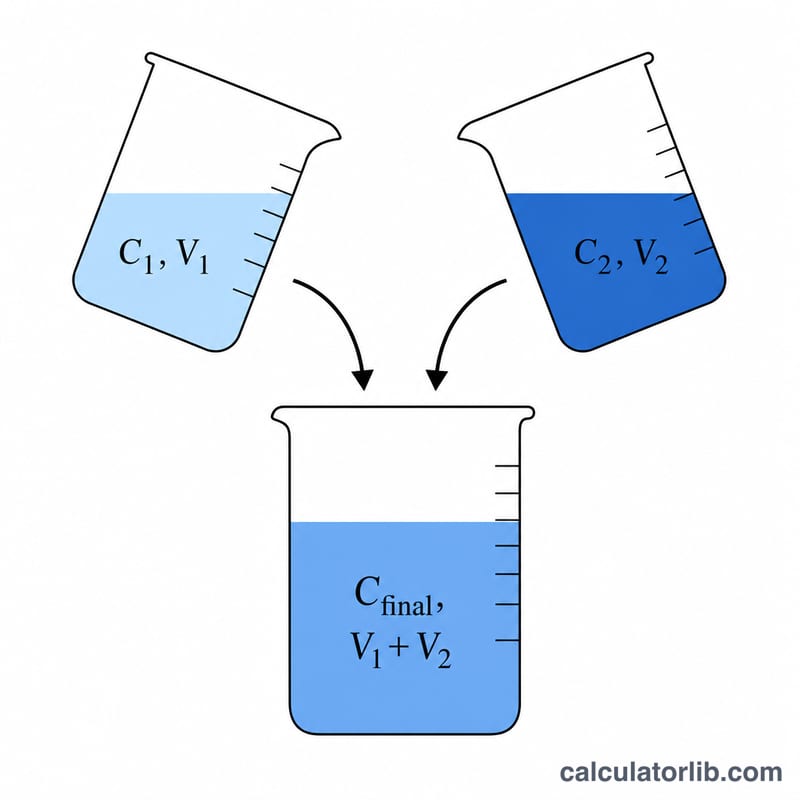
The total amount of solute is conserved when you mix two solutions. The amount in each is concentration × volume, so the combined solute is \(\text{C}_1 \cdot \text{V}_1 + \text{C}_2 \cdot \text{V}_2\). Dividing this total solute by the total volume \((\text{V}_1 + \text{V}_2)\) gives the new concentration:
$$C_{f} = \frac{\text{C}_1 \cdot \text{V}_1 + \text{C}_2 \cdot \text{V}_2}{\text{V}_1 + \text{V}_2}$$
This is a weighted average, where each concentration is weighted by its volume contribution. The result always lies between the smaller and larger of the two input concentrations.
Worked Example
Suppose you mix 100 mL of a 10 M solution with 100 mL of pure water (0 M). The total solute is \((10 \times 100) + (0 \times 100) = 1000\). The total volume is 200 mL. So $$C_{f} = \frac{1000}{200} = 5 \text{ M}.$$ Mixing equal volumes of a 10 M solution and water halves the concentration to 5 M — exactly as expected.
FAQ
Do the units have to match? Yes. Both concentrations must share one unit and both volumes must share one unit. The result is in the same concentration unit.
Can I use it for simple dilution? Yes — set C₂ = 0 to dilute with pure solvent, or set C₂ to your diluent's concentration.
Does it assume volumes are additive? Yes. It assumes the volumes simply add \((\text{V}_1 + \text{V}_2)\). For solutions where volume contraction occurs on mixing, the result is an approximation.