

What This Calculator Does
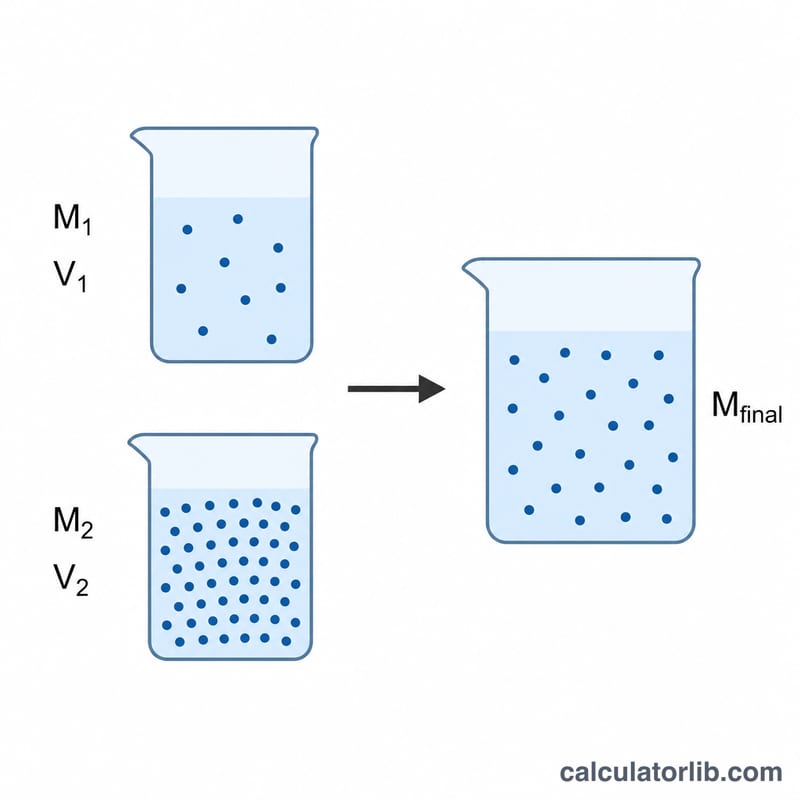
When you combine two solutions that contain the same solute, the resulting concentration lies somewhere between the two starting concentrations. This calculator finds that final molarity using a simple conservation-of-moles approach. Just enter the molarity and volume of each solution, and it returns the molarity of the combined mixture along with the total moles of solute and total volume.
The Formula Explained
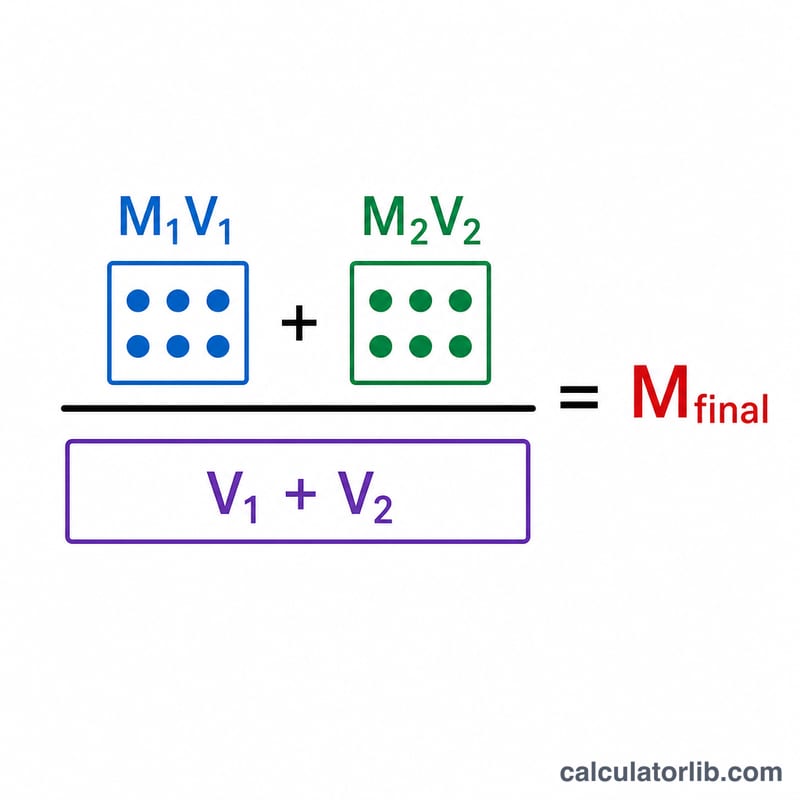
Molarity (M) is moles of solute per liter of solution. The number of moles in any solution is concentration times volume, \(n = M \times V\). When two solutions of the same solute are mixed, the moles simply add together and the volumes add together (assuming volumes are additive, which is a good approximation for dilute aqueous solutions):
$$M_{\text{final}} = \frac{M_1 V_1 + M_2 V_2}{V_1 + V_2}$$
The numerator is the total moles of solute; the denominator is the total volume. Use consistent volume units for both solutions — liters or milliliters both work as long as you stay consistent, because the units cancel in the ratio.
Worked Example
Suppose you mix 0.5 L of 1.0 M NaCl with 0.5 L of 2.0 M NaCl. The total moles are $$(1.0 \times 0.5) + (2.0 \times 0.5) = 0.5 + 1.0 = 1.5 \text{ mol}.$$ The total volume is \(0.5 + 0.5 = 1.0\) L. So $$M_{\text{final}} = \frac{1.5}{1.0} = 1.5 \text{ M}$$ — exactly the average, since the volumes are equal.
FAQ
Does this work for dilution with pure water? Yes. Set one solution to 0 M with the volume of water added, and the formula reduces to the standard dilution equation \(M_1 V_1 = M_2 V_2\).
Can I use milliliters instead of liters? Yes, as long as both volumes use the same unit. The final molarity is independent of which volume unit you choose because volume appears in both numerator and denominator.
Why must the solute be the same? The formula adds moles of a single species. If the solutes differ or react, the combined moles of any one species would not be the simple sum, so this calculator would not apply.