
What This Calculator Does
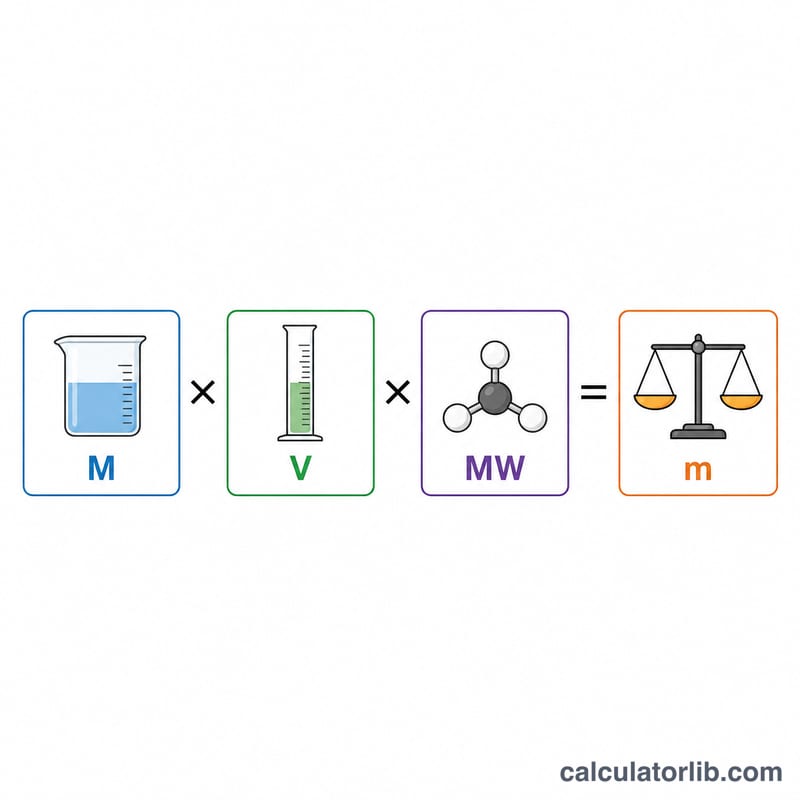
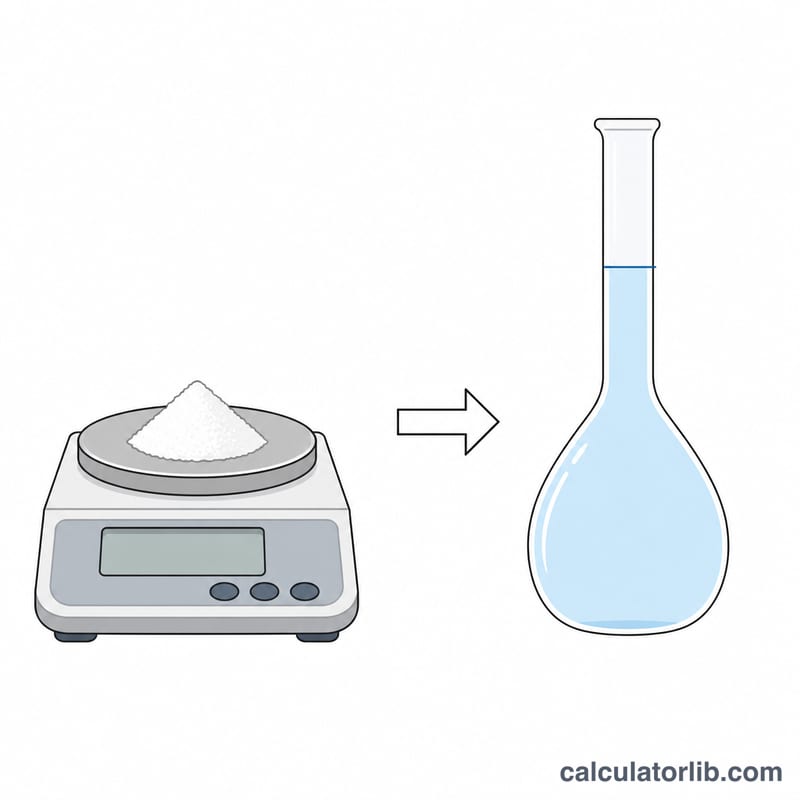
This tool tells you exactly how many grams of a solid (or other) solute you need to weigh out to prepare a solution of a target concentration. Given the desired molarity, the final volume, and the molar mass of the compound, it returns the required mass using the relation \(m = M \times V \times MW\). It is a universal chemistry calculation that applies anywhere.
How to Use It
Enter the target molarity in moles per liter (mol/L), the total solution volume in liters (L), and the molar mass of your compound in grams per mole (g/mol). The calculator multiplies these three values together to give the mass of solute in grams, and also shows the number of moles you are dissolving.
The Formula Explained
Molarity (M) is defined as moles of solute per liter of solution, so \(\text{moles} = M \times V\). Since the mass of a substance equals its number of moles multiplied by its molar mass (MW), combining the two gives $$m = M \times V \times MW.$$ Make sure your volume is in liters; if you have milliliters, divide by 1000 first.
Worked Example
To make 2 L of a 0.5 mol/L sodium chloride (NaCl, molar mass 58.44 g/mol) solution: $$m = 0.5 \times 2 \times 58.44 = 58.44 \text{ grams}.$$ So you would weigh out 58.44 g of NaCl and dissolve it to a final volume of 2 liters.
FAQ
What units should I use? Molarity in mol/L, volume in liters, and molar mass in g/mol. The result comes out in grams.
I have volume in milliliters - what do I do? Divide the milliliter value by 1000 to convert to liters before entering it.
Where do I find molar mass? Add up the atomic masses of all atoms in the formula from the periodic table, or look up the value for the compound directly.