
What Is Percent Error?
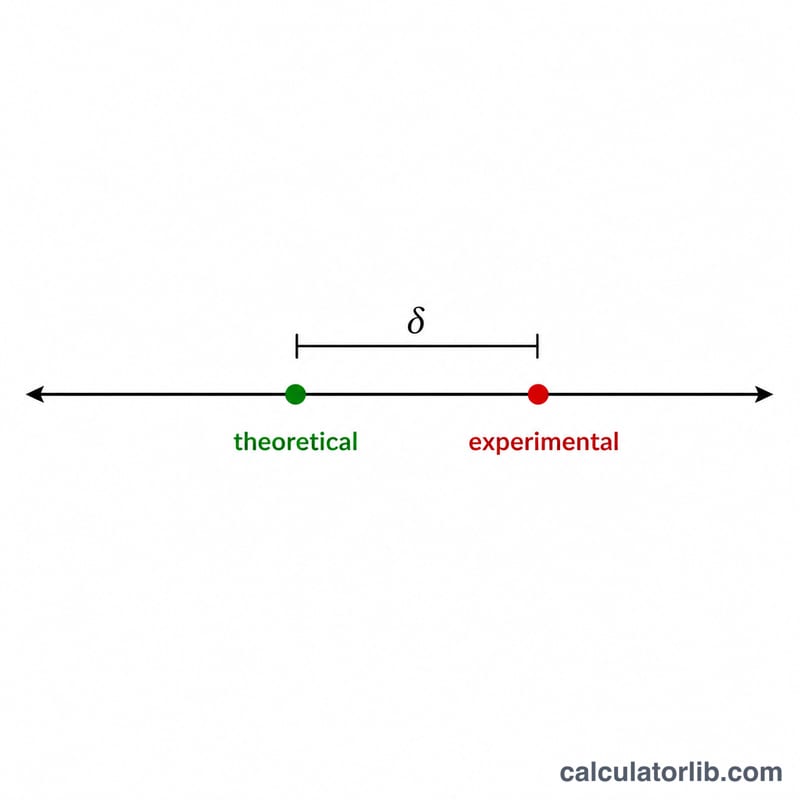
Percent error measures how close an experimental (measured) value is to a theoretical or accepted value. It is one of the most common accuracy metrics reported in chemistry and physics labs. A small percent error means your measurement is close to the true value; a large percent error signals systematic problems with technique, equipment, or calculation.
How to Use This Calculator
Enter the experimental value you obtained in the lab and the theoretical (accepted) value from a reference table or textbook. The calculator returns the percent error along with the absolute error. The result uses the absolute value of the difference, so percent error is always reported as a positive number.
The Formula Explained
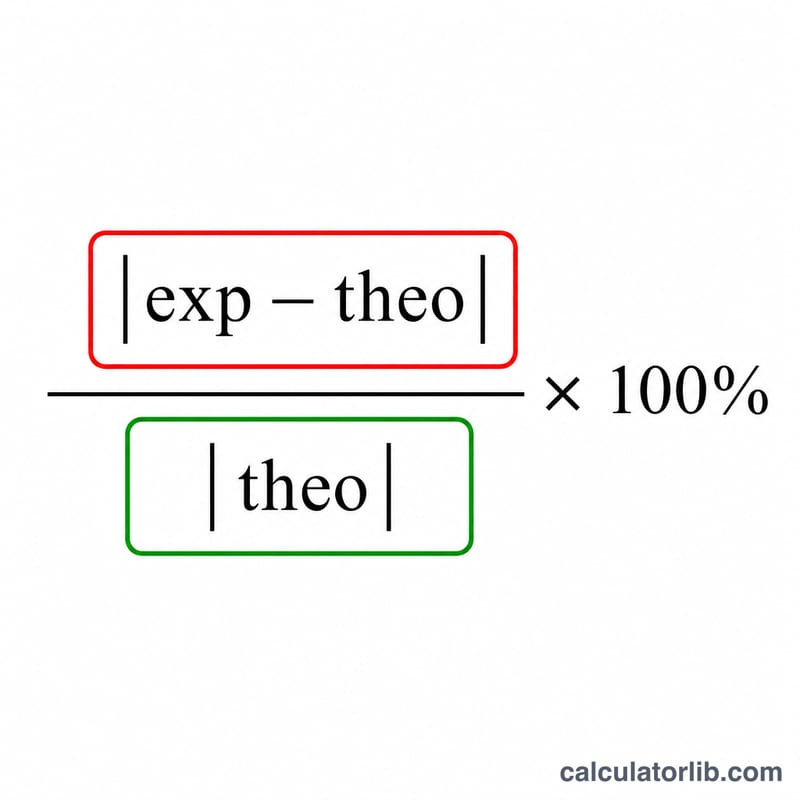
The percent error formula is:
$$\text{\% error} = \frac{\left|\text{experimental} - \text{theoretical}\right|}{\left|\text{theoretical}\right|} \times 100$$
The numerator \(\left|\text{experimental} - \text{theoretical}\right|\) is the absolute error — how far off you were in raw units. Dividing by the theoretical value scales that error relative to the size of the quantity, and multiplying by 100 converts it to a percentage.
Worked Example
Suppose you measured the density of aluminum as 2.55 g/cm³, while the accepted value is 2.70 g/cm³. The absolute error is \(\left|2.55 - 2.70\right| = 0.15\). Dividing by 2.70 gives 0.05556, and multiplying by 100 yields a percent error of about 5.56%. That is a reasonably accurate measurement for a student lab.
$$\frac{\left|2.55 - 2.70\right|}{\left|2.70\right|} \times 100 = \frac{0.15}{2.70} \times 100 \approx 5.56\%$$
FAQ
Can percent error be negative? No. Because we take the absolute value of the difference, percent error is always zero or positive. If you want to show direction (too high or too low), use percent difference or signed relative error instead.
What is a good percent error in chemistry? It depends on the experiment, but under 5% is generally considered good for introductory labs, and under 1% is excellent for precise quantitative work.
Why divide by the theoretical value and not the experimental? The theoretical value is the known, trusted reference, so it serves as the baseline for measuring how far your result strayed.