
What Is Percent Yield?
Percent yield is a measure of how efficient a chemical reaction is. It compares the amount of product you actually obtained (the actual yield) to the maximum amount predicted by stoichiometry (the theoretical yield). A percent yield of 100% means a perfect reaction with no losses, while lower values reflect side reactions, incomplete reactions, or losses during purification and handling.
How to Use This Calculator
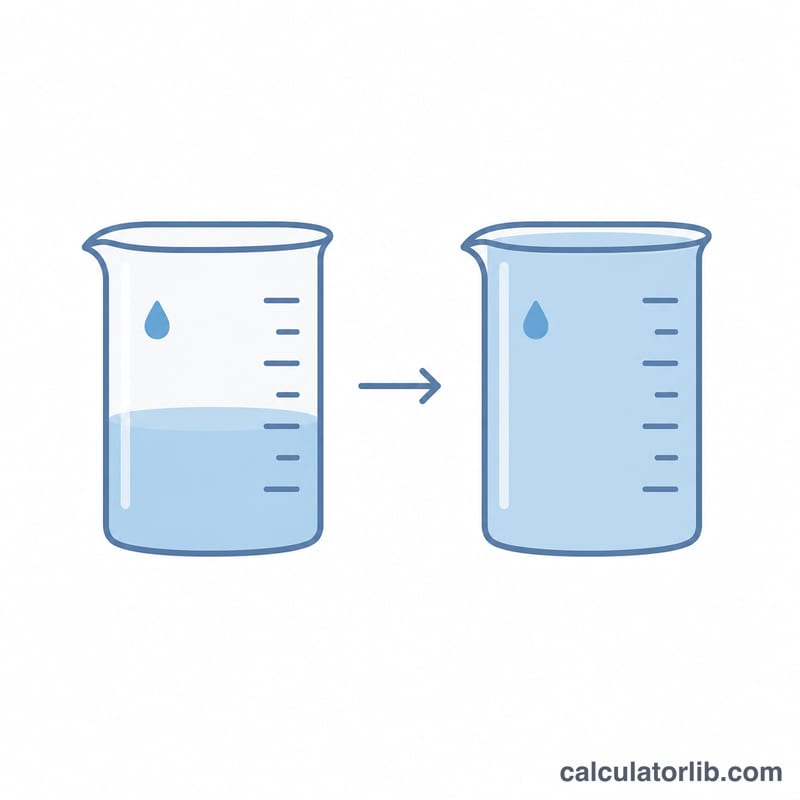
Enter the actual yield (the mass or moles of product you measured in the lab) and the theoretical yield (the amount calculated from the balanced equation). Both values must use the same units. The calculator divides actual by theoretical and multiplies by 100 to give the percent yield.
The Formula Explained
The equation is:
$$\text{Percent Yield} = \dfrac{\text{Actual Yield}}{\text{Theoretical Yield}} \times 100$$
The units (grams, moles, kilograms) cancel out as long as both numbers share the same unit, leaving a clean percentage. Always make sure the theoretical yield is calculated from the limiting reagent.
Worked Example
Suppose a reaction is expected to produce 10 grams of product (theoretical yield), but you only recover 8.5 grams (actual yield). The percent yield is $$\left(\dfrac{8.5}{10}\right) \times 100 = 85\%$$ . This is a strong yield for many organic reactions.
FAQ
Can percent yield be over 100%? In theory, no. A value above 100% usually means the product is impure, still contains solvent, or the measurement included extra mass.
Why is my percent yield low? Common causes include incomplete reactions, competing side reactions, transfer losses, and product remaining in solution.
What units should I use? Any unit works (grams, moles, etc.) as long as the actual and theoretical yields are in the same unit so they cancel.