
What Is Percent Yield?
Percent yield is a measure of the efficiency of a chemical reaction. It compares the amount of product you actually obtained (the actual yield) with the maximum amount that could theoretically form based on stoichiometry (the theoretical yield). It is expressed as a percentage, and a higher value means a more efficient, cleaner reaction with fewer losses.
How to Use This Calculator
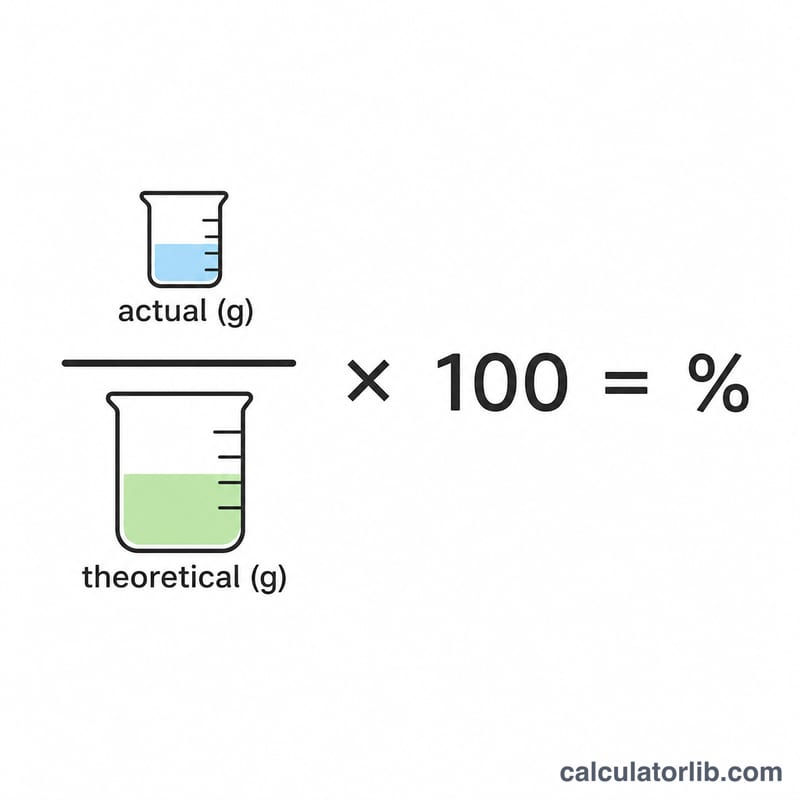
Enter the actual yield — the mass of product you measured in the lab — in grams. Then enter the theoretical yield — the mass predicted from your balanced equation and limiting reagent — in grams. The calculator divides actual by theoretical and multiplies by 100 to give your percent yield instantly.
The Formula Explained
The equation is straightforward:
$$\text{Percent Yield} = \frac{\text{Actual Yield (g)}}{\text{Theoretical Yield (g)}} \times 100\%$$
Both masses must be in the same units (grams here) so the units cancel, leaving a pure percentage. Because actual yield can never exceed the theoretical maximum in an ideal experiment, percent yield is normally between 0% and 100%. Values above 100% usually signal impurities, leftover solvent, or weighing errors.
Worked Example
Suppose a reaction predicts a theoretical yield of 10 g of product, but you isolate 8.5 g after purification. Then:
$$\text{\% yield} = \left(\frac{8.5}{10}\right) \times 100 = \mathbf{85\%}$$
This means your reaction captured 85% of the maximum possible product — a typical, respectable yield for a multi-step synthesis.
FAQ
Can percent yield be over 100%? Mathematically yes, but it indicates a problem such as wet or impure product. Dry and re-weigh your sample.
What is a good percent yield? It depends on the reaction; 70–90% is often considered good, while complex multi-step routes may yield much less.
How do I find theoretical yield? Use the limiting reagent, the balanced equation, and molar masses to calculate the maximum grams of product, then enter that here.