
What is the Milliliters to Grams Calculator?
Milliliters (mL) measure volume while grams (g) measure mass, so the two are not directly interchangeable — you need to know the substance's density. This calculator multiplies the volume you enter by the density to give the mass in grams. It works for any liquid or solid as long as you supply the right density.
How to use it
Enter the volume in milliliters and the density in grams per milliliter. If you are not sure of the density, choose one of the built-in presets (water, milk, olive oil, flour, sugar or honey) and it will be used automatically. The result shows the mass in grams, plus the equivalent in kilograms.
The formula explained
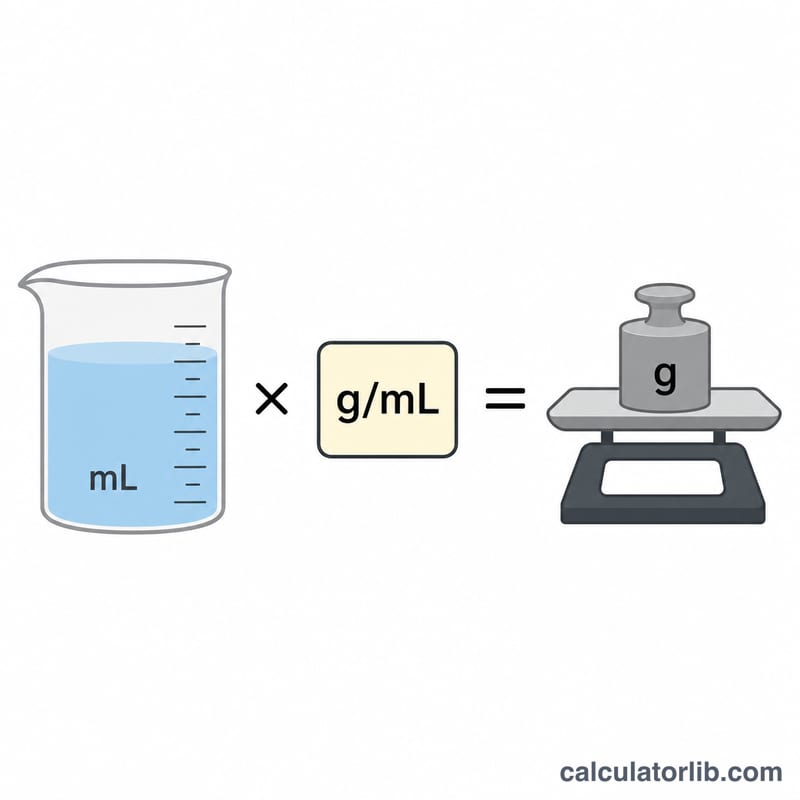
The relationship is simply mass = volume × density, or
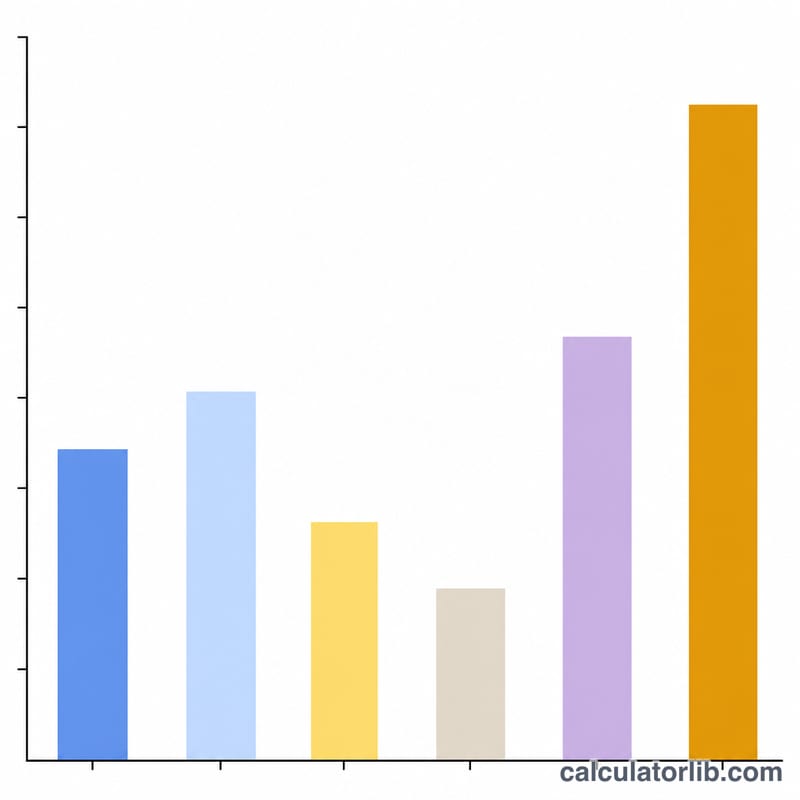
$$\text{Mass (g)} = \text{Volume (mL)} \times \text{Density (g/mL)}$$Pure water has a density of about \(1.00\) g/mL, so 1 mL of water weighs roughly 1 gram. Denser substances like honey (\(\approx 1.42\) g/mL) weigh more per mL, while lighter ones like flour (\(\approx 0.53\) g/mL) weigh less.
Worked example
Suppose you have 250 mL of milk with a density of 1.03 g/mL. The mass is
$$250 \times 1.03 = 257.5 \text{ grams}$$(about 0.2575 kg). For 250 mL of water, the mass would be \(250 \times 1.00 = 250\) grams.
FAQ
Is 1 mL always 1 gram? Only for water (and substances with density \(\approx 1\) g/mL). For oil, flour, honey and most other materials the conversion differs.
Where do I find a substance's density? Cooking and chemistry references list typical densities. Temperature changes density slightly, so values are approximate.
Can I convert grams back to mL? Yes — divide the mass in grams by the density to recover the volume in milliliters.