
What is density?
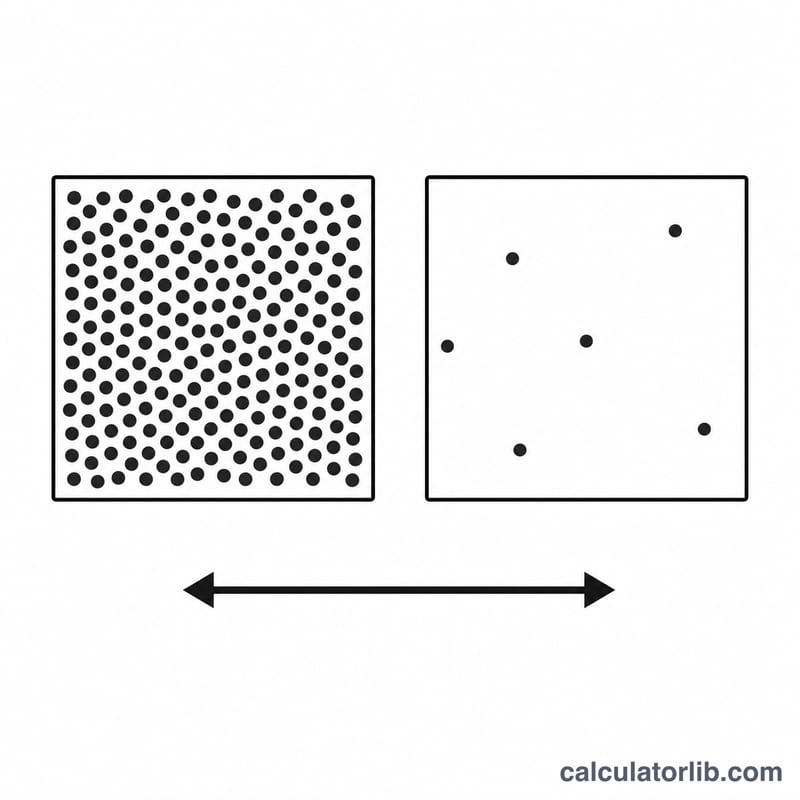
Density (\(\rho\)) measures how much mass is packed into a given volume. It is one of the most fundamental physical properties of a material, helping you identify substances, predict whether objects float or sink, and convert between mass and volume. This calculator computes density from a mass and a volume using the universal relation $$\rho = \frac{m}{V}$$ and reports the answer in both g/cm³ and kg/m³.
How to use it
Enter the mass and choose its unit (grams or kilograms). Enter the volume and choose its unit (cubic centimeters, milliliters, liters, or cubic meters). The calculator converts everything internally to a common base, divides mass by volume, and shows the density. Because 1 mL equals exactly 1 cm³, those two volume options are treated identically.
The formula explained
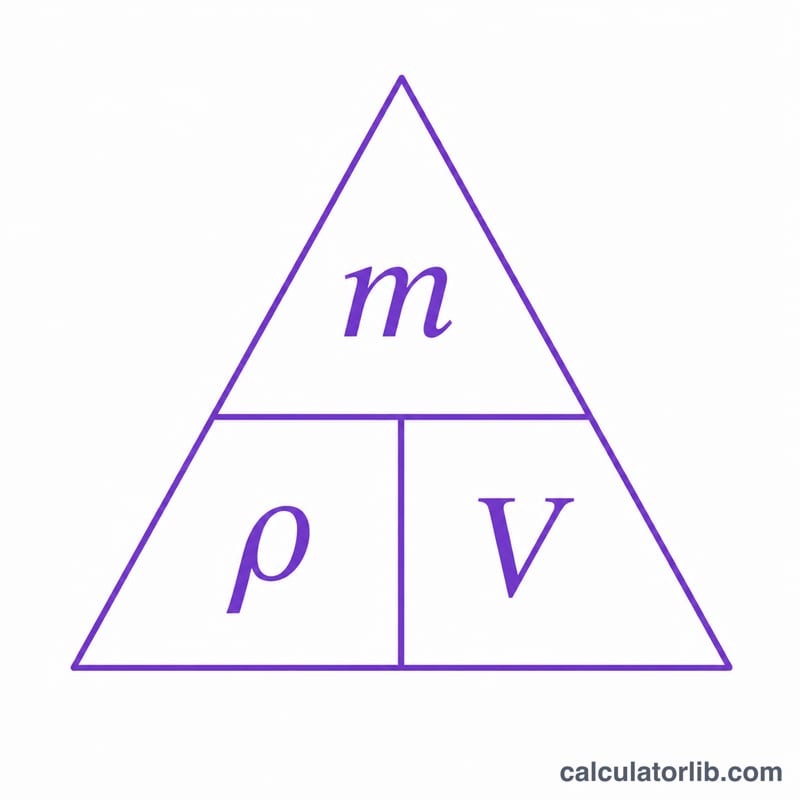
The equation is $$\rho = \frac{m}{V}$$ where \(\rho\) is density, \(m\) is mass, and \(V\) is volume. Density is therefore an intensive property — it does not depend on how much material you have, only on the type of material. Note that 1 g/cm³ is the same as 1000 kg/m³, which is why pure water has a density of about 1 g/cm³ or 1000 kg/m³ at 4 °C.
Worked example
Suppose a metal block has a mass of 200 g and a volume of 25 cm³. Then $$\rho = 200 \div 25 = 8 \text{ g/cm}^3$$ which equals 8000 kg/m³. That value is close to the density of iron, helping confirm the material's identity.
FAQ
What units does this support? Mass in grams or kilograms, volume in cm³, mL, liters, or m³. Output is shown in g/cm³ and kg/m³.
Why is my volume zero giving no result? Density is undefined when volume is zero because you cannot divide by zero — enter a positive volume.
How can I find mass or volume instead? Rearrange the formula: mass \(m = \rho \times V\), and volume \(V = \frac{m}{\rho}\).