
What the Density Calculator Does
This Density Calculator works out how much mass is packed into a given volume of any material or substance. You enter a mass and a volume — each in the unit that suits you — and the tool returns the density expressed in three convenient forms at once: kilograms per cubic metre (kg/m³), grams per cubic centimetre (g/cm³) and kilograms per litre (kg/L). It is unit-system neutral and works for metals, liquids, gases, foods, soils — anything where you know the mass and the volume.
The Inputs You Provide
- Mass — choose from kilograms (kg), grams (g) or pounds (lb).
- Volume — choose from cubic metres (m³), cubic centimetres (cm³) or litres (L).
You can freely mix units — for example grams with litres — because the calculator converts everything to base SI units before computing.
The Formula
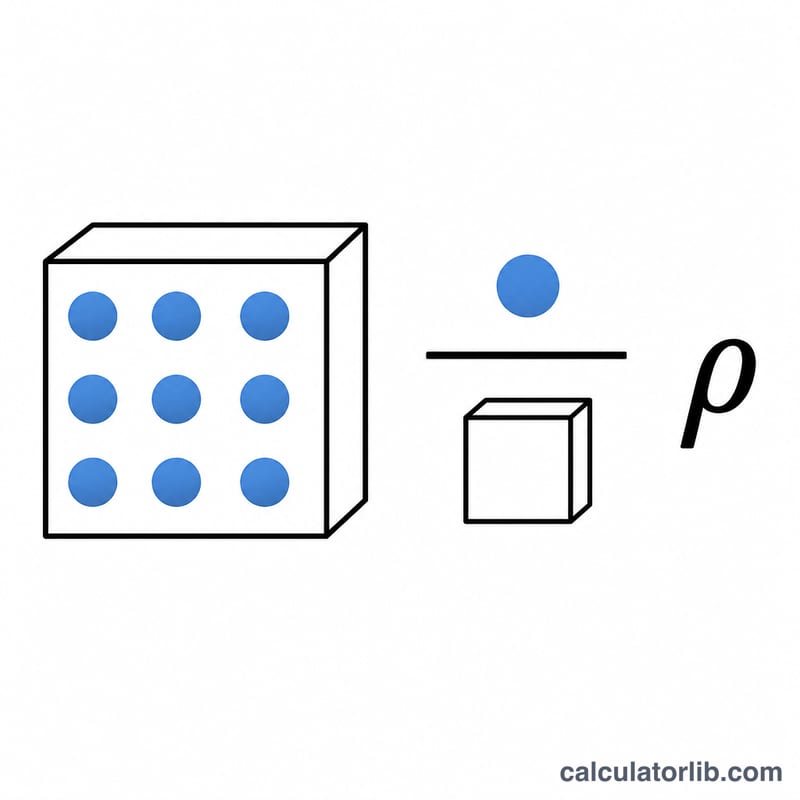
Density is defined simply as mass divided by volume:
Density = Mass ÷ Volume
Behind the scenes the tool first standardises your inputs. Mass is converted to kilograms (g ÷ 1000, or lb × 0.45359237), and volume is converted to cubic metres (cm³ ÷ 1,000,000, or L ÷ 1000). It then divides to get kg/m³, and derives g/cm³ and kg/L by dividing that result by 1000.
Worked Example
Suppose you have a block weighing 500 g that occupies 200 cm³.
- Mass in kg: 500 ÷ 1000 = 0.5 kg
- Volume in m³: 200 ÷ 1,000,000 = 0.0002 m³
- Density: 0.5 ÷ 0.0002 = 2500 kg/m³
- That equals 2.5 g/cm³ and 2.5 kg/L
A density of 2.5 g/cm³ is roughly that of glass or aluminium-rich rock.
Frequently Asked Questions
Why is g/cm³ the same as kg/L? Because one litre equals 1000 cm³ and one kilogram equals 1000 g — the two conversion factors cancel, so the numerical values are always identical.
What is the density of water? Pure water is about 1000 kg/m³, or 1 g/cm³ — a handy reference point. Anything denser than 1 g/cm³ will sink in water; anything lighter will float.
Can I leave volume as zero? No. Dividing by a volume of zero is undefined, so always enter a positive, non-zero volume to get a valid result.