
What the Thrust to Weight Ratio Calculator Does
The Thrust to Weight Ratio (TWR) Calculator works out how powerful an engine is relative to the mass it has to move. It is a fundamental figure for rockets, aircraft, drones and high-performance vehicles, because it tells you whether a craft can accelerate, climb or lift off at all. This tool uses metric units throughout: thrust in Newtons (N) and mass in kilograms (kg), and applies standard Earth gravity.
The Inputs You Provide
- Engine Thrust (N): the total force your engine (or engines combined) produces, measured in Newtons.
- Vehicle Weight (kg): the mass of the vehicle in kilograms. The calculator converts this to weight (force) for you by multiplying by gravity.
The Formula Explained
The calculator uses:
TWR = Thrust ÷ (Weight × 9.81)
Here 9.81 m/s² is standard Earth gravitational acceleration. Multiplying your mass (kg) by 9.81 converts it into weight (Newtons), so both the top and bottom of the fraction are forces — which makes TWR a clean, unitless number.
The tool also derives two things from the result:
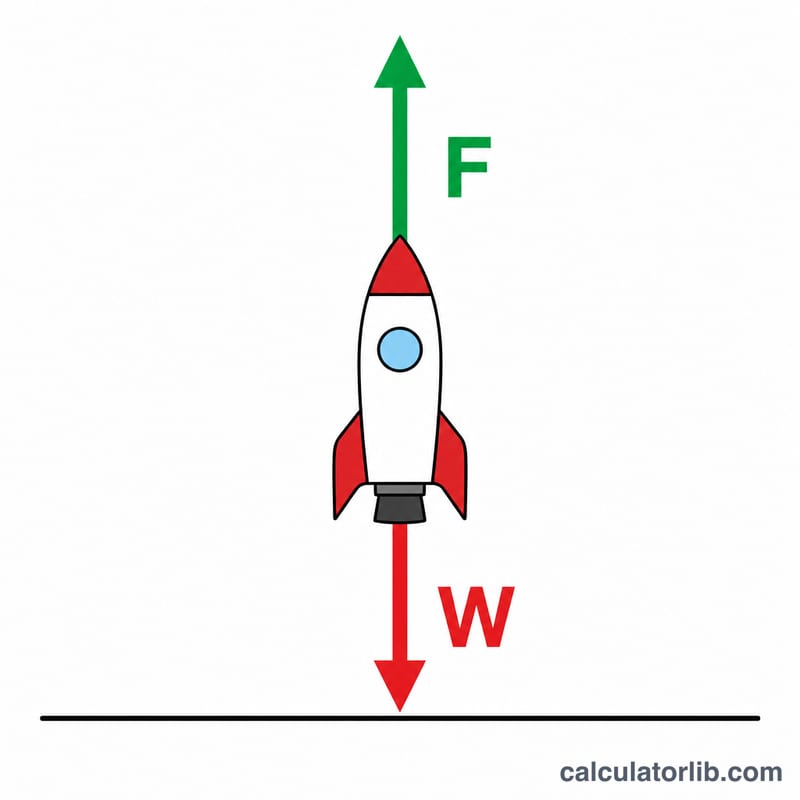
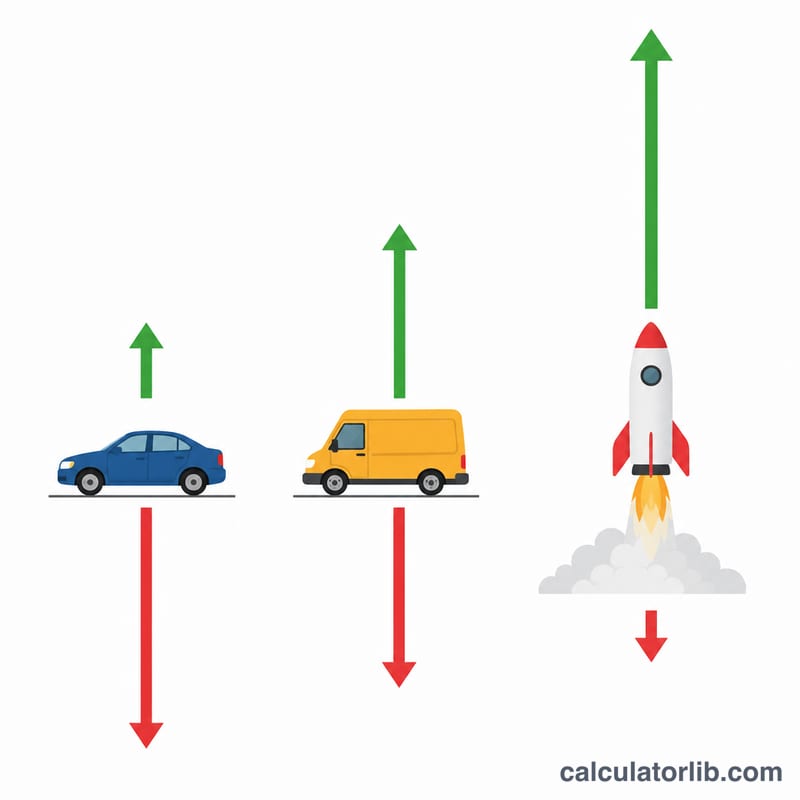
- Liftoff check: if TWR is greater than 1, the vehicle can lift off against gravity; if it is 1 or below, it cannot leave the ground vertically.
- Performance category: Low (below 0.5), Medium (0.5–1.0), High (1.0–2.0) and Very High (2.0 or more).
Worked Example
Suppose a rocket produces 15,000 N of thrust and has a mass of 1,000 kg.
- Weight = 1,000 × 9.81 = 9,810 N
- TWR = 15,000 ÷ 9,810 ≈ 1.53
Because 1.53 is greater than 1, the rocket can lift off, and with a value between 1.0 and 2.0 it falls into the High performance category.
Frequently Asked Questions
What TWR do I need to take off? Anything above 1.0 means thrust exceeds weight, so the craft can rise vertically. Rockets typically aim for around 1.2–1.5 at launch to climb efficiently without wasting fuel.
Does this use Earth gravity? Yes — the calculator fixes gravity at 9.81 m/s², which is Earth's surface value. On the Moon or Mars the effective TWR would be higher because gravity is weaker.
Why enter weight in kilograms, not Newtons? Kilograms measure mass, which is what you usually know about a vehicle. The calculator multiplies by 9.81 internally to turn that mass into the weight force needed for the ratio.
Related calculators
- Power-to-Weight Ratio Calculator — power divided by weight.