
What the Sprocket Ratio Calculator Does
The Sprocket Ratio Calculator works out the relationship between two sprockets in a chain drive system — the kind found on bicycles, motorcycles, go-karts, conveyors and industrial machinery. By comparing the number of teeth on each sprocket, it tells you how much the drive speeds up or slows down and how much torque you trade in the process. It is unit-independent, so it works for any region or measurement standard.
You enter just two values:
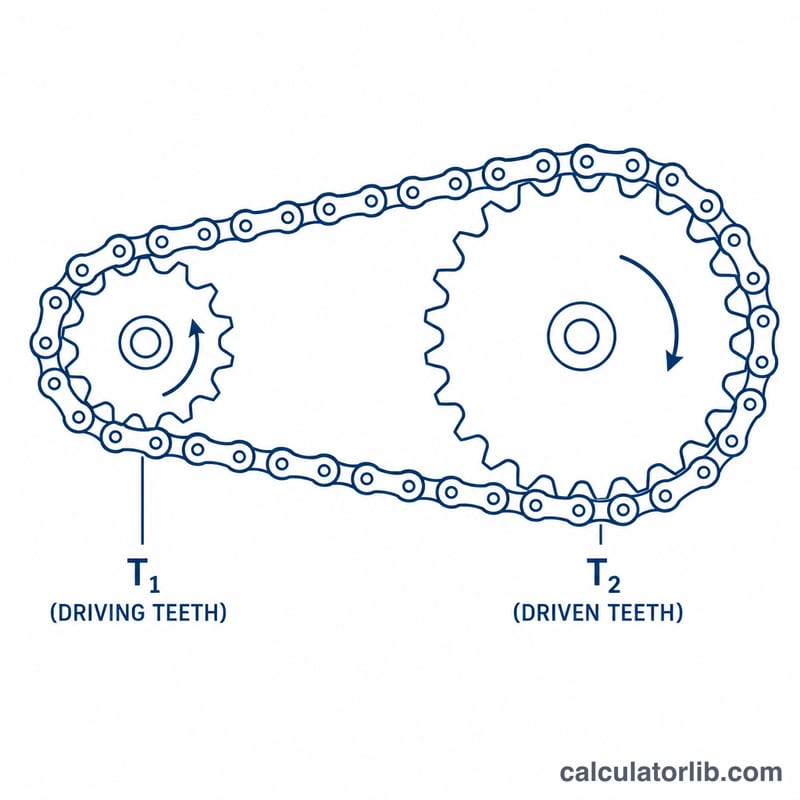
- Driving Sprocket Teeth — the sprocket attached to the power source (engine, motor or pedal crank). Default is 20.
- Driven Sprocket Teeth — the sprocket that receives the power and drives the wheel or load. Default is 40.
The Formula Explained
The calculator uses the standard gear-ratio relationship:
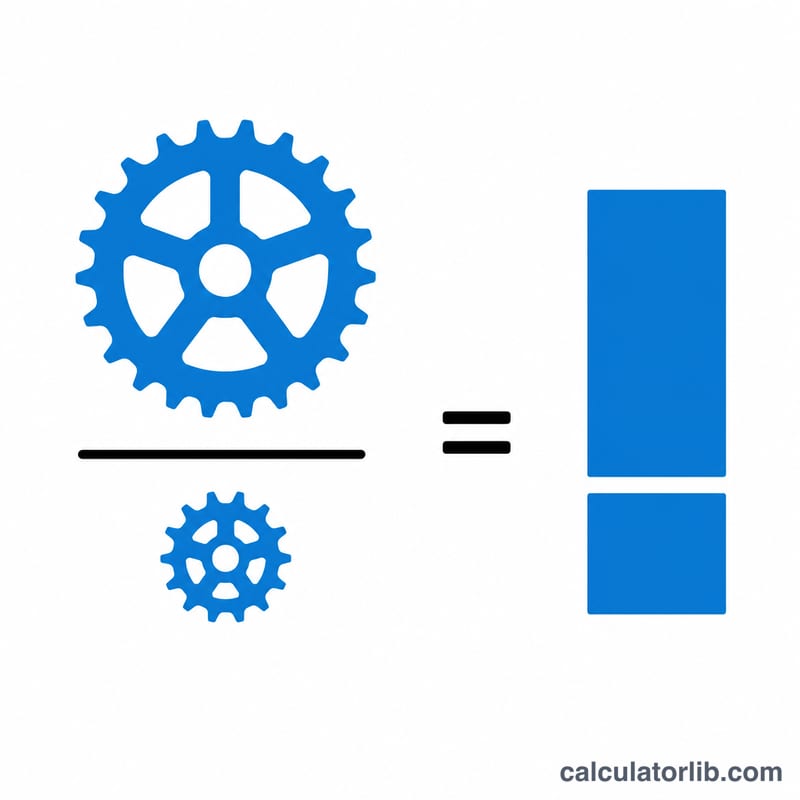
- \(\text{Ratio} = \dfrac{\text{Driven Teeth}}{\text{Driving Teeth}}\)
- \(\text{Speed Reduction} = \dfrac{1}{\text{Ratio}}\) (how the output rotational speed compares to input)
- \(\text{Reduction Percentage} = (1 - \text{Ratio}) \times 100\)
A ratio greater than 1 means a speed reduction with a torque increase (more pulling power, slower output). A ratio less than 1 means an overdrive — faster output but less torque. The calculator also scales a visual of both sprockets, capping the drawn size at 150 units so large combinations still display proportionally.
Worked Example
Using the defaults — a 20-tooth driving sprocket and a 40-tooth driven sprocket:
- $$\text{Ratio} = \frac{40}{20} = \mathbf{2.0}$$
- $$\text{Speed Reduction} = \frac{1}{2.0} = \mathbf{0.5}$$ (the output turns at half the input speed)
- $$\text{Reduction Percentage} = (1 - 2.0) \times 100 = \mathbf{-100\%}$$
A 2:1 ratio means the driving sprocket turns twice for every single turn of the driven sprocket. You lose half the speed but roughly double the torque — useful for climbing or moving heavy loads.
Frequently Asked Questions
What does a 2:1 sprocket ratio mean?
It means the driven sprocket has twice as many teeth as the driving sprocket, so the output rotates at half the speed but with greater torque.
How do I make my machine faster?
Use a smaller driven sprocket or a larger driving sprocket. This lowers the ratio below 1 (an overdrive), increasing output speed while reducing torque.
Why is my reduction percentage negative?
A negative value simply means the ratio is above 1 — the system is reducing speed and multiplying torque rather than overdriving it.