
What This Calculator Does
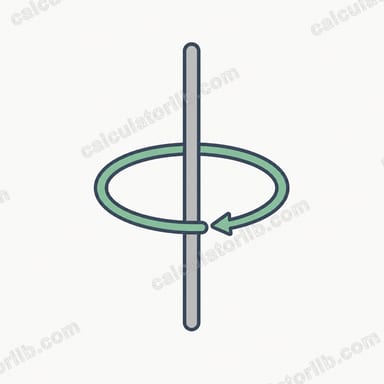
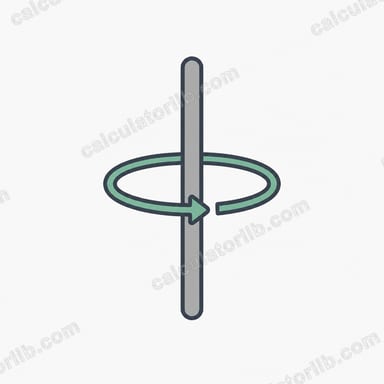
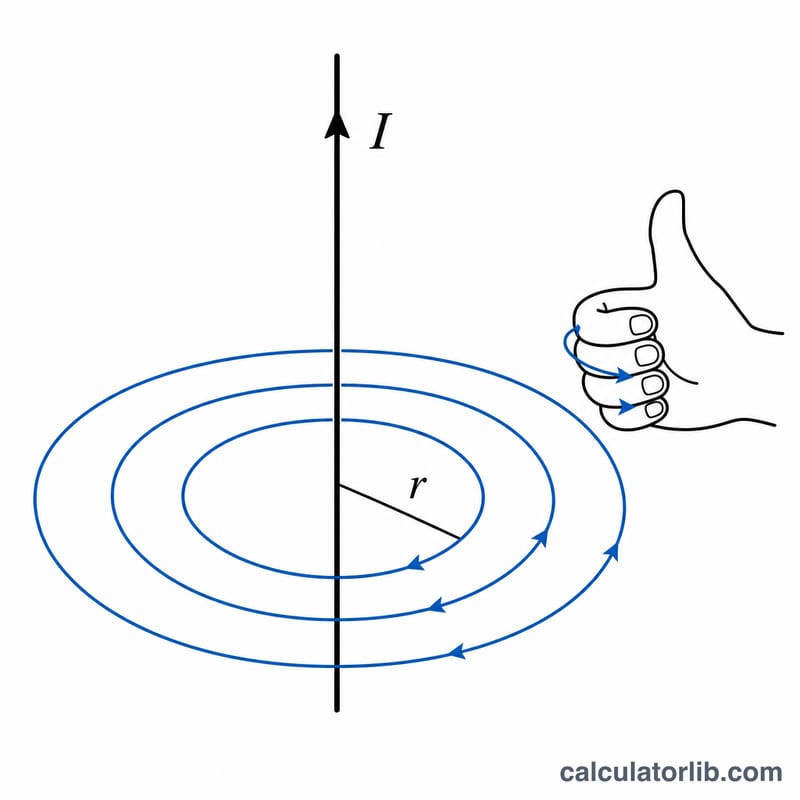
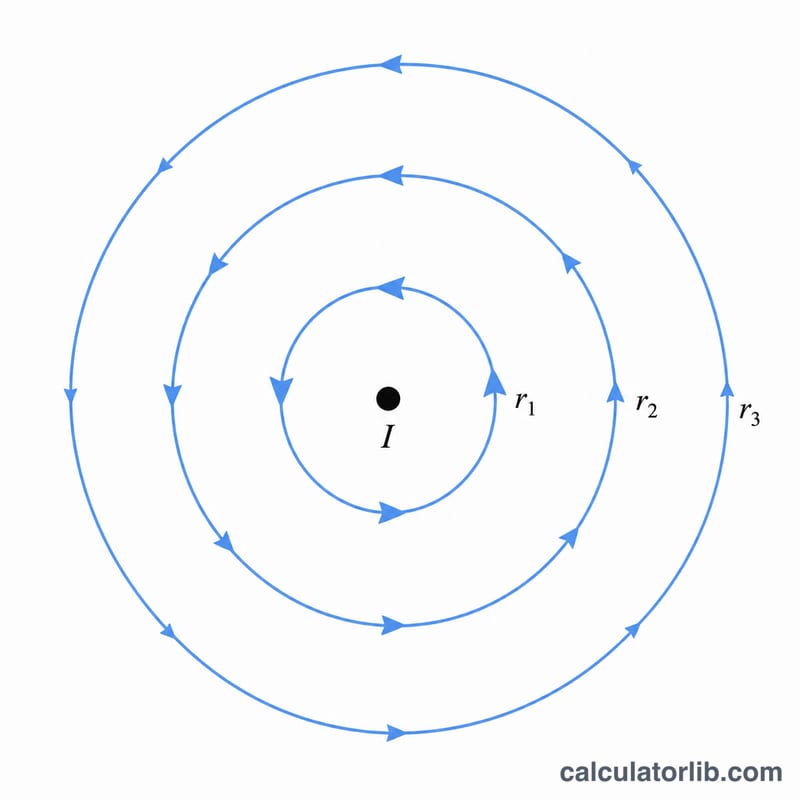
This tool calculates the magnetic field (B) produced around a long, straight, current-carrying wire. Whenever electric current flows through a wire, it generates a circular magnetic field that wraps around the conductor. The strength of that field depends on how much current is flowing and how far away from the wire you measure. This is a fundamental result in classical electromagnetism (physics, applicable universally — not country-specific).
The Inputs You Enter
- Current (A) – the electric current flowing through the wire, in amperes. Larger currents create stronger fields.
- Radius (m) – the perpendicular distance from the centre of the wire to the point where you want to know B, in metres. The field weakens as you move further away.
The Formula Explained
The calculator uses Ampère's law for an infinitely long straight wire:
$$B = \frac{\mu_0 \cdot I}{2\pi \cdot r} = \frac{2 \times 10^{-7} \cdot I}{r}$$
Here \(\mu_0\) is the permeability of free space, equal to \(4\pi \times 10^{-7}\ \text{T}\cdot\text{m/A}\). Plugging that constant in simplifies the expression to \(2 \times 10^{-7}\) multiplied by the current divided by the radius. The result B comes out in tesla (T). Notice the field is directly proportional to current and inversely proportional to distance — double the current and B doubles; double the distance and B halves.
Worked Example
Suppose a wire carries a current of 10 A, and you want the field at a distance of 0.05 m (5 cm).
- $$B = \frac{4\pi \times 10^{-7} \times 10}{2\pi \times 0.05}$$
- $$B = \frac{2 \times 10^{-7} \times 10}{0.05}$$
- $$B = \frac{2 \times 10^{-6}}{0.05} = 4 \times 10^{-5}\ \text{T}$$
So the magnetic field is about 0.00004 tesla, or 40 microtesla — roughly the same order as the Earth's natural field.
Frequently Asked Questions
Why does the field decrease with distance, not distance squared? For a long straight wire, B falls off as \(1/r\) (inverse, linear in distance), unlike a point charge or magnetic dipole which follow inverse-square or cube laws.
What units should I use? Enter current in amperes and radius in metres. The answer is in tesla. To convert to microtesla, multiply by 1,000,000; to gauss, multiply by 10,000.
Does this work for short wires or coils? No. This formula assumes an effectively infinite, straight wire. Coils, loops and solenoids require different equations because of their geometry.