
What is a Friction Calculator?
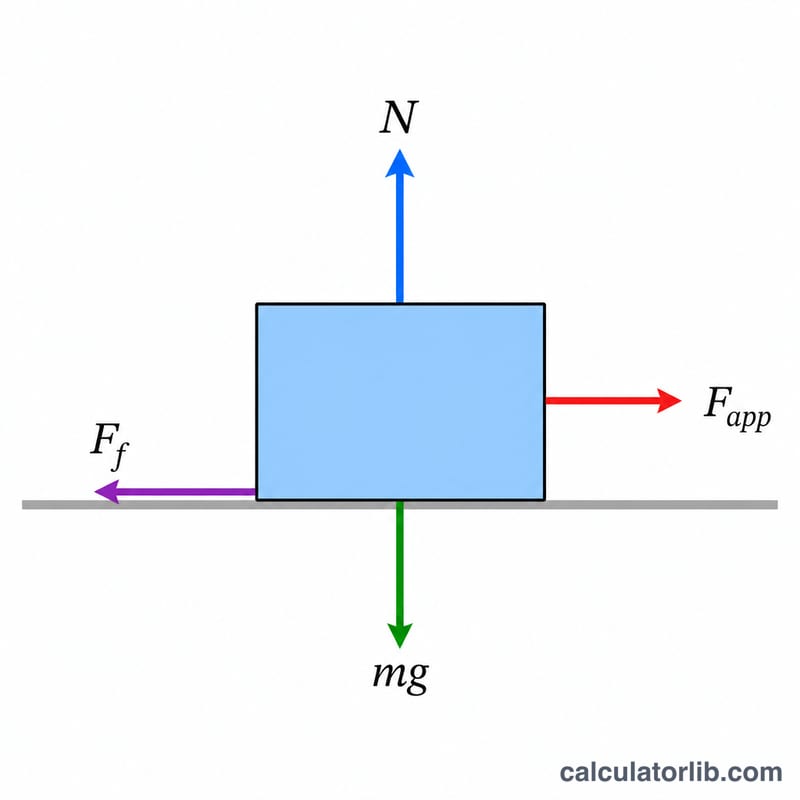
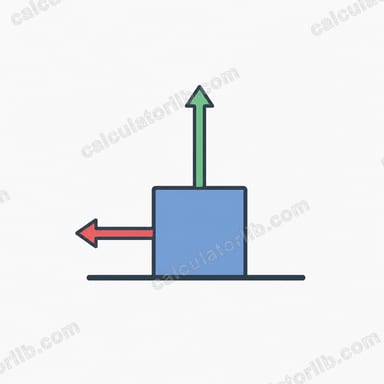
A friction calculator is a tool that helps determine the friction force between two surfaces in contact. Friction is the resistance force that opposes the relative motion or tendency of motion between two surfaces. This calculator uses the coefficient of friction and normal force to calculate the resulting friction force.
When to Use a Friction Calculator
A friction calculator is useful in various scenarios:
- Engineering design - To determine the force needed to move an object across a surface
- Physics problems - To solve mechanics problems involving sliding or stationary objects
- Material science - To analyze how different materials interact with each other
How to Calculate Friction Force
The friction force is calculated using the following formula:
$$F_f = \mu \times F_n$$Where:
- \(F_f\) = Friction force (N)
- \(\mu\) = Coefficient of friction (dimensionless)
- \(F_n\) = Normal force (N)
The normal force is typically the force perpendicular to the surface, often related to the weight of an object. For objects on a horizontal surface, the normal force equals the weight of the object (\(F_n = m \times g\)).
Types of Friction
There are two main types of friction that can be calculated:
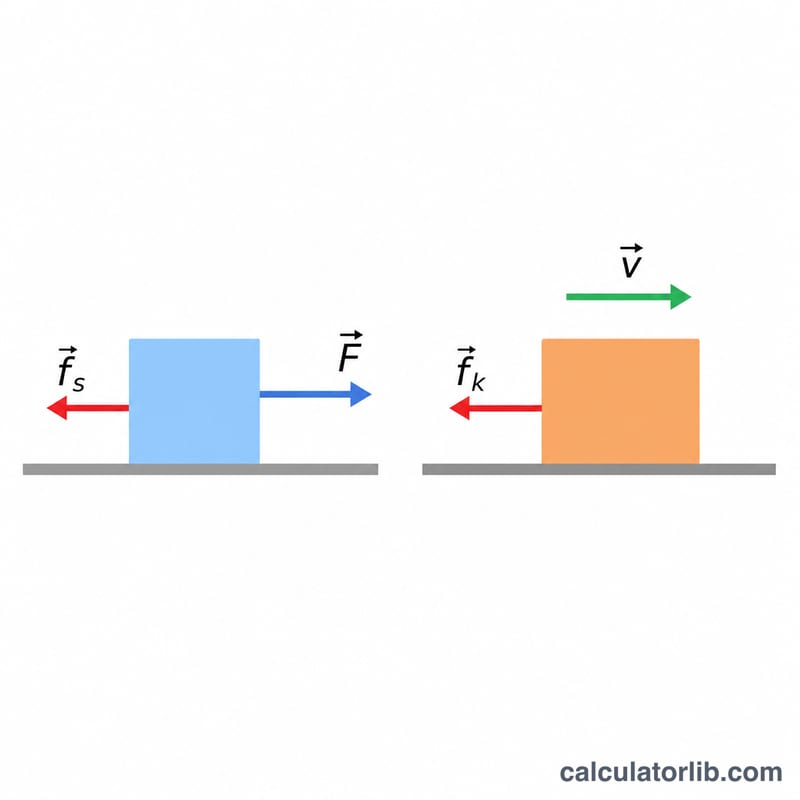
- Static friction: The friction force that must be overcome to start moving an object at rest
- Kinetic friction: The friction force that opposes motion once an object is already moving
Each type of friction has its own coefficient, with static friction coefficients typically being larger than kinetic friction coefficients for the same materials.
Common Friction Coefficients
| Materials | Static Friction Coefficient (\(\mu_s\)) | Kinetic Friction Coefficient (\(\mu_k\)) |
|---|---|---|
| Rubber on concrete | 0.9 | 0.7 |
| Wood on wood | 0.5 | 0.3 |
| Steel on steel | 0.7 | 0.6 |
| Ice on ice | 0.1 | 0.03 |
| Waxed ski on snow | 0.14 | 0.05 |
Examples
Example 1: Sliding a Box
Calculate the friction force for a 50 kg box on a horizontal surface with a kinetic friction coefficient of 0.3.
| Input | Value |
|---|---|
| Normal Force (\(F_n\)) | 490 N (\(50 \text{ kg} \times 9.8 \text{ m/s}^2\)) |
| Friction Coefficient (\(\mu\)) | 0.3 |
Result: Friction Force = 147 N
Example 2: Inclined Surface
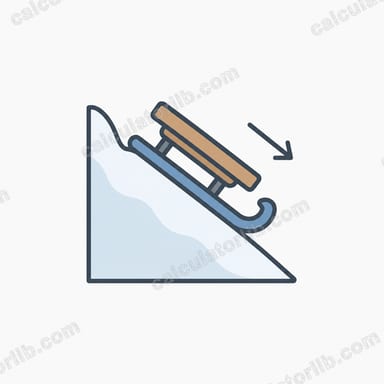
Calculate the friction force for a 20 kg object on a 30° inclined surface with a static friction coefficient of 0.6.
| Input | Value |
|---|---|
| Normal Force (\(F_n\)) | 169.7 N (\(20 \text{ kg} \times 9.8 \text{ m/s}^2 \times \cos(30°)\)) |
| Friction Coefficient (\(\mu\)) | 0.6 |
Result: Friction Force = 101.8 N
Example 3: Pushing a Heavy Object
Calculate the minimum force needed to start moving a 100 kg crate on a floor with a static friction coefficient of 0.8.
| Input | Value |
|---|---|
| Normal Force (\(F_n\)) | 980 N (\(100 \text{ kg} \times 9.8 \text{ m/s}^2\)) |
| Friction Coefficient (\(\mu\)) | 0.8 |
Result: Minimum Force Needed = 784 N
Related Calculators
For more physics and engineering calculations, check out these related tools:
- Force to Horsepower Calculator
- Kinetic Energy Calculator
- Potential Energy Calculator
- Gravitational Force Calculator