
What Is the Laminar Friction Factor?
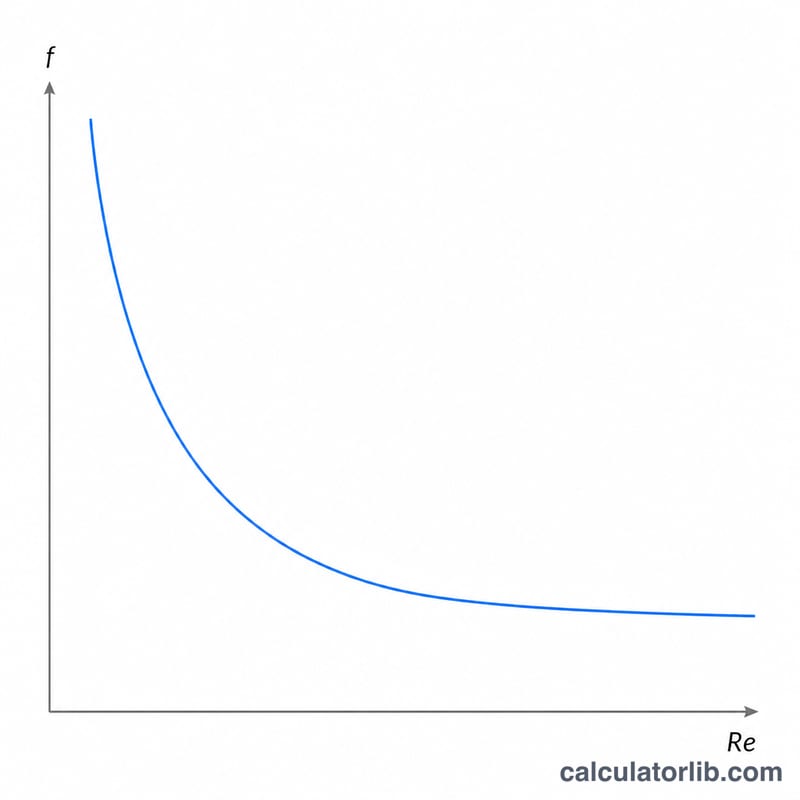
The Darcy friction factor (\(f\)) is a dimensionless number used in the Darcy-Weisbach equation to quantify pressure loss due to friction in pipe flow. In the laminar regime, where the flow is smooth and orderly, the friction factor depends only on the Reynolds number and follows the simple exact relationship \(f = 64/\text{Re}\). This is a universal result of fluid mechanics, derived analytically from the Hagen-Poiseuille solution for flow in a circular pipe, and requires no empirical curve fitting.
How to Use This Calculator
Enter the Reynolds number (Re) of your flow. The tool returns the Darcy friction factor \(f\). Laminar flow in a round pipe is generally assumed for Re below roughly 2300; above that the flow transitions to turbulent and you should use a turbulent correlation such as the Colebrook or Swamee-Jain equation instead.
The Formula Explained
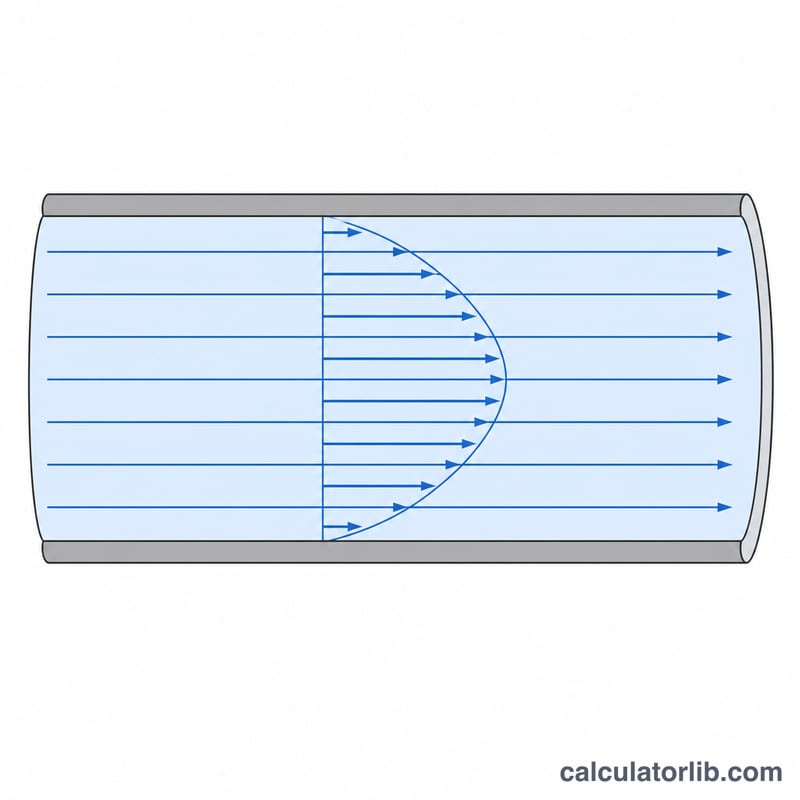
The relationship $$f = \dfrac{64}{\text{Re}}$$ comes from solving the Navier-Stokes equations for steady, fully developed laminar flow in a circular cross-section. Because the velocity profile is parabolic, the wall shear stress and the resulting pressure gradient are directly proportional to the mean velocity, giving an exact inverse dependence on Re. Note this is the Darcy friction factor; the Fanning friction factor is one-quarter of this value (\(16/\text{Re}\)).
Worked Example
Suppose oil flows through a pipe with a Reynolds number of 1500. Then $$f = \frac{64}{1500} = 0.042667.$$ This dimensionless value can then be inserted into the Darcy-Weisbach equation to find the head loss along the pipe.
FAQ
When is \(f = 64/\text{Re}\) valid? Only for laminar flow in a circular pipe, typically Re < 2300. It does not apply to turbulent flow.
Does pipe roughness matter in laminar flow? No. For laminar flow the friction factor is independent of surface roughness; it depends only on Re.
What is the difference between Darcy and Fanning factors? The Darcy factor (used here) is four times the Fanning factor, so \(f_{\text{Darcy}} = 64/\text{Re}\) while \(f_{\text{Fanning}} = 16/\text{Re}\).