
What Is the Solubility Product (Ksp)?
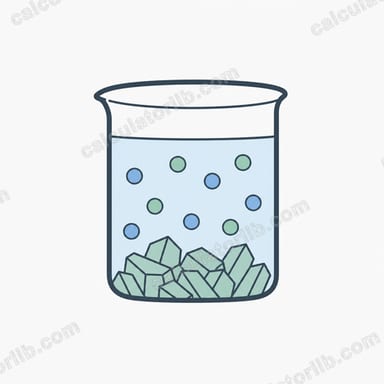
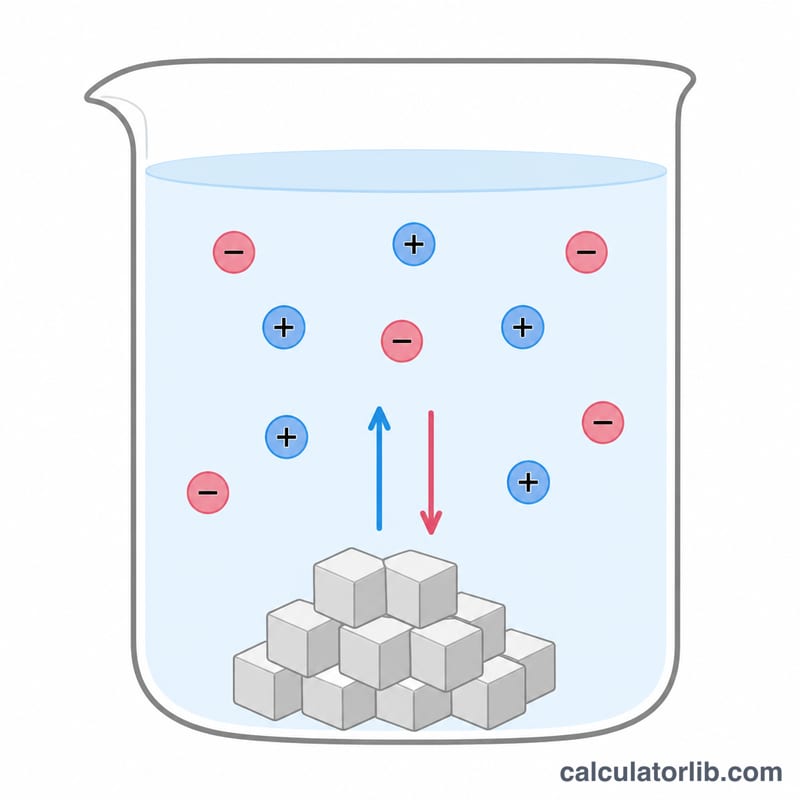
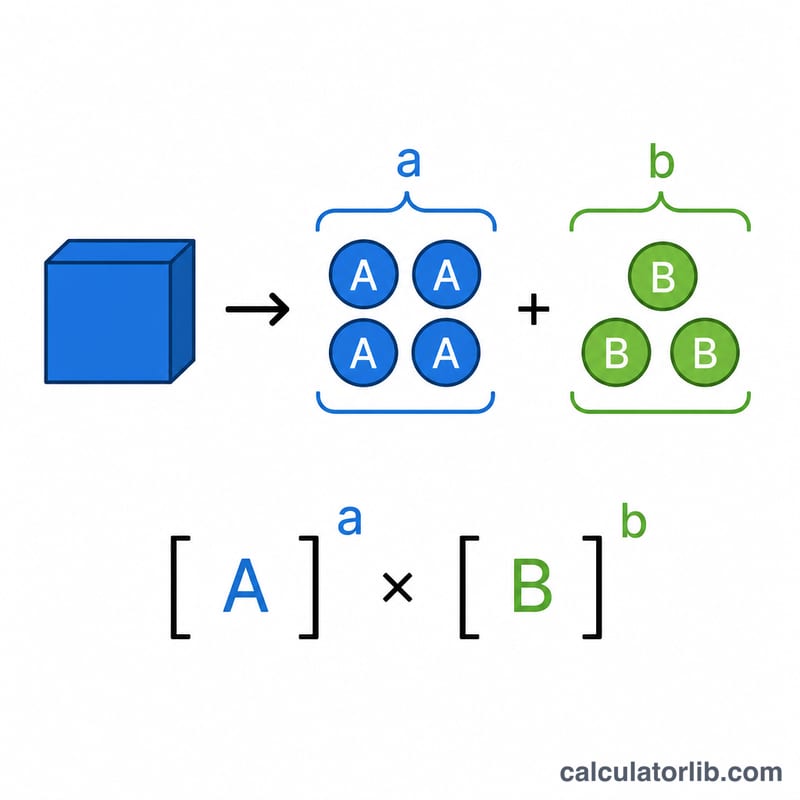
The solubility product constant, Ksp, is the equilibrium constant for a sparingly soluble ionic solid dissolving in water. For a salt that dissolves as AaBb → a A + b B, the solid is omitted from the expression and Ksp equals the product of the dissolved ion concentrations, each raised to the power of its stoichiometric coefficient. A small Ksp means low solubility; a large Ksp means the salt dissolves readily.
How to Use This Calculator
Enter the equilibrium concentration of the cation [A] and the anion [B] in mol/L, plus the stoichiometric coefficients a and b from the balanced dissolution equation. The tool returns Ksp, the individual ion terms, and pKsp. For a simple 1:1 salt such as AgCl, both coefficients are 1. For Mg(OH)2, the cation coefficient is 1 and the anion (OH) coefficient is 2.
The Formula Explained
$$K_{sp} = [A]^{a} \cdot [B]^{b}$$ Each ion concentration is raised to the number of moles of that ion produced per formula unit. Because activity of the pure solid is 1, it never appears. The result is a dimensionless number (by convention concentrations are referenced to 1 mol/L standard state).
Worked Example
Consider Ag2CrO4 → 2 Ag + CrO4. Suppose \([Ag] = 2 \times 10^{-4}\) mol/L (\(a = 2\)) and \([CrO_4] = 1 \times 10^{-4}\) mol/L (\(b = 1\)). Then $$K_{sp} = (2\times10^{-4})^{2} \times (1\times10^{-4}) = 4\times10^{-8} \times 1\times10^{-4} = 4\times10^{-12}$$ giving \(pK_{sp} \approx 11.4\).
FAQ
Does Ksp have units? By the modern convention using activities, Ksp is dimensionless because each concentration is divided by the 1 mol/L standard state.
What is the difference between Ksp and Q? Q (the reaction quotient) uses any concentrations; Ksp uses equilibrium (saturated) concentrations. If Q > Ksp a precipitate forms; if Q < Ksp the solution is unsaturated.
Can I use molar solubility directly? Yes — express each ion concentration in terms of the molar solubility s, then substitute. This calculator works with the explicit ion concentrations you provide.