
What This Calculator Does
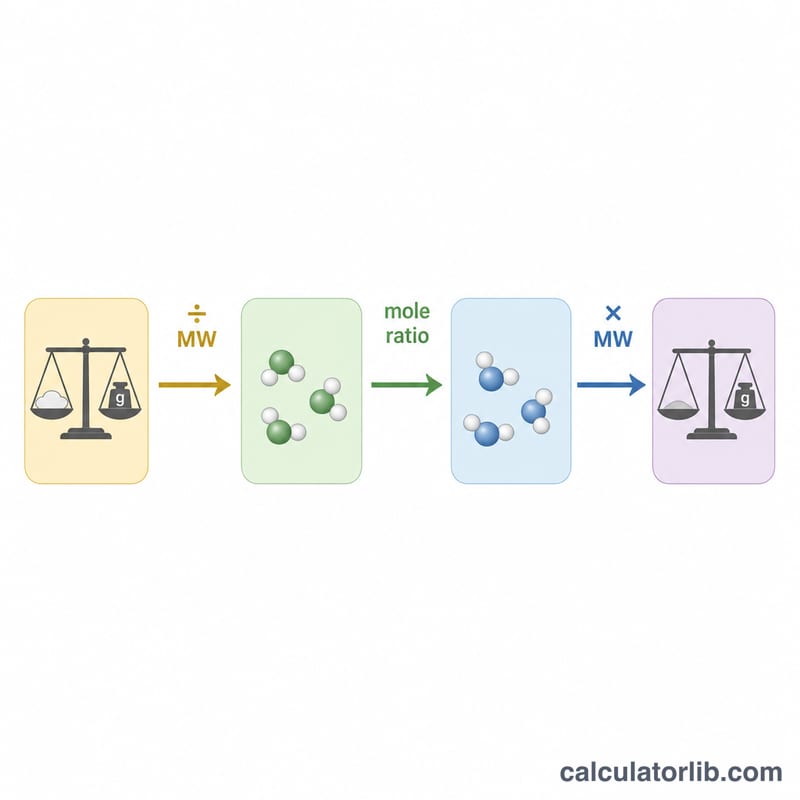
This tool determines how many grams of a product can form from a known mass of the limiting reactant in a chemical reaction. It walks through the classic three-step stoichiometry sequence: grams of reactant → moles of reactant → moles of product → grams of product. An optional percent-yield field lets you estimate the actual amount you would collect in the lab rather than the ideal theoretical maximum.
How to Use It
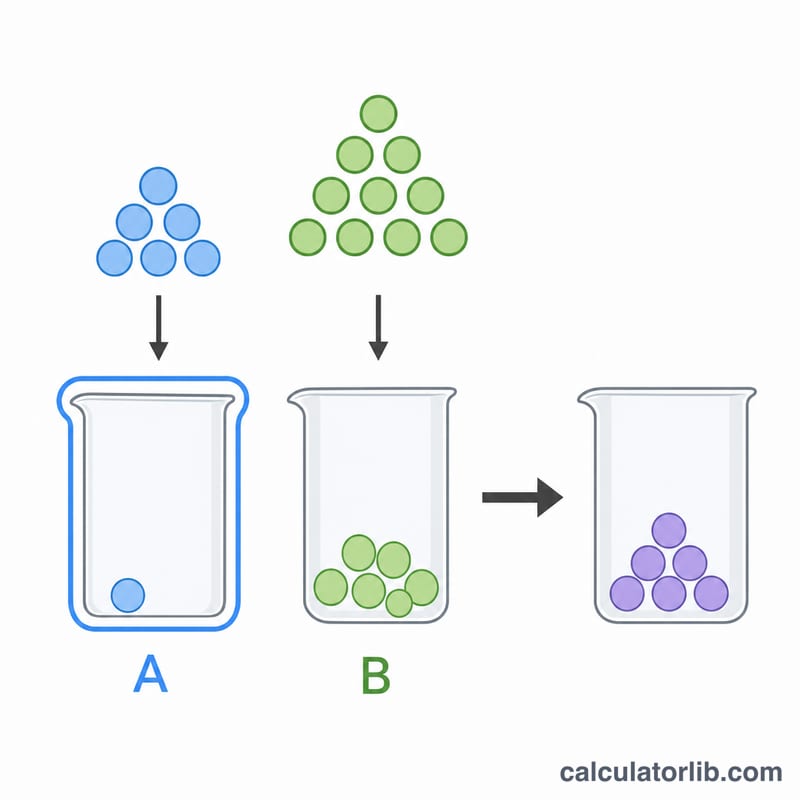
Start with a balanced chemical equation. Enter the mass of the limiting reactant in grams and its molar mass (g/mol). Type the stoichiometric coefficients of the reactant and the product taken directly from the balanced equation. Finally, enter the molar mass of the product. If you know your reaction efficiency, enter a percent yield; otherwise leave it at 100 for the theoretical yield.
The Formula Explained
The core equation is:
$$m_{\text{prod}} = \frac{m_{LR}}{MW_{LR}} \times \frac{c_{prod}}{c_{LR}} \times MW_{prod}$$
Dividing mass by molar mass gives moles of the limiting reactant. Multiplying by the coefficient ratio (product coefficient over reactant coefficient) converts to moles of product. Multiplying by the product's molar mass returns grams of product. Multiplying that result by \((\text{percent yield} \div 100)\) gives the realistic actual yield.
Worked Example
Consider 5.00 g of NaCl (MW 58.44 g/mol) reacting to form AgCl (MW 143.32 g/mol) in a 1:1 mole ratio. Moles of NaCl = $$\frac{5.00}{58.44} = 0.08556 \text{ mol}$$ Mole ratio 1:1 keeps 0.08556 mol of AgCl. Mass = $$0.08556 \times 143.32 = \mathbf{12.26 \text{ g}}$$ of AgCl at 100% yield. At 90% yield you would expect about 11.04 g.
FAQ
How do I know which reactant is limiting? Compute moles of each reactant divided by its coefficient; the smallest value is the limiting reactant. Use that reactant here.
Do the coefficients have to be whole numbers? Any positive number works, but they should come from a properly balanced equation.
What is the difference between theoretical and actual yield? Theoretical yield assumes the reaction goes perfectly to completion (100%). Actual yield is the theoretical value scaled by the real percent yield observed.