
What Is the Grams to Moles Calculator?
This calculator converts a mass measured in grams into the amount of substance measured in moles. The mole is the SI unit chemists use to count particles (atoms, molecules, ions). Because particles are far too small to count directly, we relate them to mass through the substance's molar mass.
How to Use It
Enter two values: the mass of your sample in grams, and the molar mass of the substance in grams per mole (g/mol). The molar mass comes from the periodic table — sum the atomic masses of every atom in the formula. Press calculate to get the number of moles.
The Formula Explained
The relationship is simply:
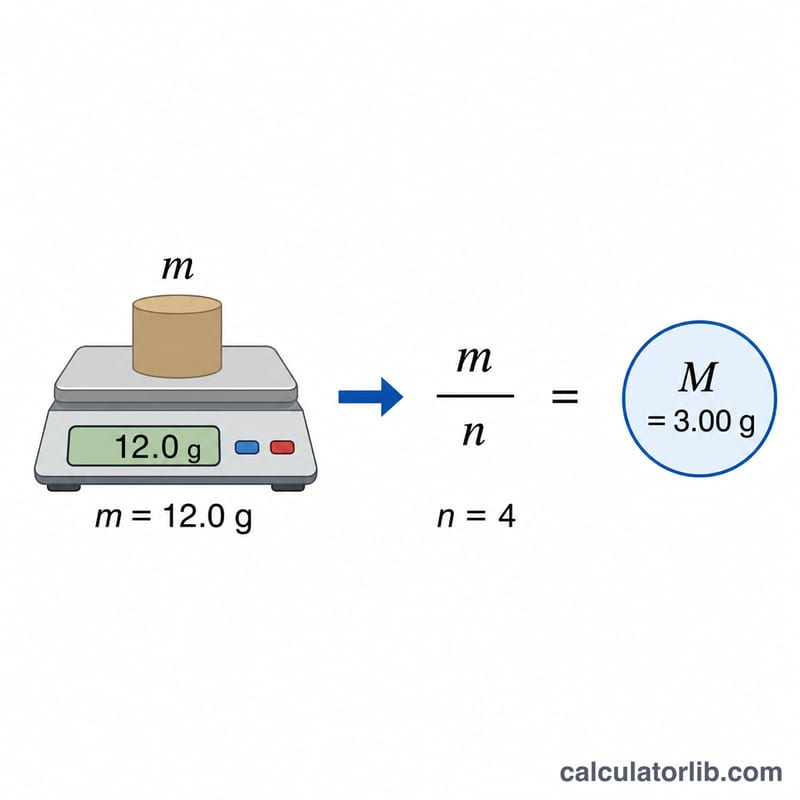
$$n = \frac{m}{M}$$
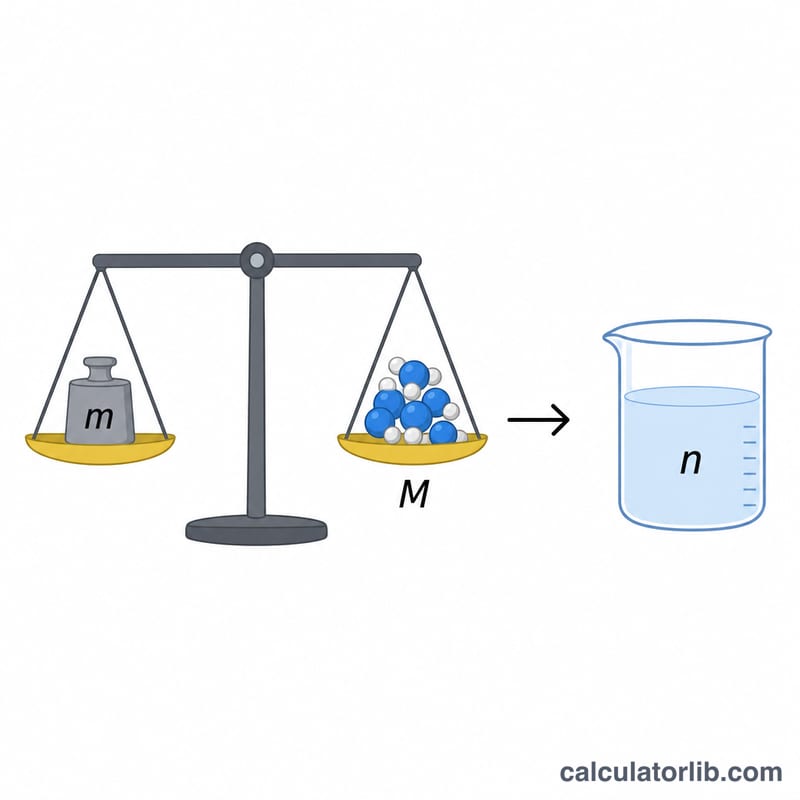
where n is the amount of substance in moles, m is the mass in grams, and M is the molar mass in g/mol. Dividing grams by grams-per-mole leaves moles, since the gram units cancel.
Worked Example
Suppose you have 36 g of water (H₂O). Water's molar mass is about 18.015 g/mol (2 × 1.008 for hydrogen + 16.00 for oxygen). Then:
$$n = \frac{36}{18.015} = 1.998 \text{ mol} \approx 2 \text{ moles of water.}$$
FAQ
Where do I find the molar mass? Add up the atomic masses of each atom in the chemical formula using the periodic table. For example, NaCl = 22.99 + 35.45 = 58.44 g/mol.
Does this work for elements? Yes. For a pure element, use its atomic mass (in g/mol) as the molar mass — e.g., carbon is 12.011 g/mol.
How do I convert moles back to grams? Multiply moles by molar mass: \(m = n \times M\). This reverses the calculation.